
MANILA, Philippines — Starting an online business in the Philippines has arguably never been easier.
A product can be sourced in days. A store can be opened on a marketplace in hours. Social-media advertising can put a new brand in front of thousands of potential customers almost immediately.
But turning that accessibility into a company that actually survives is becoming considerably harder.
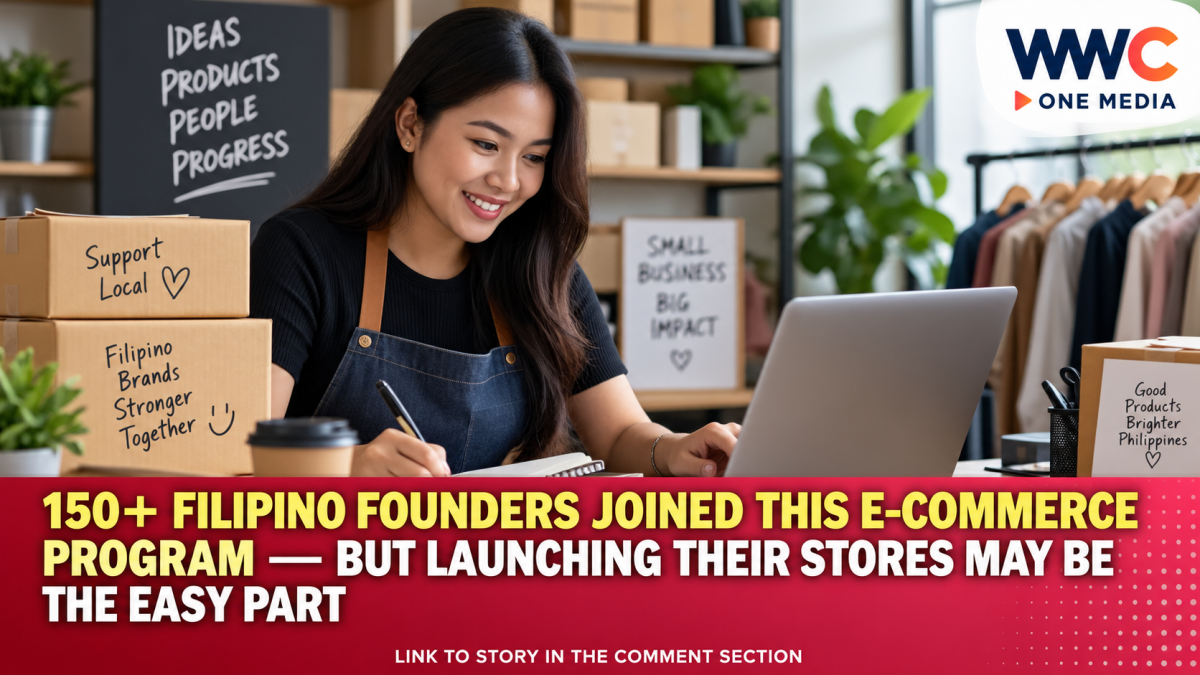
That is the gap Philippine-founded LaunchStrong says it is trying to address as the e-commerce mentorship program enters its second year after guiding more than 150 first-time Filipino founders and helping develop more than 100 homegrown consumer brands.
Founded in 2025 by entrepreneur Jungie Gumiran, LaunchStrong operates as a five-week live mentorship program aimed largely at aspiring founders attempting to move from a product idea to a functioning e-commerce brand.
And its expansion is happening at an unusually important moment for Philippine digital commerce.
Google, Temasek and Bain estimate that Philippine e-commerce alone generated around $24 billion in gross merchandise value in 2025, up from about $20 billion a year earlier, with the sector potentially approaching $50 billion by 2030.
The opportunity is getting larger.
So is the competition.
More than 150 founders — but the 80% figure needs context
LaunchStrong says approximately 80% of first-time founders who entered the program without an existing product or previous e-commerce experience progressed toward launching their first online business.
That is a notable outcome.
But the wording matters.
It does not mean 80% built profitable businesses.
It does not mean 80% remain operating today.
And it does not mean 80% have achieved a specific revenue or return-on-investment threshold.
The publicly available reports describe the metric as progress toward launching, based on LaunchStrong’s own program data.
For publication, the safest language is therefore:
“LaunchStrong says about 80% progressed toward launching their first online businesses.”
Not:
“80% became successful e-commerce entrepreneurs.”
That distinction becomes particularly important in an industry where generating initial sales can be dramatically easier than sustaining positive cash flow.
What founders are actually being taught
LaunchStrong’s curriculum focuses on the sequence of decisions that come before and immediately after an online product launch.
The five-week program covers:
product ideation and validation;
supplier sourcing;
brand positioning;
pricing;
branding;
launch strategy;
customer acquisition;
and early-stage growth.
That list might sound elementary to experienced operators.
For first-time entrepreneurs, however, those decisions can determine whether a business generates real profit or simply creates sales while consuming cash.
A founder can sell hundreds of units and still lose money after accounting for advertising, marketplace commissions, payment charges, packaging, returns, shipping subsidies, inventory storage and unsold stock.
Gumiran summarized the problem by arguing that e-commerce has become easier to enter but harder to win, with aspiring entrepreneurs potentially generating revenue while misunderstanding the economics underneath it.
That may be the most important idea behind the program.
The barrier to opening a store has fallen.
The barrier to building a good business has not.
More than 100 brands have come through the program
LaunchStrong says it has helped facilitate the development of more than 100 brands at different stages of growth.
They span consumer categories including:
wellness and supplements;
food and beverage;
personal care;
pet care;
and fashion.
Brands identified in program-related coverage include Eat Move Love, Pharmatrust, Magic Bowl, Tonios, TELA Pinoy and NanaPro Litter.
Again, “developed” or “supported” should not automatically be read as “scaled successfully.”
Some may be operating businesses, while others may still be in validation, launch or early-growth stages.
That is why LaunchStrong’s second-year challenge will be more difficult than simply increasing participant numbers.
The bigger proof point will eventually be how many of those brands remain commercially viable after launch.
Philippine e-commerce is already a huge market
LaunchStrong’s growth is happening inside a national digital economy that is much larger than many small founders may realize.
The Philippine Statistics Authority says the country’s digital economy generated approximately ₱2.74 trillion in gross value added in 2025, equivalent to 9.8% of national GDP.
E-commerce accounted for 32.2% of digital-economy GVA, making it one of its most important components.
Employment is similarly significant.
PSA estimates the digital economy supported about 10.39 million workers in 2025, with e-commerce accounting for the largest share of digital-economy employment.
Meanwhile, Google, Temasek and Bain’s separate GMV-based measurement estimates that the Philippine internet economy reached about $36 billion in 2025, with e-commerce contributing roughly $24 billion.
Those figures measure different things and should not be directly compared as though they are interchangeable: PSA measures economic value added, while the e-Conomy SEA report uses gross merchandise value for major online sectors.
But together they establish the same broader point:
online commerce is no longer a small side economy in the Philippines.
It is mainstream business.
And video commerce is making entry even easier
The next competitive pressure is social commerce.
Google-Bain data show rapid growth in Philippine video commerce, with the number of sellers and stores increasing by around 90% year on year in the dataset presented in the 2025 e-Conomy SEA report.
Transaction volume rose roughly 35%, while typical order values were only around $4.50 to $5.50.
Fashion and accessories represented the largest category share, followed by beauty and personal care.
That low-ticket, high-volume environment creates enormous opportunities for first-time sellers.
But it can also produce brutal economics.
When average orders are relatively small, advertising expenses, commissions, fulfillment costs and returns can consume margins quickly.
A founder who focuses only on gross sales may therefore conclude a campaign is successful even while the business itself is destroying cash.
That makes education around contribution margin, inventory turnover and customer-acquisition cost increasingly important.
TikTok, Shopee and other platforms are also teaching sellers
LaunchStrong is also entering a crowded entrepreneurship-education ecosystem.
TikTok Shop has been expanding seller education and MSME partnerships in the Philippines, emphasizing livestreaming, creator partnerships and “discovery e-commerce.” The platform recently highlighted Filipino MSMEs using short-form content and affiliate tools to expand sales.
Shopee has likewise been emphasizing seller education, platform tools and continuous learning as businesses adapt to changing customer behavior.
The Philippine government is active as well.
The Department of Trade and Industry launched its Online Negosyo Program through the E-Commerce Bureau to equip Filipino businesses with skills and knowledge needed to participate more effectively in the digital marketplace.
That means LaunchStrong’s competitive advantage cannot simply be access to basic information about how to sell online.
Tutorials on opening stores, placing ads and finding products are already widely available.
Its value proposition has to be decision quality, execution discipline and reducing expensive mistakes.
The government is also making online sellers more accountable
The e-commerce environment is simultaneously becoming more regulated.
The Internet Transactions Act of 2023 strengthened rules covering online marketplaces and merchants, while DTI subsequently introduced the E-Commerce Philippine Trustmark to identify businesses meeting consumer-protection and fair-commerce requirements.
Trustmark applicants are expected to provide business documentation, identify their sales platforms and demonstrate an internal system for handling customer complaints.
That shift is significant for first-time founders.
A modern e-commerce business is no longer just:
find a product;
open a store;
run Facebook or TikTok ads;
collect orders.
Founders increasingly need to understand consumer protection, taxation, registrations, refunds, privacy, product claims and platform compliance.
For health, wellness and food brands in particular, regulatory mistakes can become far more expensive than a badly performing advertisement.
Digital payments have removed another old barrier
Paying online has also become much more normal for Filipino consumers.
The Bangko Sentral ng Pilipinas reported that digital transactions already represented 57.4% of monthly retail-payment volume and 59% of value in 2024.
That adoption benefits entrepreneurs because buyers are increasingly accustomed to wallets, online transfers and other cashless payment options.
But it creates another effect:
the easier payment becomes, the easier it becomes for competitors to sell too.
A first-time founder is no longer competing only against the shop down the street.
They may be competing against thousands of sellers simultaneously visible on Shopee, Lazada, TikTok Shop, Facebook and Instagram.
The result is a market with lower entry barriers but potentially higher customer-acquisition costs.
Gumiran is building the program from his own founder experience
LaunchStrong founder Jungie Gumiran also operates wellness company JUJU Lifestyle.
Program-related reports say JUJU, founded in 2021, has served more than 300,000 customers and expanded to more than 20 physical retail partners within its first year of entering offline retail, including SouthStar Drug, HeyDay and Wellness Plus.
Those numbers, like LaunchStrong’s participant outcomes, are primarily company-supplied claims in the public coverage reviewed here rather than independently audited data.
Gumiran says his own failed launches and costly early mistakes shaped LaunchStrong’s emphasis on product validation and limiting unnecessary capital risk.
That experience may resonate with first-time entrepreneurs because failed e-commerce products often leave founders with something far worse than poor sales:
inventory that has already been paid for but cannot be sold profitably.
Product validation may matter more than advertising
This is where the program’s philosophy becomes more interesting.
A common assumption among inexperienced online sellers is that weak sales can be fixed by better advertising.
Sometimes they can.
But advertising cannot repair:
a product nobody wants;
pricing that leaves no margin;
a supplier that cannot deliver consistently;
poor repeat-purchase economics;
a product with weak differentiation;
or excessive inventory purchased before demand is proven.
LaunchStrong’s emphasis on validating an idea before committing significant capital therefore addresses one of the oldest problems in entrepreneurship.
The most important business decision can be choosing not to launch a product that does not make economic sense.
That is considerably less glamorous than celebrating revenue screenshots.
But it may be far more valuable.
The next cohort arrives in December
LaunchStrong says its next five-week live mentorship cohort is scheduled for December 2026.
The program says its second-year ambition is to equip more founders with the skills to build consumer brands capable of competing nationally and, eventually, internationally.
That is an ambitious target.
Launching nationally is already difficult.
Going cross-border introduces another level of complexity involving customs, international logistics, payments, localization, product regulation and customer service.
Still, the broader Philippine market is moving in that direction.
DTI’s e-commerce strategy has long identified cross-border selling as one of the opportunities created by digital commerce.
For programs such as LaunchStrong, the next phase will therefore be less about convincing Filipinos that they can become entrepreneurs.
Many already believe they can.
The challenge is teaching them what separates a product that receives orders from a company that remains alive several years later.
The real test begins after the first sale
LaunchStrong’s first-year numbers sound impressive:
more than 150 founders;
more than 100 brands;
around 80% of inexperienced participants moving toward launch.
But those are ultimately early-stage measurements.
The more revealing numbers will come later.
How many businesses remain open after 12 months?
How many become profitable?
How many earn repeat customers?
How many can scale advertising without destroying their margins?
How many can move beyond marketplaces and build durable brands?
And how many eventually reach customers outside the Philippines?
Those outcomes will determine whether mentorship programs like LaunchStrong are merely helping people launch stores—or actually helping create the next generation of sustainable Filipino consumer companies.
Because in a Philippine e-commerce market already worth an estimated $24 billion, opening the store is no longer the extraordinary part.
Surviving what happens after it opens is.
WWC ONE MEDIA M.J.E

Leave a Reply