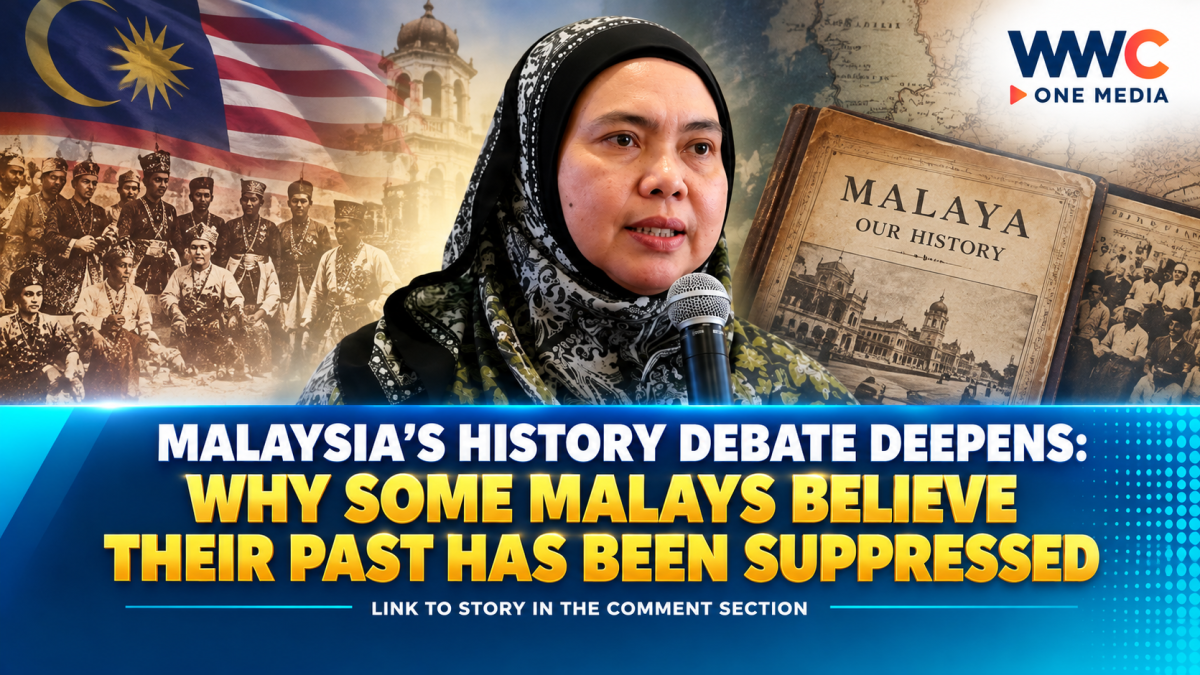
KUALA LUMPUR — Malaysia’s long-running debate over history is entering another contentious phase, as questions about Malay identity, national narratives and the country’s multicultural past gain renewed attention.
A September 28 report by The Straits Times examines why some Malay commentators and academics argue that important parts of Malay history have been overlooked or misrepresented, even as critics contend that Malaysia’s mainstream historical narrative already places substantial emphasis on Malay-Muslim history.
At the centre of the debate is a larger question: Who gets to define Malaysia’s history — and where should that history begin?
A Malay-Centred National Narrative
Malaysia’s school curriculum gives significant attention to the 15th-century Melaka Sultanate, traditionally presented as an important period of Malay political and cultural development.
Yet some scholars and commentators argue that conventional accounts rely too heavily on colonial-era interpretations and terminology.
Historian Azmi Arifin of Universiti Sains Malaysia, for example, has questioned the use of concepts such as “feudal” and “absolute monarchy” when describing traditional Malay political systems, arguing that applying European frameworks can produce a Eurocentric interpretation of Malay institutions.
The debate is not limited to academic circles. Alternative interpretations of Malay history have gained audiences through social media, seminars and books.
The Rise of Alternative History Claims
One prominent figure discussed in the debate is Malaysian linguistics professor Solehah Yaacob, whose claims about ancient Malay civilisation have attracted both strong support and criticism.
Among the claims attributed to her are assertions connecting ancient Malays to major historical figures and civilisations far outside the established historical record.
Historians interviewed by The Straits Times disputed such interpretations, warning that claims unsupported by credible evidence can blur the distinction between historical research and speculation. Solehah was contacted for comment by the newspaper but did not respond by publication time.
Her supporters, however, view her work differently, arguing that she is challenging historical narratives they believe were shaped by colonial perspectives.
Why the Debate Is So Sensitive
The disagreement reflects more than competing interpretations of ancient history.
Malaysia is a multi-ethnic society, and different communities have different perspectives on when the country’s national story begins and which events deserve greater emphasis.
Sociologist Aziff Azuddin told The Straits Times that Malay socio-political and economic concerns, together with Malaysia’s multicultural environment, help explain why nativist historical narratives appeal to some segments of the Malay community.
At the same time, historians have pointed out that historical Malay societies were themselves deeply connected to India, China, the Middle East and Europe, challenging the idea that Malay civilisation developed in isolation.
Historical records of Melaka, for example, describe a highly diverse trading centre with people speaking numerous languages.
Malaysia’s History Curriculum Is Also Under Scrutiny
The controversy comes as Malaysia continues to debate how history should be taught across its education system.
In January 2026, Prime Minister Anwar Ibrahim announced that Bahasa Melayu and History would become compulsory subjects for students in international, religious and Chinese independent-school pathways seeking access to public universities. The government said the move was intended to establish a common national educational framework.
The decision has also revived questions about how Malaysia’s history curriculum should represent its different communities.
Other Malaysian commentators have argued that the contributions of Chinese, Indian, Orang Asli, Sabah and Sarawak communities deserve fuller treatment within the national narrative. A recent Borneo Post commentary, for example, highlighted concerns that some historical subjects involving Borneo and earlier regional civilisations receive comparatively limited attention in current textbooks.
One Country, Many Historical Experiences
The debate ultimately goes beyond whether Malaysian history is “Malay-centric” or whether Malay history has been “suppressed.”
It raises a more complicated issue: how can a national history acknowledge Malay political and cultural development while also accurately representing the many communities, migrations, economic forces, religions and regional histories that shaped modern Malaysia?
Scholars cited by The Straits Times caution that replacing one simplified narrative with another does not necessarily produce a more accurate history.
For Malaysia, the continuing argument over its past may therefore be less about finding a single version of history — and more about determining how a diverse country can build a historical narrative broad enough to include all of its communities without sacrificing evidence and historical scholarship.
WWC ONE MEDIA G,A