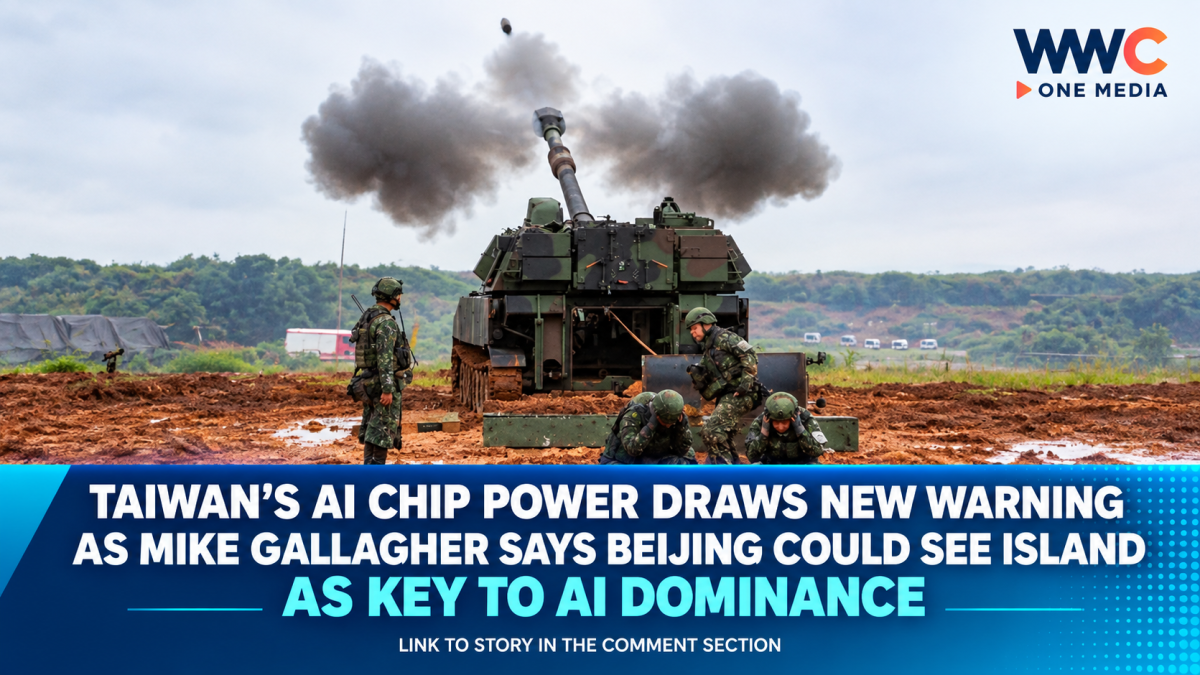
TAIPEI — Taiwan’s role in the global semiconductor industry is increasingly being linked to the strategic competition between the United States and China over artificial intelligence, with former U.S. congressman and Palantir Technologies defense executive Mike Gallagher warning that Beijing could view control over Taiwan as increasingly important to its technology ambitions.
In a recent Wall Street Journal commentary, Gallagher argued that Taiwan has become a critical vulnerability in the supply chain supporting advanced AI development. He said the island’s semiconductor industry has implications not only for technology companies but also for U.S. economic and national-security planning.
Why Taiwan Matters to the AI Industry
Taiwan is home to TSMC, one of the world’s most important advanced semiconductor manufacturers. Taiwan’s position in chip production has made stability across the Taiwan Strait an increasingly important issue for companies and governments involved in the global technology supply chain.
Gallagher argued that if competition over AI becomes a decisive element of global power, Taiwan’s semiconductor capabilities could take on even greater strategic importance.
The Council on Foreign Relations similarly noted this month that the U.S. ability to maintain leadership in AI depends significantly on Taiwan’s semiconductor and technology ecosystem, while warning that a conflict in the Taiwan Strait could disrupt the American AI industry.
Gallagher Points to a Potential 2027 Flashpoint
Gallagher cited concerns surrounding China’s military preparations and the frequently discussed 2027 readiness target for the People’s Liberation Army.
Taiwan News reported that Gallagher said China’s military has reorganized forces, expanded missile and amphibious capabilities and increased activity around the Taiwan Strait. These points were presented as part of his argument that Taiwan’s security should receive greater attention in U.S. defense planning.
It is important to distinguish those assessments from established facts about future events: a military readiness target does not itself establish that China has decided to launch an invasion in 2027.
Call for Faster U.S. Defense Support
Gallagher argued that Washington should accelerate pending arms sales to Taiwan and streamline the U.S. Foreign Military Sales process.
He also called for the United States to coordinate potential economic responses with allies and to strengthen semiconductor manufacturing capacity outside Taiwan, including through cooperation with partners such as Japan and the Netherlands. Taiwan’s government has separately increased defense spending and emphasized drone development as part of its broader security efforts.
The Debate Is Bigger Than Semiconductors
The connection between Taiwan and AI is not limited to Gallagher’s argument.
A May 2026 analysis by Hudson Institute researchers Alexander Benard and David Feith described Taiwan as increasingly important to the technology infrastructure behind U.S. AI leadership. More recently, the Council on Foreign Relations argued that Washington and Beijing may find it increasingly difficult to separate their AI competition from Taiwan Strait stability.
At the same time, these analyses represent strategic assessments rather than proof that an armed conflict will occur.
For the global technology industry, however, the issue is becoming harder to ignore: Taiwan’s semiconductor capacity sits at the intersection of AI, trade, technology supply chains and cross-strait security.
As the U.S.-China competition over advanced AI continues, attention is increasingly turning to whether governments and technology companies can reduce their dependence on a single critical semiconductor hub — and what that could mean for Taiwan’s position in the global economy.
WWC ONE MEDIA G,A