
KUALA LUMPUR — Malaysia’s haze problem has taken a dramatic turn.
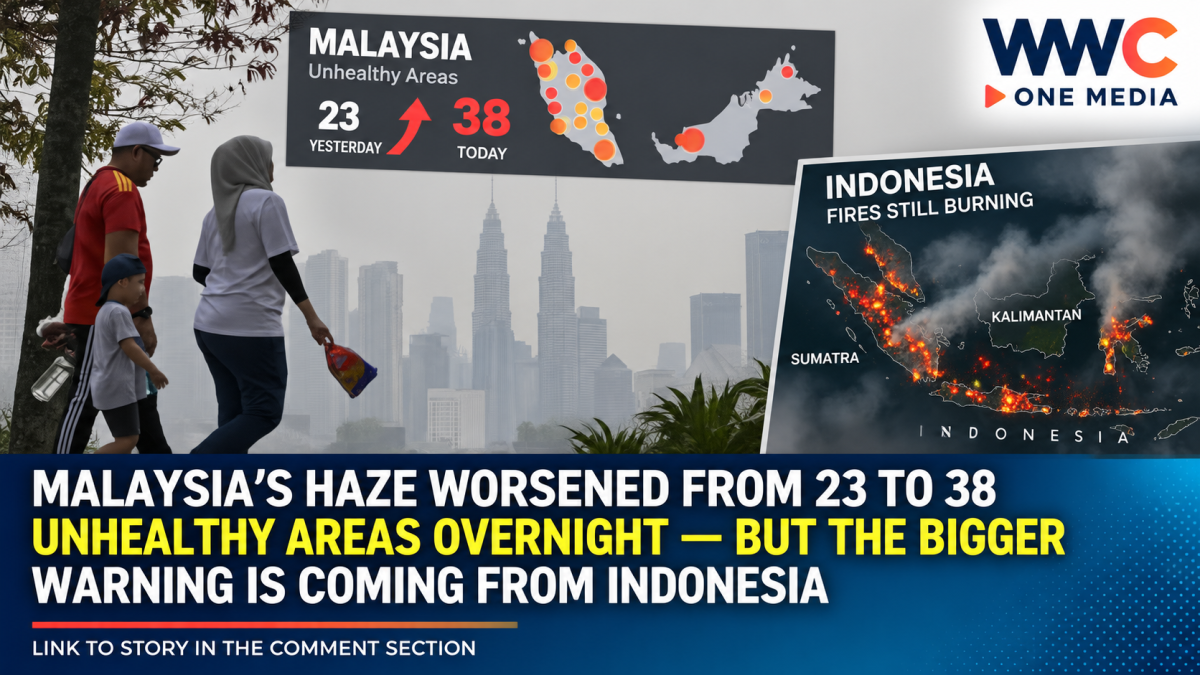
In less than a day, the number of monitoring stations reporting unhealthy air quality surged from 11 on Monday morning to 23 by Monday evening and 38 by Tuesday morning, as smoke spread across an increasingly large swath of the country.
At 8.45am on Sept. 15, the worst air quality was again recorded in Serian, Sarawak, with an Air Pollutant Index of 188.
That put the district only 13 points below Malaysia’s “Very Unhealthy” threshold of 201.
Next came Johan Setia in Selangor at 183.
But the biggest change was not simply how high the readings climbed.
It was how widely the haze had spread.
Johor suddenly had more unhealthy areas than any other state
By Tuesday morning, Johor had become the state with the largest number of monitoring locations in the Unhealthy category.
Pasir Gudang was at 172, Larkin 169, Tangkak 166, Kota Tinggi 165, Pengerang 162, Batu Pahat 160 and Kluang 151.
That matters because much of the earlier severe haze had been concentrated in Sarawak.
Now the problem is increasingly national.
The Klang Valley was heavily affected too.
Cheras in Kuala Lumpur reached 170.
Shah Alam was at 167.
Putrajaya registered 165.
Batu Muda stood at 161, while both Petaling Jaya and Klang reached 160.
Banting was at 157.
In Negeri Sembilan, Nilai reached 167 and Seremban 164.
Unhealthy readings were also recorded across Pahang, Terengganu, Melaka, Perak, Penang and Kedah.
Even Sungai Petani, which had the lowest reading among locations already classified as Unhealthy, stood at 103.
In other words, this was no longer merely a Sarawak haze story.
More than half of Malaysia’s monitoring stations were unhealthy
Malaysia’s Department of Environment operates 68 API monitoring stations nationwide.
With 38 of them in the Unhealthy category Tuesday morning, more than half of the monitoring network was reporting polluted air above 100.
Malaysia classifies API readings of 0-50 as Good, 51-100 as Moderate, 101-200 as Unhealthy, 201-300 as Very Unhealthy and anything above 300 as Hazardous.
So 188 in Serian was serious.
But context matters.
It was nowhere near what Serian experienced less than two weeks earlier.
Serian was above 500 only 11 days ago
On Sept. 4, Serian’s API soared past 500.
CNA reported a reading of 515 at 5pm, after it had first crossed the 500 mark earlier that morning.
Malaysia then declared a localized state of emergency around the district.
Reuters reported the API reaching as high as 519 during the emergency period.
The emergency was lifted on Sept. 7 after pollution levels fell below the hazardous range following improved conditions and cloud-seeding operations.
Then the haze returned.
By Sept. 8, Serian was back in hazardous territory with an API of 305.
On Sept. 11 it was again Very Unhealthy.
On Sept. 12 it reached 258 in the morning.
By Sept. 13 it had fallen to 185.
And now, on Sept. 15, it was at 188.
That roller-coaster pattern shows why haze conditions can be so unpredictable.
The fires may continue burning hundreds of kilometers away, while local readings rise or fall depending on wind, rainfall and atmospheric conditions.
Tuesday’s real warning is how quickly conditions deteriorated
At 11am on Monday, only 11 locations were reporting Unhealthy air.
By 6pm, that number had more than doubled to 23.
By 8.45am Tuesday, it had reached 38.
That expansion happened in less than 22 hours.
It illustrates an uncomfortable reality of transboundary haze:
A country can go from localized problems to widespread unhealthy air without the underlying fires suddenly appearing overnight.
The smoke may already be sitting elsewhere in the region.
A change in wind can simply move it.
The fires are still burning in Kalimantan and Sumatra
The ASEAN Specialised Meteorological Centre has been warning for weeks about persistent fire and smoke activity across Indonesia.
On Aug. 26, ASMC activated Alert Level 3 for the southern ASEAN region, its highest haze alert level.
That step is associated with significant and persistent hotspot activity, widespread moderate-to-dense smoke and conditions in which prevailing winds can carry pollution into neighboring countries.
At the time of the alert, ASMC said widespread moderate-to-dense smoke was emerging from hotspot clusters in Kalimantan, with transboundary haze drifting northward from West Kalimantan.
Significant smoke was also affecting southern and central Sumatra.
More recent regional monitoring has continued to show smoke over Kalimantan and southern Sumatra and haze extending toward parts of Malaysia.
The full extent can sometimes be difficult to determine because clouds block satellite detection.
That caveat matters.
A satellite hotspot count is not the same thing as a complete count of every fire burning on the ground.
El Niño is making the problem harder to extinguish
The region is also confronting unusually difficult weather.
ASMC says strong El Niño conditions are expected to persist, increasing the likelihood of prolonged dry periods across the southern ASEAN region.
Drier conditions make vegetation easier to ignite and allow peatlands to dry sufficiently for fires to penetrate below the surface.
Indonesia’s forestry minister has warned that controlling fires will remain difficult as El Niño intensifies. Reuters reported that officials regard much of the devastation as human-caused, even though weather conditions have dramatically amplified the scale and persistence of burning.
That distinction is important.
El Niño does not walk into a forest and light a match.
It creates conditions in which fires—whether started deliberately, accidentally or through other causes—can become much harder to stop.
Peat fires are especially dangerous
Part of Indonesia’s fire problem involves peatlands.
Peat is carbon-rich organic material accumulated over centuries.
When healthy and waterlogged, it is difficult to burn.
When drained and dried, it can become a giant underground fuel source.
Fire can smolder beneath the surface for days or weeks, making it extremely difficult to locate and extinguish completely.
That is why helicopters pouring water onto visible flames do not always solve the problem.
And it helps explain why haze can return after officials appear to have brought surface fires under control.
CNA’s analysis of the regional crisis notes that preventing repeat haze episodes will require not only firefighting but also better peatland conservation and land-use management.
Indonesia’s fire emissions have reached extraordinary levels
The scale of this year’s Indonesian fire season is becoming clearer.
According to Copernicus data cited by Reuters, fires in Indonesia emitted about 19.7 million metric tons of carbon dioxide between Sept. 1 and Sept. 7 alone.
That was more than one-third of global wildfire emissions during the period and around 273% above Indonesia’s seasonal average.
Reuters reported that emissions were approaching levels associated with the catastrophic 2015 fire season.
Hotspot activity has also been unusually high.
From Aug. 1 through Sept. 8, about 13,443 hotspots were recorded, compared with 9,454 during the equivalent period in 2015.
That does not mean 2026 has already surpassed 2015 overall.
Hotspot counts, burned area and emissions are different measurements.
Cloud cover can hide fires from satellites.
Some hotspots burn briefly.
Peat fires can continue underground and generate enormous emissions without always producing the same satellite signal.
But the numbers explain why the haze is affecting such a large part of Southeast Asia.
Indonesia itself is suffering far more severely
It is easy in Malaysia or Singapore to think of the haze primarily as pollution arriving “from Indonesia”.
That misses a crucial part of the story.
Millions of Indonesians are breathing the smoke much closer to its source.
Indonesia’s Health Ministry said more than 113,000 cases of respiratory illness linked to the fires had been recorded by Sept. 9—more than double the 50,891 cases recorded on Sept. 1.
More than 12.5 million people across seven provinces had been exposed to smoke and haze.
Schools have moved students online in badly affected areas.
AP reported that more than 1.4 million students nationwide had been affected by haze-related school disruptions.
In Pontianak, West Kalimantan, thick smoke has also disrupted flights, with visibility at times falling below one kilometer.
So this is not simply an international pollution dispute.
It is also a major Indonesian public-health and disaster-response crisis.
Indonesia has deployed more than 50 aircraft
Jakarta has intensified firefighting.
Reuters reported that Indonesia deployed more than 50 aircraft for water bombing and cloud-seeding operations across Sumatra and Borneo.
Thousands of military personnel, firefighters and other responders have also been mobilized.
Japan has sent three CH-47 Chinook helicopters and around 180 personnel to help fight fires in West Kalimantan, with operations scheduled from Sept. 12 to Sept. 19.
But aerial firefighting has limits.
Aircraft need accessible water.
Cloud seeding needs appropriate clouds.
And when burning moves deep into peat, suppressing it can require prolonged ground operations and sustained rainfall.
That is why Malaysia’s haze can persist even while Indonesia is throwing substantial resources at the fires.
Indonesian authorities are also investigating possible fire starters
Not every blaze is being treated as a natural disaster.
Indonesian police announced the arrest of 72 people suspected of involvement in forest and peatland fires across several provinces in Kalimantan and Sumatra.
Those people are suspects, not convicted offenders, and individual responsibility still has to be proved.
Indonesia’s Forestry Ministry has separately said 42 forest and land-fire cases are undergoing legal proceedings.
It also imposed administrative sanctions on six forest concession holders after fires affected more than 1,500 hectares of land within areas they managed.
President Prabowo Subianto has ordered authorities to revoke permits if companies are proven to have instructed people to burn land.
That still does not justify assuming every hotspot was caused by a plantation company.
Attribution has to be established fire by fire.
Anwar says Malaysia will not protect Malaysian companies either
Malaysia has taken a notable position on that point.
Prime Minister Anwar Ibrahim said Kuala Lumpur would not defend Malaysian companies if Indonesian authorities found them responsible for fires.
“If there are Malaysian companies involved, we give room for Indonesia to take action,” he said last week.
That statement matters because accusations surrounding plantation ownership have complicated previous haze disputes.
Anwar simultaneously called for stronger ASEAN mechanisms to deal with recurring transboundary pollution.
His argument was straightforward:
The existing regional system has not been sufficient to prevent a problem that continues affecting millions of people.
ASEAN has had a haze treaty for more than 20 years
Southeast Asia is not lacking a formal agreement.
The ASEAN Agreement on Transboundary Haze Pollution entered into force in 2003.
The problem is enforcement.
CNA reported that the treaty relies heavily on consultation, cooperation and national sovereignty.
There are no ASEAN-level fines for countries that fail to prevent haze, while disputes are designed to be resolved through consultation or negotiation.
That reflects ASEAN’s broader principle of non-interference.
It also creates an obvious weakness.
When smoke produced in one jurisdiction damages public health in another, the affected government cannot simply send investigators across the border and start prosecuting people.
It needs cooperation.
Malaysia wants that system revisited
The 2026 crisis has therefore reignited a debate policymakers have had many times before.
Malaysia wants ASEAN to reconsider whether the existing haze framework is strong enough.
Experts interviewed by CNA said stronger accountability could include faster evidence-sharing, more transparent investigations and better regional firefighting coordination.
But any significant change requires agreement among ASEAN members, including Indonesia.
That makes major reform politically difficult.
The bloc’s new ASEAN Coordinating Centre for Transboundary Haze Pollution Control could eventually improve real-time information sharing and operational coordination, but it has not yet become fully operational.
ASEAN still wants a haze-free region by 2030.
The current skies show how difficult that target may be.
Malaysia has already closed hundreds of schools during this haze season
The public-health consequences inside Malaysia have not been theoretical either.
In August, Sarawak ordered 591 schools across 10 districts to close for two days, affecting about 200,000 students, after air quality reached dangerous levels.
Serian had earlier become the first district to order school closures when its API exceeded 200.
Later, the district moved into a full haze emergency when pollution exceeded 500.
Tuesday morning’s API readings had not returned to those levels.
But the expansion of unhealthy conditions across Malaysia means far more people are now being exposed to moderate-to-high pollution even without an emergency declaration.
What does an API of 101 to 200 mean for health?
Malaysia’s Health Ministry advises reducing exposure when haze enters the Unhealthy range.
Its workplace guidance says outdoor workers should use suitable respiratory protection, susceptible workers should be reassigned indoors where appropriate and strenuous outdoor work should be minimized when the API is between 101 and 200.
The ministry’s general haze advice also recommends reducing outdoor physical activity, staying indoors where possible and seeking medical attention if haze causes significant symptoms.
People with asthma, chronic lung disease, cardiovascular conditions, children and older adults can be particularly vulnerable to smoke pollution.
Haze exposure can cause coughing, throat irritation, watery eyes and breathing discomfort and can aggravate existing respiratory or cardiovascular disease.
So the fact that most Tuesday readings remained below 200 should not be confused with the air being harmless.
“Unhealthy” means precisely what the name suggests.
Kuala Lumpur may get showers — but the haze forecast is not reassuring
Rain can temporarily improve local air quality by removing particles from the atmosphere.
But a shower in Kuala Lumpur cannot extinguish peat fires in Kalimantan.
Current MetMalaysia forecasts show haze remaining in parts of the Klang Valley during the coming days, although thunderstorms may provide intermittent relief in locations such as Petaling Jaya. Other areas, including Sepang, have forecasts dominated by haze through much of the week.
Regional conditions remain the bigger problem.
ASMC’s outlook says southern ASEAN continues to face an elevated haze risk because strong El Niño conditions and below-normal rainfall increase the likelihood of prolonged dry periods.
More substantial relief may come as the region moves toward the inter-monsoon period around October and rainfall increases.
That is an outlook, not a guarantee.
A change in winds can improve—or worsen—conditions much sooner.
Singapore’s skies deteriorated at the same time
Malaysia is not experiencing Tuesday’s deterioration alone.
Across the Causeway, all five regions of Singapore entered the Unhealthy 24-hour PSI range on Sept. 15, the first time that had happened islandwide since September 2019.
The worsening occurred after central, eastern and western Singapore had already moved above 100 on Monday.
The simultaneous deterioration in Malaysia and Singapore is another clue that this is a broad regional smoke event rather than a collection of isolated urban pollution episodes.
Different countries use somewhat different air-quality indices, so Malaysia’s API and Singapore’s PSI figures should not be directly compared point for point.
But both systems were telling residents the same basic thing Tuesday:
The air had become unhealthy.
Serian’s 188 may actually be the least surprising number in the story
After API readings above 500 earlier this month, another morning with Serian near 200 unfortunately looks familiar.
The more striking statistic is 38.
Thirty-eight locations across Malaysia.
Only 11 had been unhealthy at approximately the same time the previous morning.
That shows how rapidly a haze episode can change character.
On Sunday, much of the concern was still centered on Sarawak.
By Tuesday, Johor had seven unhealthy monitoring stations.
The Klang Valley was heavily affected.
Negeri Sembilan, Pahang, Terengganu, Melaka, Perak, Penang and Kedah were also on the list.
The smoke had become a national problem.
And there is a bigger number Malaysia cannot control: how long the fires keep burning
Air-quality numbers update every hour.
A 188 can become 160.
It can become 220.
A thunderstorm can improve the sky.
A wind shift can make it murky again.
That is why a single API reading is only a snapshot.
The underlying issue is whether the source fires continue.
Indonesia’s wildfire emissions are already running at extraordinary levels.
Millions of people are exposed.
More than 100,000 respiratory illnesses have been recorded.
Dozens of aircraft are fighting the fires.
Foreign military helicopters have been brought in.
ASEAN’s southern-region haze alert remains at its highest level.
Malaysia can close schools.
It can distribute masks.
It can conduct cloud seeding.
It can ask people to stay indoors.
It can push ASEAN for tougher action.
But as long as huge volumes of smoke continue rising from burning land across Sumatra and Kalimantan, Malaysian air quality remains partly dependent on what happens hundreds of kilometers away.
And that is the uncomfortable lesson behind Tuesday morning’s jump from 23 unhealthy monitoring sites to 38:
The haze can spread much faster than the region can put out the fires producing it.




Leave a Reply