
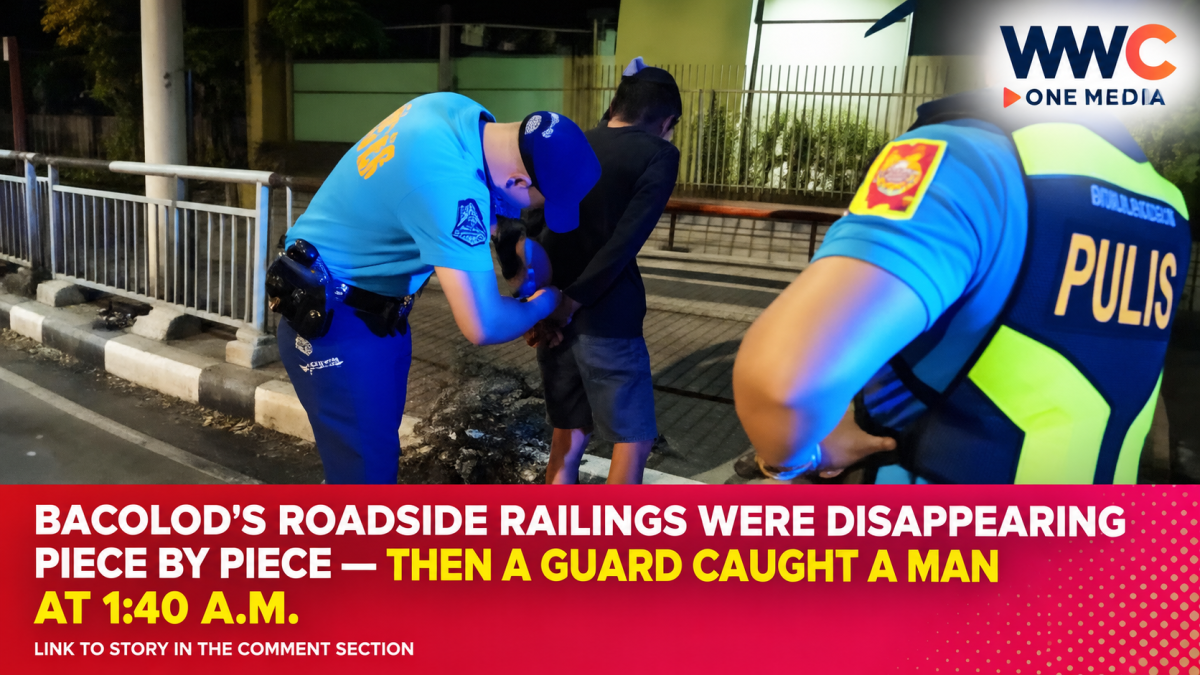
BACOLOD CITY, Philippines — Decorative metal railings along one of Bacolod’s public sidewalks had reportedly been disappearing little by little.
Early Sunday morning, authorities say they finally caught someone in the act.
The Bacolod City Government filed a theft complaint on Monday, September 14, against a 36-year-old Barangay 16 resident who was allegedly caught removing metal railings from the sidewalk in front of Negros Occidental High School.
Mayor Greg Gasataya said personnel from the city’s Public Order and Safety Office apprehended the suspect at around 1:40 a.m. on September 13.
The man was subsequently turned over to Bacolod Police Station 1, where he remained in custody as the complaint was processed.
But city officials believe the arrest may answer only part of the mystery.
Gasataya said he suspects the man may not have acted alone, warning others involved in stealing or damaging city infrastructure that authorities would eventually catch them.
Police describe how the railings were allegedly removed
Independent local reporting provides more detail about what police believe was happening.
Bombo Radyo Bacolod identified the suspect only by an alias and quoted Police Major Eugene Tolentino, commander of Police Station 1, saying the man allegedly used a piece of wood as leverage against the metal bars.
According to Tolentino, the railing was gradually loosened by repeatedly twisting and working the metal until portions could be removed.
Police believe the process may have been happening over a period of time rather than in one single attempt.
That would fit the pattern described by City Hall.
Panay News reported that several sections of decorative railings installed along Bacolod roads had already been gradually disappearing, including those along the sidewalk outside Negros Occidental High School.
The police commander also told Bombo Radyo that the metal has resale value because of the type and solidity of the material.
Authorities, however, have not publicly identified who — if anyone — purchased earlier missing railings.
There is also no public evidence yet connecting any scrap dealer to the alleged theft.
Another report says a POSO guard spotted the suspect
Digicast Negros independently reported the September 13 arrest.
According to its account, a Public Order and Safety Office guard spotted a man allegedly attempting to take steel grills from the area in front of Negros Occidental High School along Araneta Street in Barangay 36.
The guard contacted police, prompting Police Station 1 personnel to respond and take the suspect into custody.
Bacolod City Police Office Director Col. Eugene Rebadomia said the arrest demonstrated the importance of quick reporting and coordination between security personnel and police responders.
The city government owns the railings, according to police, which is why the City Legal Office moved to file the theft complaint.
One important number is still missing: the value of the metal
Authorities have not yet publicly established the value of the railing involved.
Digicast reported that police were still determining how much the property was worth.
That detail matters legally.
Under the Philippines’ Revised Penal Code, as amended by Republic Act No. 10951, penalties for ordinary theft vary according to the value of the property involved.
It would therefore be premature to speculate on the possible sentence the suspect could face if convicted until investigators establish the value and prosecutors determine the appropriate charge.
The suspect also remains accused, not convicted, and is entitled to due process.
The bigger problem: this is not Bacolod’s only recent metal theft
The railing case comes against a troubling local backdrop.
Only weeks earlier, Bacolod officials reported repeated thefts of electrical copper wiring around the Bacolod City Government Center.
Negros Now Daily reported that three incidents involving city-government wiring produced estimated losses totaling around ₱50,000.
Among the property targeted were wires connected with signage, markers and other infrastructure around the government-center grounds.
Bombo Radyo similarly reported that wiring had been stolen from the area in multiple incidents, prompting additional attention from the Public Order and Safety Office.
There is no reported evidence that the man arrested outside Negros Occidental High School was involved in those cases.
But together, the incidents illustrate why the city has become increasingly concerned about the theft of metal and electrical components from public infrastructure.
Cell towers have also been targeted
The problem extends beyond government property.
At the end of August, Bacolod officials called representatives of telecommunications companies and their security providers to a meeting after 15 theft incidents involving cell tower facilities were reported over roughly two weeks.
Thieves had allegedly taken cables, copper components, batteries and other equipment.
In some cases, the damage disrupted internet and telecommunications services.
Again, authorities have not publicly connected those thefts with the railing suspect.
But they demonstrate why stealing metal infrastructure is not necessarily a victimless property offense.
A stolen railing has to be replaced.
A cut electrical wire can leave government installations damaged or unsafe.
A stripped cell tower can interrupt communications for an entire neighborhood.
And eventually, businesses, taxpayers or customers pay for the damage.
Bacolod council had already called for stronger patrols
Even before the railing arrest, city legislators were pushing for more visible policing.
The Bacolod Sangguniang Panlungsod approved a resolution urging the Bacolod City Police Office, barangay officials and barangay tanods to strengthen patrols amid reported theft, snatching and akyat-bahay incidents.
The measure called for increased police visibility in residential streets, markets, terminals and other areas considered vulnerable to crime.
Councilor Em Ang, who authored the measure, said visible patrols could deter crime while faster responses could reassure residents that reports were being acted upon.
The resolution also recommended closer coordination between barangays, police and the city government, along with consideration of improved CCTV coverage and street lighting in crime-prone areas.
The September 13 arrest arguably shows what that kind of presence can accomplish.
A city security officer spotted suspicious activity.
Police were called.
The suspect was apprehended before authorities say more property could be removed.
Public property theft creates a second bill
Metal theft can appear relatively minor when compared with armed robbery or violent crime.
But public-infrastructure theft carries a cost that is easy to underestimate.
First, the government pays to install the railing, cable, fixture or other infrastructure.
Then, when it is stolen, government has to pay again to replace or repair it.
Security may also need to be increased afterward.
In the case of roadside railings, there can be another consideration: the structures may serve not only as decoration but also as barriers separating pedestrians from traffic or controlling access along a sidewalk.
Removing sections can therefore affect the appearance, functionality and potentially the safety of public spaces.
City Hall has said it will continue monitoring public facilities and infrastructure in an effort to prevent additional theft or damage.
Police say the suspect had previous records, but caution is necessary
Bombo Radyo reported that Police Major Tolentino said the suspect had previous records but had apparently not been formally charged in those earlier incidents.
That information should be interpreted cautiously.
A previous police record or prior allegation does not establish guilt in the current case or in any earlier matter.
The September 13 incident must stand on its own evidence.
For prosecutors, the immediate questions will likely include whether the city can establish ownership of the railing, what exactly was taken or damaged, what the property was worth and whether available eyewitness or physical evidence supports the theft allegation.
The unanswered question now is whether one arrest ends the problem
Mayor Gasataya’s suggestion that the suspect may not have acted alone raises the most important unresolved issue.
Were the railings being removed by one person over time?
Were other people helping?
Where were previously removed sections taken?
Were they being sold as scrap?
And if they were sold, who was buying them?
City officials have not publicly announced answers to those questions.
Nor have police announced additional arrests connected specifically with the disappearing road railings.
That means the September 13 apprehension may be either the end of a relatively small theft case — or the first useful lead in explaining why public metal fixtures had been vanishing across parts of the city.
Bacolod has already dealt with stolen government wiring.
Telecommunications companies have reported stripped tower equipment.
Now City Hall is prosecuting an alleged attempt to remove roadside metal infrastructure.
Authorities have not established that these cases are connected, and they should not be portrayed as one organized operation without evidence.
But together, they expose a common vulnerability:
Anything made of metal and left in an accessible public location can become valuable to somebody willing to cut it loose.
The city caught one suspect at 1:40 in the morning.




Leave a Reply