
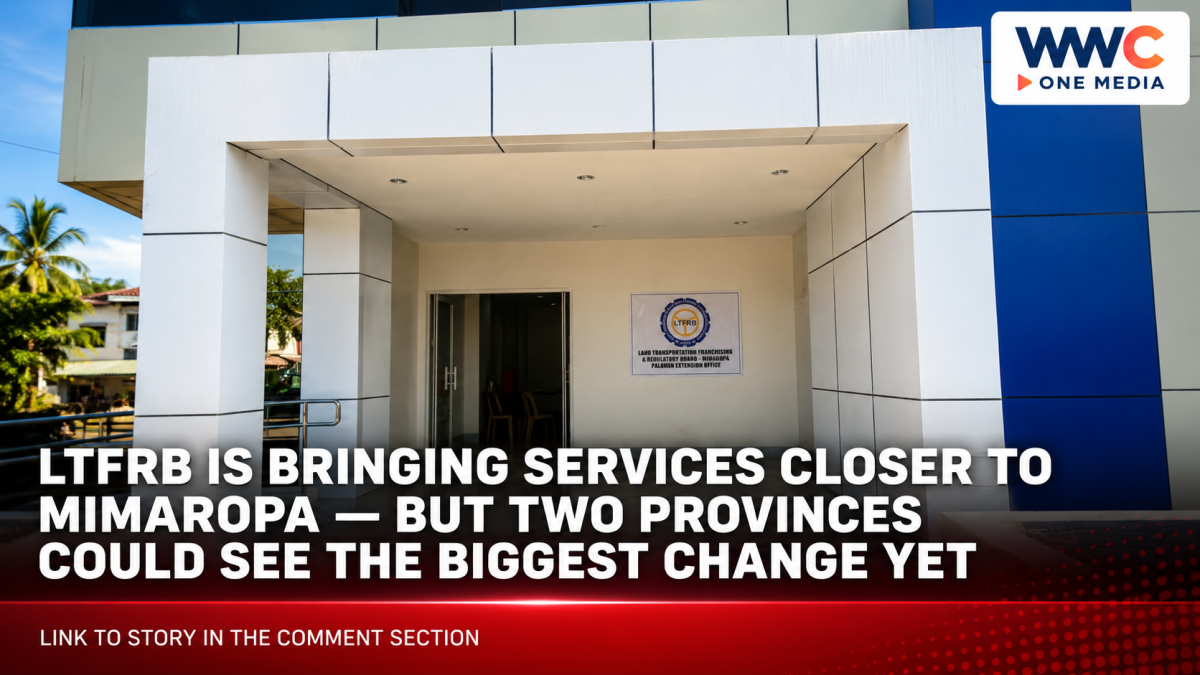
CALAPAN CITY, Oriental Mindoro — Transport operators in two MIMAROPA provinces could soon spend less time and money traveling to Calapan City for government transactions as the Land Transportation Franchising and Regulatory Board moves to expand its physical presence across the island region.
LTFRB MIMAROPA Regional Director Enrico Moreno Bautista said the agency is working on establishing additional extension offices in Marinduque and Occidental Mindoro, part of a broader effort to make franchising and regulatory services more accessible to public transport operators and drivers.
The planned expansion addresses one of MIMAROPA’s biggest logistical problems: geography.
Unlike many mainland administrative regions, MIMAROPA is spread across several major islands. Transport operators who need to process documents, clarify franchise concerns or deal with regulatory matters may therefore face considerably more complicated travel than stakeholders living close to a regional government center.
Bautista acknowledged that challenge during the August 26 edition of Arangkada sa MIMAROPA, a program jointly produced by the Philippine Information Agency MIMAROPA and Radyo Pilipinas Palawan.
The regional director said LTFRB officials have been coordinating with provincial and local governments as the agency identifies transport concerns and works out how services can be brought closer to communities.
Thousands of public transport units fall under LTFRB MIMAROPA
The potential expansion is significant because of the size of the transport network the regional office already regulates.
As of August 26, LTFRB MIMAROPA recorded 1,102 registered operators, 303 approved routes and 2,932 transport units across the region.
Those figures were separately reported in another PIA story on LTFRB’s transport-assistance programs, providing additional confirmation of the regional data.
An extension office could allow operators to handle more transactions closer to home instead of making their way to the LTFRB regional office in Calapan City, Oriental Mindoro.
For an archipelagic region, that seemingly administrative change could have a practical effect: government paperwork would move closer to the transport businesses and drivers the agency regulates.
Romblon and Palawan offer a glimpse of the strategy
LTFRB says it already has extension-office arrangements or presence in Palawan and Romblon, although the status of individual facilities needs some qualification.
In Romblon, LTFRB MIMAROPA and the municipal government of San Agustin signed an agreement on July 24, 2026 to establish an extension office in the municipality.
Under that agreement, the local government is providing space for the facility. Once operational, the office is expected to handle franchise applications, permits and other LTFRB transactions without requiring stakeholders to travel outside their area.
San Agustin was selected partly because of its location and accessibility to neighboring municipalities and nearby islands, according to a separate government report.
The development also reveals a bigger ambition behind the current expansion: Bautista has said establishing an LTFRB office in every province of MIMAROPA has been a long-term goal of the regional office.
Palawan operators already seeing benefits of decentralized services
Palawan provides another example of why LTFRB wants services outside Calapan.
Bautista said operators from Palawan generally no longer need to travel to the regional office for ordinary transactions, although cases requiring personal appearance may still require a trip.
At the same time, LTFRB is working with Palawan local governments on a broader public transport review.
Officials are assessing commuter demand and the number of available vehicles to determine whether additional public transport routes should be opened. Any new routes would have to be incorporated into an approved Local Public Transport Route Plan, with qualified operators undergoing the prescribed selection process.
That means decentralizing LTFRB offices is only one part of a larger regional transport strategy involving route planning, franchise compliance and coordination with local governments.
Occidental Mindoro already moving on local transport planning
Occidental Mindoro, one of the provinces targeted for another LTFRB extension office, has also recently moved forward with its local transport planning.
The municipality of Paluan received LTFRB approval for its Local Public Transport Route Plan through a Special Notice of Compliance issued on August 4.
According to PIA, the local assessment found that existing tricycles and local transport services were sufficient for current passenger demand, meaning the approved plan did not immediately require new four-wheel public transport routes.
The development illustrates why stronger provincial LTFRB access could become increasingly important: local governments are being asked to plan transportation demand more systematically while operators must navigate franchises, permits, route approvals and compliance requirements.
Government assistance gives operators another reason to stay registered
LTFRB’s push to bring offices closer to operators also comes as registered transport groups gain access to government assistance programs.
In MIMAROPA, qualified operators have been covered by cash subsidies, service contracting and a fuel-discount program.
LTFRB said qualified diesel-powered public utility vehicle operators and drivers can receive a ₱12-per-liter fuel discount at accredited fuel stations upon presentation of the required franchise credentials.
The regional office has also reported distributing ₱12.757 million through its service contracting program.
Under that arrangement, participating transport services provide discounted fares, including 40-percent discounts for students, senior citizens and persons with disabilities and 20 percent for ordinary passengers, according to LTFRB MIMAROPA.
That creates another practical reason for operators to maintain valid registrations and franchises.
LTFRB also targets unfranchised operators
The agency is simultaneously encouraging operators of unfranchised public utility vehicles to legalize their operations.
Earlier this year, LTFRB MIMAROPA acknowledged that it did not have an exact regional count comparing franchised and unfranchised vehicles, although officials said they continued receiving reports of vehicles operating without the required authority.
Bautista has repeatedly encouraged operators to deal directly with LTFRB instead of unauthorized intermediaries or fixers and to complete the documents required to operate legally.
For commuters, proper franchising is not merely paperwork. Regulation determines who is legally authorized to carry passengers, what routes vehicles may serve and which operators can qualify for government transportation programs.
The bigger test: turning planned offices into working services
For Marinduque and Occidental Mindoro, the most important details have yet to emerge.
LTFRB has announced that it is working toward establishing the additional offices, but the August 28 announcement did not provide firm opening dates, exact locations, staffing levels or a complete list of transactions that each proposed facility will handle.
Those details will ultimately determine how much difference the expansion makes.
But the direction is clear: instead of requiring transport operators scattered across an island region to repeatedly come to the regulator, LTFRB MIMAROPA wants more of the regulator to come to them.
If the Marinduque and Occidental Mindoro offices become fully operational — and if the Romblon expansion is completed as planned — MIMAROPA could move considerably closer to LTFRB’s broader goal of having accessible agency services in every province of the region.
For thousands of drivers and operators, the real benefit may be measured not in the number of new government offices opened, but in the ferry trips, travel expenses and working hours they no longer have to sacrifice just to process government paperwork.




Leave a Reply