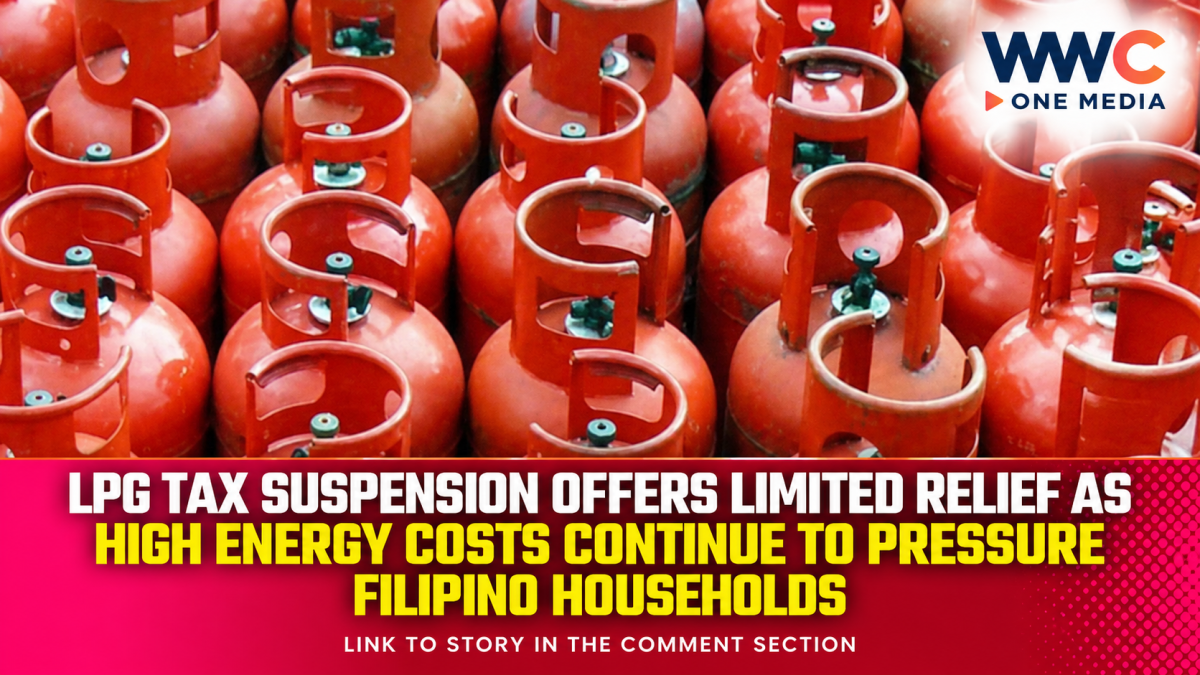
MANILA — The Philippine government’s suspension of excise taxes on liquefied petroleum gas and kerosene is expected to lower household energy costs, but the measure may provide only limited relief as elevated global oil prices continue to push up fuel and other consumer expenses.
The tax suspension was approved as the government responds to higher energy costs linked to disruptions in global oil markets. The measure removes the excise levy on LPG and kerosene while keeping excise taxes on gasoline and diesel in place.
For LPG users, the suspension translates to an estimated reduction of ₱3.36 per kilogram, or about ₱36.96 for an 11-kilogram cylinder. Kerosene users are expected to save roughly ₱5.56 per liter.
The potential savings are significant for households that rely heavily on LPG for cooking and kerosene for basic energy needs, but the effect on overall household expenses is expected to remain relatively narrow because food, transportation and other costs are also being affected by the broader energy-price environment.
Government data show that lower-income households account for a substantial share of LPG and kerosene consumption. About 48% of kerosene consumption is attributed to the bottom 30% of households, while 55.7% of LPG users come from the bottom 70%, according to the latest available family-income and expenditure data cited by economic officials.
The government expects to forgo about ₱4.1 billion in revenue over three months because of the suspension. Officials have said the revenue impact could partly be offset by stronger value-added tax collections if crude oil prices remain elevated.
The limited scope of the measure is deliberate. Gasoline and diesel taxes were left unchanged because officials argued that removing those levies would have a relatively small effect on pump prices while creating a much larger revenue loss. A separate targeted subsidy program has been used to assist sectors particularly exposed to transport-fuel costs.
Economists have offered differing views on the wider impact. Some have described LPG and kerosene tax relief as a targeted way of reducing household energy expenses, while others have pointed out that diesel and gasoline costs can filter through transportation, agriculture, shipping and food distribution, potentially affecting prices even for households that do not directly purchase large amounts of fuel.
Another complication is the timing of the price benefit. Existing LPG inventories may already have been purchased with the excise tax included, meaning the full reduction may not immediately reach consumers. Industry representatives have said some distributors may need to absorb part of the cost before tax-free supplies become available.
The government is also dealing with a broader energy-security challenge. The Philippines has declared a one-year national energy emergency as international oil-market disruptions threaten to raise fuel costs and complicate efforts to protect domestic energy supply.
The duration of the tax suspension will therefore be important. A short-term measure could reduce some household expenses while limiting the effect on government revenues, but a prolonged period of elevated energy prices and continued tax relief would increase the fiscal cost.
For consumers, the immediate benefit will depend on how quickly the tax savings are reflected in retail LPG and kerosene prices. For the government, the challenge is balancing targeted assistance with the need to preserve revenue while global energy markets remain volatile.
The bigger issue now is whether the LPG and kerosene tax suspension can provide meaningful breathing room for households while broader fuel, transport and food costs continue to face pressure from the global energy shock.