
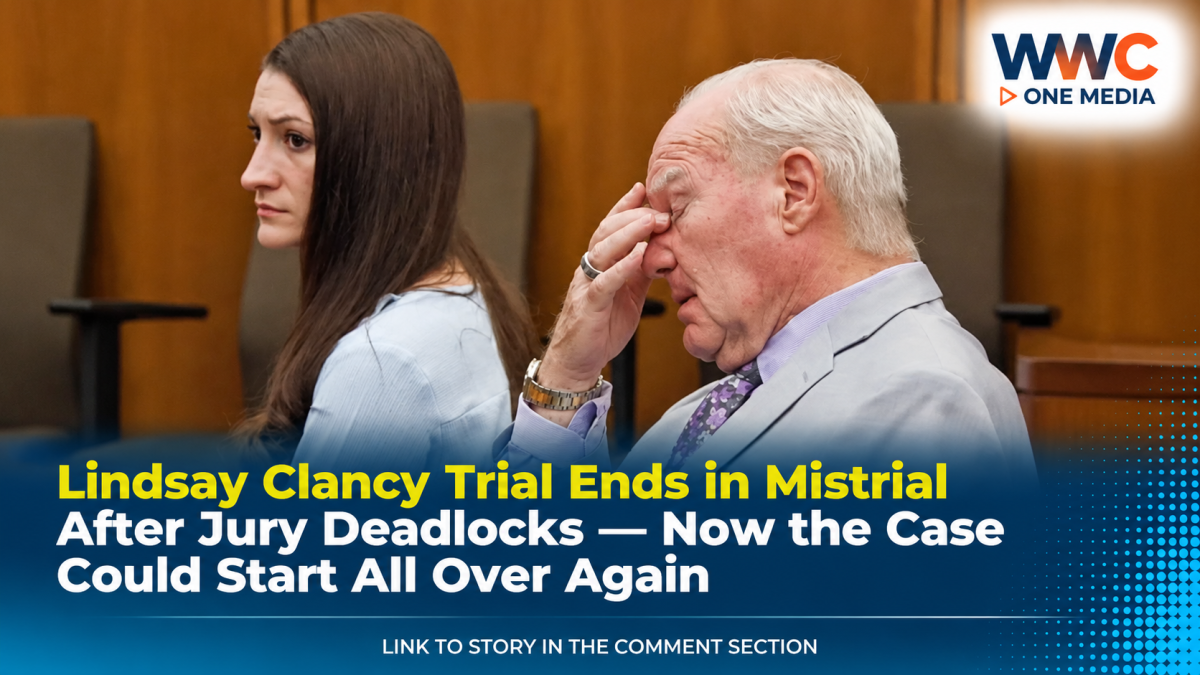
PLYMOUTH, Massachusetts — The highly watched murder trial of Lindsay Clancy, the Massachusetts mother accused of killing her three young children, has ended without a verdict after jurors failed to reach a unanimous decision.
Judge William Sullivan declared a mistrial on Friday, Sept. 4, after the 12-member jury remained deadlocked on whether Clancy was criminally responsible for the deaths. The jury had been deliberating for seven days.
The decision leaves one of the most closely followed US criminal cases of recent years unresolved — and opens the possibility of another trial.
Jury could not agree
The jury consisted of nine women and three men. According to reporting by AFP and other outlets, 11 jurors were reportedly prepared to find Clancy not guilty by reason of insanity, while one juror remained opposed.
The disagreement became increasingly tense during the final days of deliberations.
On Thursday, the jury foreperson told the judge that a juror was refusing to follow the court’s instructions concerning reasonable doubt.
Clancy’s defense attorney, Kevin Reddington, argued that the juror should be removed, saying the juror’s position was preventing the panel from reaching a verdict.
Judge Sullivan rejected that request, finding that the jury’s communication did not establish that the juror was refusing to follow the law.
The jury returned another note on Friday saying it could not reach a unanimous decision.
That ultimately led Sullivan to declare the mistrial.
Clancy never denied killing her children
The central issue at trial was not whether Clancy killed her children.
Clancy, a former labor-and-delivery nurse, acknowledged that she strangled 5-year-old Cora, 3-year-old Dawson and 8-month-old Callan in the family’s Duxbury home on Jan. 24, 2023.
Her defense argued that she should not be held criminally responsible because she was suffering from postpartum psychosis, along with bipolar disorder, at the time.
The defense maintained that the severe psychiatric condition distorted her perception and contributed to the killings and her subsequent suicide attempt.
Prosecutors presented a dramatically different account.
They argued that Clancy knew what she was doing and deliberately created circumstances that left her alone with the children before the killings.
The prosecution therefore urged jurors to find her criminally responsible.
A case that divided public opinion
The nearly six-week trial attracted intense attention well beyond Massachusetts.
At the heart of the case was a difficult question: Can a mother who kills her children while experiencing an extreme psychiatric disorder be held criminally responsible for her actions?
The trial also renewed discussion about postpartum psychosis, a rare but serious psychiatric condition that can occur after childbirth.
Unlike the more widely recognized postpartum depression, postpartum psychosis can involve severe confusion, delusions, hallucinations and loss of contact with reality.
The defense made Clancy’s mental state the centerpiece of its case.
Prosecutors, however, challenged the argument that her illness prevented her from understanding the nature or consequences of her actions.
Dramatic final hours
The final day of deliberations brought an extraordinary sequence of events.
After jurors again reported that they could not reach a unanimous verdict, Judge Sullivan initially indicated that he would declare a mistrial.
But before doing so, he gave the defense an opportunity to seek emergency relief from the Massachusetts Supreme Judicial Court.
Reddington argued that the trial had been compromised by the judge’s refusal to remove the disputed juror.
The emergency appeal was ultimately unsuccessful, clearing the way for the mistrial to be declared.
The courtroom then closed a trial that had consumed weeks of testimony and deliberation without determining whether Clancy was legally responsible for the deaths.
What happens next?
The mistrial does not mean Clancy was acquitted.
Instead, the criminal case remains unresolved.
Prosecutors now have several possible paths, including seeking a new trial before another jury, negotiating a plea agreement or deciding not to pursue the case further.
Plymouth County District Attorney Timothy Cruz said there would not necessarily be an immediate decision on whether to retry Clancy.
A hearing has been scheduled for Sept. 29 to address the next steps.
If prosecutors pursue another trial, the central battle would once again likely revolve around Clancy’s mental state and whether postpartum psychosis prevented her from being criminally responsible.
Why the mistrial matters
The case has become much bigger than a single criminal proceeding.
It has forced difficult conversations about maternal mental health, psychiatric care, criminal responsibility and the limits of the insanity defense.
For the families of Cora, Dawson and Callan, however, the mistrial means there is still no final criminal verdict concerning their deaths.
For Clancy, it means she remains without either a conviction or acquittal.
And for prosecutors, the question now is whether they are prepared to put the case — and its deeply divisive mental-health arguments — before another jury.
After six weeks of testimony and seven days of deliberations, the courtroom has closed without an answer. The next decision could determine whether the battle begins again.
Editorial accuracy note
This should be described as a mistrial caused by a deadlocked jury, not as a finding that Clancy was innocent or legally insane. The jury did not reach a unanimous verdict, so the question of criminal responsibility remains unresolved.
The reported 11-to-1 split should also be attributed to reporting on the jury deliberations rather than presented as an official verdict. Most importantly, the prosecution’s allegations and the defense’s postpartum-psychosis argument are competing positions in the case, not established facts.
WWC ONE MEDIA J.M.D




Leave a Reply