
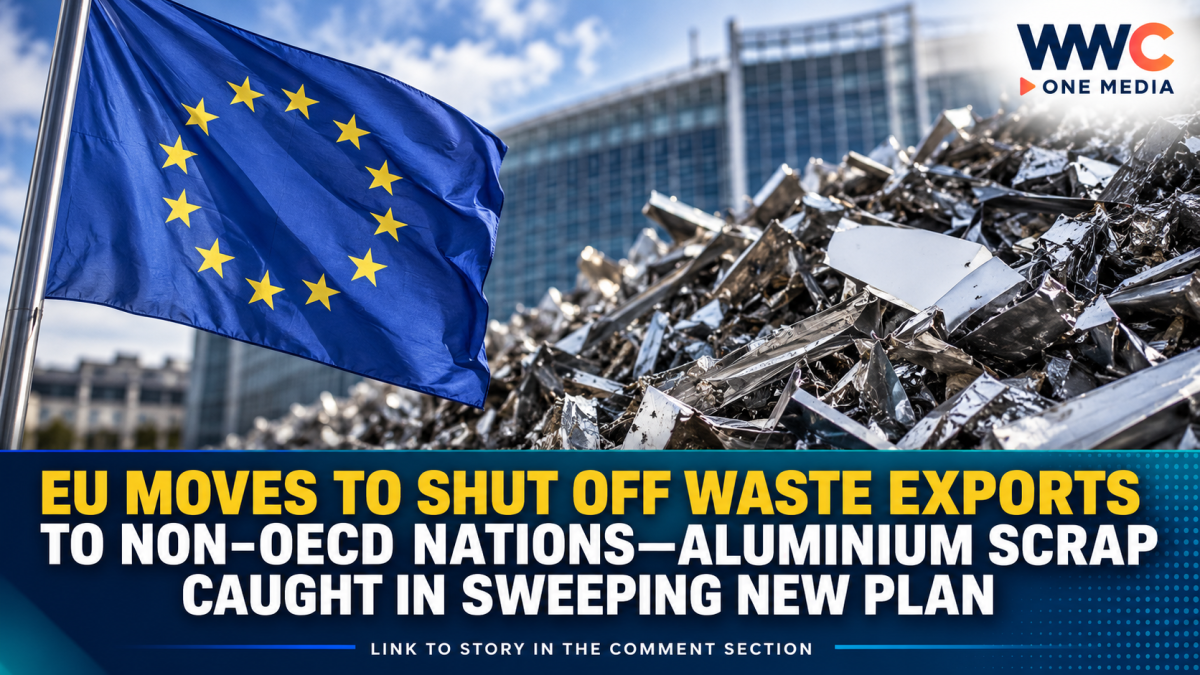
BRUSSELS — The European Union is preparing a sweeping new move to restrict waste exports to countries outside the Organisation for Economic Co-operation and Development (OECD), with aluminium scrap among the materials that could be affected.
The proposal marks a significant shift from a narrower trade measure that EU officials had been preparing for September. European Commission Executive Vice-President for Prosperity and Industrial Strategy Stéphane Séjourné has instead decided to pursue a broader approach under the bloc’s Waste Shipments Regulation.
Séjourné’s cabinet said the earlier trade instrument was withdrawn after internal discussions showed it could cover only about half of aluminium-scrap exports. The Commission is now working on a delegated act that would ban exports of waste, including aluminium scrap, to non-OECD countries, with an exception for certain EU candidate countries.
The proposed measure is significant for major Asian recycling and manufacturing markets because several important destinations for European scrap—including China and India—are not OECD members.
A bigger move than the original aluminium plan
The EU had been considering more targeted trade restrictions on aluminium scrap after European producers raised concerns that valuable recyclable material was leaving the bloc for overseas processors.
The European Commission’s broader strategy is tied to concerns about maintaining access to secondary raw materials for European industry. Aluminium scrap is particularly important because recycling aluminium requires dramatically less energy than producing primary aluminium from bauxite.
Reuters reported that recycling aluminium uses about 95% less energy than producing new aluminium from mined bauxite, making scrap an important part of Europe’s efforts to cut industrial emissions while keeping domestic smelters and recyclers supplied.
The EU had previously signaled that it would consider targeted measures on aluminium scrap as part of its efforts to address global scrap-flow imbalances and protect the competitiveness of European metal industries.
The important distinction: this is not an immediate blanket ban
The latest development should not be interpreted as meaning that all European waste exports to non-OECD countries have already stopped.
The EU’s new Waste Shipments Regulation entered into force in May 2024, but most export provisions take effect later. Under the existing framework, stricter rules for non-hazardous waste exports to non-OECD countries begin on May 21, 2027. Generally, such exports will be prohibited unless the destination country meets the regulation’s requirements and is placed on the EU’s approved list.
The Commission says non-OECD countries that want to continue receiving eligible non-hazardous waste from the EU must demonstrate that they can manage the material in an environmentally sound manner.
The first list of approved countries is scheduled for establishment by November 21, 2026. Exports to non-OECD countries that are not included on the list will then be prohibited from May 2027.
That existing framework is separate from the new, broader delegated act now being explored specifically to cover waste—including aluminium scrap—more comprehensively.
The Philippines is among the countries seeking eligibility
The development could matter to the Philippines and other Asian economies that import recyclable materials from Europe.
European Commission records show that the Philippines was among the non-OECD countries that submitted a request to remain eligible to import non-hazardous waste from the EU. Other applicants included India, Indonesia, Malaysia, Pakistan, Singapore, Thailand and Vietnam, among others.
However, submitting an application does not guarantee continued access.
The Commission must assess whether each applicant can meet the environmental and waste-management requirements established under the regulation. Approval can also be limited to specific waste streams rather than covering every type of non-hazardous waste.
That distinction could become increasingly important for recyclers, traders and manufacturers that depend on imported scrap as industrial feedstock.
Why aluminium scrap has become a flashpoint
Aluminium scrap is not simply waste in the conventional sense. It is a valuable secondary raw material that can be remelted and used to manufacture new aluminium products.
European aluminium producers have argued that unrestricted exports can leave European recyclers and smelters competing with overseas buyers for limited supplies of scrap.
The Commission’s own policy documents have identified aluminium scrap as a strategic issue, saying targeted measures were being considered to help European smelters and recyclers retain sufficient access to essential feedstock. The Commission has also highlighted concerns over scrap being exported as products rather than being properly classified as waste.
The new approach therefore combines environmental policy, industrial competitiveness and resource security.
What happens next?
The proposed delegated act is not yet final.
Séjourné’s team said the measure will first go through public consultation before the Commission seeks to adopt it by the end of 2026.
That leaves potentially significant questions for European exporters and non-OECD importers, particularly over which materials will ultimately be covered, which countries will receive exemptions or authorization, and how the new measure will interact with the Waste Shipments Regulation already scheduled to tighten in 2027.
For Asian recycling markets, the stakes are considerable.
If the EU ultimately closes the export channel for aluminium scrap and other recyclable waste to non-OECD destinations, European scrap supplies could increasingly remain within the bloc—potentially reshaping international scrap flows, competition for secondary aluminium and raw-material costs.
The immediate question is no longer whether Brussels wants tighter control over aluminium scrap. It is how broad the final restrictions will be—and which countries will still be allowed through the EU’s regulatory gate.
WWC ONE MEDIA J.M.S

Leave a Reply