
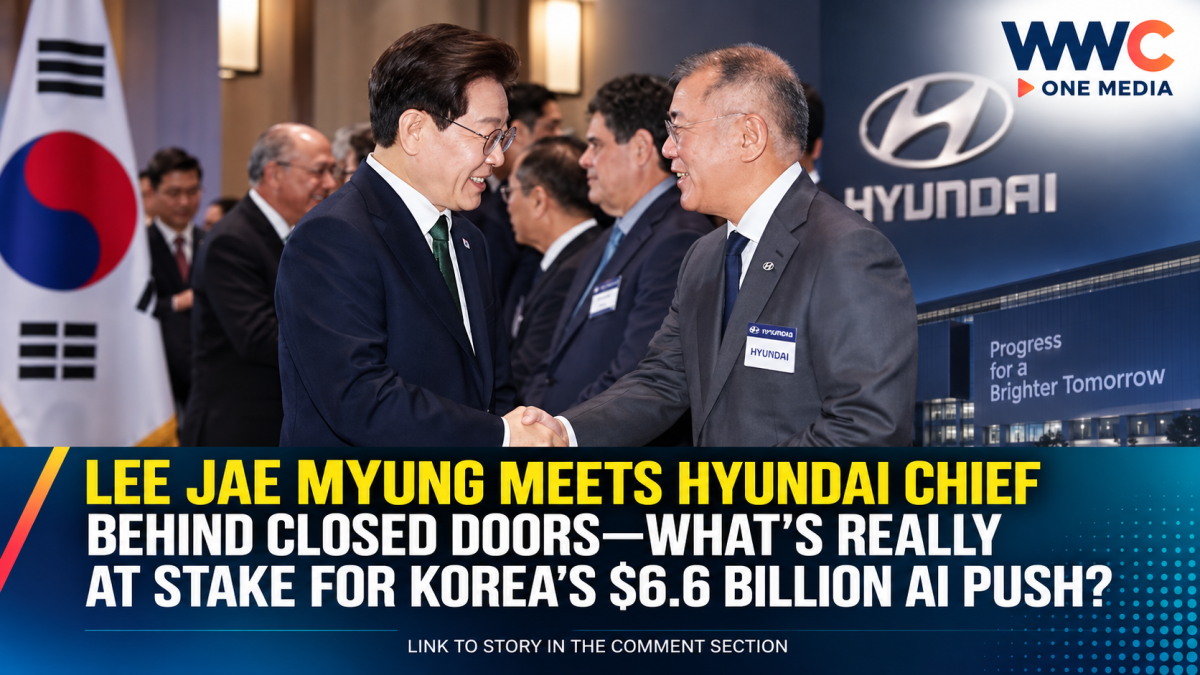
SEOUL — South Korean President Lee Jae Myung has held a closed-door meeting with Hyundai Motor Group Executive Chair Euisun Chung, as Seoul intensifies efforts to keep major corporate investment projects moving and accelerate the country’s push into artificial intelligence, robotics and advanced industries.
The meeting took place on Wednesday, Sept. 2, according to sources cited by Yonhap and other Korean media. Details of the private discussion were not officially disclosed, but reports indicate that Hyundai’s ₩9 trillion (about US$6.6 billion) investment in Saemangeum was likely a major topic.
The presidential office has declined to confirm details of Lee’s private schedule, meaning the precise subjects discussed between the two executives remain unconfirmed.
Hyundai’s massive Saemangeum bet
The meeting comes as Hyundai moves forward with an ambitious plan to establish an AI, robotics and hydrogen-focused industrial hub in Saemangeum, a large reclaimed-land development in North Jeolla Province.
Hyundai announced the ₩9 trillion investment in February and signed a memorandum of understanding with the central government and North Jeolla Province. The project is planned to be developed in stages and will use approximately 1.12 million square meters of land.
The planned investment includes approximately:
- ₩5.8 trillion for an AI data center
- ₩400 billion for a robotics manufacturing and components cluster
- ₩1 trillion for a water-electrolysis plant
- ₩1.3 trillion for solar-power facilities
Hyundai estimates the project could create roughly 70,000 jobs and generate around ₩16 trillion in economic impact. Those figures are company projections rather than guaranteed outcomes.
The project is designed to combine AI infrastructure, robotics manufacturing and hydrogen-related energy systems, reflecting Hyundai’s broader strategy of expanding beyond conventional automobile manufacturing into what it calls physical AI.
Why Lee is personally involved
The Hyundai meeting is part of a broader pattern.
President Lee has recently been meeting with leaders of South Korea’s biggest conglomerates to discuss major investment plans.
Yonhap reported that Lee previously met SK Group Chairman Chey Tae-won and Samsung Electronics Chairman Lee Jae-yong amid the government’s push to turn its large-scale industrial investment plans into reality.
That effort is closely connected to Seoul’s three mega-projects, which focus on semiconductors, AI data centers and physical AI.
The government unveiled the initiative in June as part of a strategy to strengthen South Korea’s technological competitiveness while spreading advanced industries beyond the Seoul metropolitan area.
President Lee has subsequently called for government agencies to speed up administrative procedures, including environmental reviews and infrastructure preparations, so major projects are not held up by bureaucratic delays.
Saemangeum could become more than an industrial park
Hyundai’s Saemangeum project fits directly into that national strategy.
The company has described the planned development as an innovation hub combining AI, robotics and carbon-neutral energy, with hydrogen produced using renewable electricity playing a role in the proposed industrial ecosystem.
Hyundai has also been increasingly positioning AI and robotics at the center of its future growth strategy.
In July, the company presented its physical AI vision in the United States, describing an approach that combines AI with autonomous vehicles, robotics, manufacturing and eventually broader connected environments. Hyundai also highlighted its plans for the Saemangeum AI Valley.
The US factor adds another layer
There is also a wider economic backdrop to Lee’s meetings with corporate leaders.
South Korean companies are balancing large domestic investment commitments with pressure to expand their presence in the United States.
Seoul Economic Daily reported that Lee’s meeting with Chung was also believed to have touched on difficulties companies are facing amid changing trade conditions and US tariff-related investment pressures. However, because the meeting was private, those details remain based on sources rather than an official readout.
Reuters previously reported that Hyundai planned substantial investment in South Korea following the Korea-US trade agreement and that the automaker was expanding its focus on AI, autonomous driving and robotics.
Korea’s bigger AI gamble
Hyundai’s Saemangeum investment is only one piece of a much larger industrial transformation being pursued by the Lee administration.
The government’s three-mega-project strategy involves enormous planned spending across semiconductors, AI infrastructure and physical AI. Korea.net reported that the overall initiative is designed to develop advanced-industry hubs in provincial regions and strengthen the country’s position in emerging technologies.
Yonhap reported in July that the government was also supporting plans for hundreds of trillions of won in AI data-center investment, while promoting the use of physical AI in factories, robotics, automobiles, shipbuilding, electronics and semiconductor manufacturing.
That makes the Lee-Chung meeting significant beyond Hyundai itself.
The question is increasingly whether Korea can convert enormous investment announcements into actual construction, production capacity, jobs and technological competitiveness.
What remains unknown
For now, there is no public confirmation that Lee and Chung reached a new agreement or increased Hyundai’s ₩9 trillion commitment.
The reported focus was on the existing Saemangeum investment and how it could connect with the government’s broader industrial strategy. The presidential office has not publicly released a detailed account of the private meeting.
That distinction matters.
The ₩9 trillion Saemangeum commitment was announced earlier, in February. Wednesday’s meeting appears to have been part of Lee’s continuing effort to personally review major corporate investment plans—not an announcement of a new ₩9 trillion deal.
And with South Korea betting heavily on AI, semiconductors, robotics and next-generation energy, the next question may be whether these huge promises can move from presidential meetings and corporate announcements to projects that actually reshape the Korean economy.
WWC ONE MEDIA M.J.E


Leave a Reply