
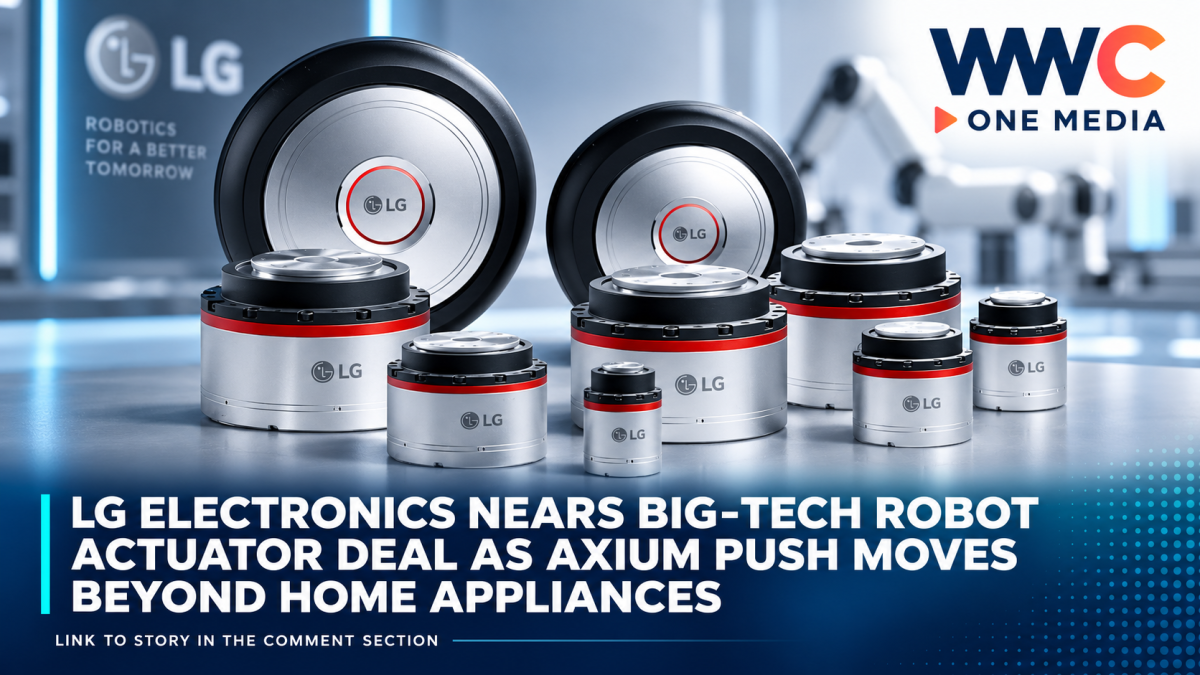
BERLIN — LG Electronics may be approaching one of the most important commercial breakthroughs in its expanding robotics business, with the Korean technology giant confirming that it is negotiating to supply robot actuators to several major global technology companies.
But the bigger story is not simply whether LG lands its first high-profile customer.
The company is attempting to turn decades of expertise building motors for washing machines, vacuum cleaners and other appliances into a potentially lucrative position inside the rapidly developing humanoid robot supply chain.
Speaking during IFA 2026 in Berlin, Baek Seung-tae, head of LG Electronics’ Home Appliance Solution business, said discussions are underway with several major technology companies and that LG expects to hold a technical and production-readiness meeting with one prospective customer in October.
No supply agreement has been finalized, however — an important distinction as speculation grows around who LG’s potential customers could be.
LG’s appliance technology is becoming robot technology
At the center of the strategy is LG Actuator AXIUM, the company’s newly developed family of robot actuators.
Actuators effectively serve as the muscles and joints of a robot. They typically combine an electric motor, control electronics and a reduction mechanism that converts the motor’s movement into the precise torque required to move an arm, leg or other robotic joint.
LG formally introduced the AXIUM brand at CES 2026, arguing that decades of motor-development experience could give the company an advantage in efficiency, weight, torque and manufacturing scale.
Baek said LG has spent roughly 60 years developing motors, including high-speed motors capable of exceeding 100,000 revolutions per minute. He told reporters that the technology allows LG to build motors that can be substantially lighter and smaller than competing designs while maintaining cost competitiveness.
That manufacturing heritage is what LG hopes will separate it from the growing number of companies chasing the humanoid robotics boom.
The October meeting could be an important test
Yonhap reported that LG is already holding discussions with multiple global big-tech companies and has scheduled an October meeting with one company to review technical specifications and production preparedness.
Baek stopped short of announcing a customer, saying no deal had been finalized.
However, his comments suggest AXIUM has moved beyond the demonstration phase and into serious commercial negotiations.
LG is also increasing production capacity at its Changwon manufacturing complex in South Gyeongsang Province.
Initial quantities of AXIUM actuators are already being produced there, according to Yonhap, while LG plans to establish a more fully automated mass-production system as it prepares for larger external orders.
That distinction matters: making prototype or initial-production actuators is one challenge; producing thousands or eventually millions of highly reliable robotic joints at competitive prices is another.
And mass manufacturing is an area where LG believes its appliance business gives it an unusual advantage.
Robot joints could become an enormous component business
The financial opportunity is significant because actuators are among the most expensive pieces of a humanoid robot.
LG executives at IFA cited industry estimates suggesting actuators can account for roughly 60 to 70 percent of a robot’s material costs, although estimates across the industry vary depending on robot design and what components are included in the calculation.
E-Daily reported that a humanoid robot may use around 30 actuators, meaning even one successful robot platform could generate demand for large numbers of components.
Baek said LG believes its actuator business could grow within one or two years to a scale comparable with the company’s external compressor-component business.
That would mark a significant evolution for a company still best known globally for televisions, refrigerators, washing machines and air conditioners.
But LG still has a technology gap to close
There is one important qualification to LG’s confidence.
While the company has deep expertise in motors and control systems, Baek acknowledged that LG does not yet fully possess its own reducer technology.
Reducers — precision mechanical systems that translate high-speed motor rotation into controlled high-torque movement — are critical components of many advanced actuators.
LG is considering both internal development and sourcing the technology from outside suppliers.
That could become one of the most closely watched parts of LG’s robotics strategy.
Its motor technology may give the company a strong entry point, but successfully integrating motors, reducers, electronics and software into reliable mass-produced actuators will determine whether AXIUM can become a major global robotics platform rather than simply another component brand.
Nvidia partnership makes LG’s robot ambitions much bigger
LG’s actuator push is also connected to a much broader robotics strategy.
In August, LG and Nvidia announced plans to unveil a next-generation bipedal humanoid robot in the first quarter of 2027.
According to Yonhap, the planned machine is expected to use Nvidia’s Jetson Thor robotics computing platform and Isaac GR00T humanoid foundation model.
Different LG affiliates are expected to contribute key hardware: LG Electronics will provide actuators, LG Innotek sensors and LG Energy Solution batteries.
The arrangement gives LG something many prospective component suppliers do not have: an opportunity to develop and validate hardware inside a vertically connected robotics ecosystem.
LG Electronics has also established a dedicated Robotics Business Center reporting directly to CEO Lyu Jae-cheol, bringing together business development, sales, supply-chain operations and manufacturing as the company attempts to commercialize physical AI technologies.
The timing was notable. LG formed the organization in July, several months ahead of its regular annual restructuring — a sign of how urgently management is treating robotics.
Factories will likely come before living rooms
Despite the excitement surrounding humanoid robots capable of performing household chores, LG appears to be taking a more measured commercialization path.
Baek said humanoid robots are expected to be deployed at manufacturing facilities including LG’s Tennessee plant in the United States and its Changwon smart factory in Korea before widespread household deployment.
The strategy is straightforward: industrial environments offer repetitive tasks and controlled conditions where robots can accumulate operational experience before being entrusted with unpredictable jobs around people at home.
LG believes demand for so-called physical AI — artificial intelligence embodied in machines capable of interacting with the physical world — could accelerate sharply around 2030.
If that forecast is correct, getting AXIUM into commercial production now could allow LG to establish supplier relationships before humanoid production reaches much larger volumes.
B2B is becoming increasingly important to LG
Robotics also fits another major strategic shift underway inside LG Electronics: reducing reliance on conventional consumer-electronics sales and expanding recurring and business-to-business revenue.
LG reported that company-wide B2B operations accounted for about 36 percent of revenue in the second quarter of 2026, when consolidated quarterly revenue reached KRW 23.83 trillion.
Within its home appliance operation, LG is pushing further into built-in appliances and commercial laundry equipment.
The Korea Herald reported that LG’s builder-focused built-in appliance and commercial laundry businesses have each posted annual revenue growth above 40 percent during the past three years.
LG separately launched its expanded LG Professional commercial laundry lineup this year, targeting customers ranging from hotels and hospitals to nursing facilities and laundromats.
Robot actuators could become the next piece of that strategy — turning technology originally developed for LG’s own products into components sold to other companies.
Why the next few months matter
LG has the motor expertise.
It has factories.
It has a dedicated robotics organization.
It has a major partnership with Nvidia.
And it is already producing initial AXIUM components.
What LG does not yet have is the external big-tech contract that would validate its transformation from consumer-appliance giant into a serious supplier to the global humanoid robotics industry.
That is why the reported October customer meeting deserves attention.
If LG converts those discussions into a sizeable production contract, AXIUM could become one of the first tangible commercial payoffs from the company’s physical-AI push.
If negotiations stall, however, LG will still face the much harder task confronting almost every company betting on humanoid robotics: proving that impressive technology can be manufactured reliably, economically and at enormous scale.
WWC ONE MEDIA M.J.E




Leave a Reply