
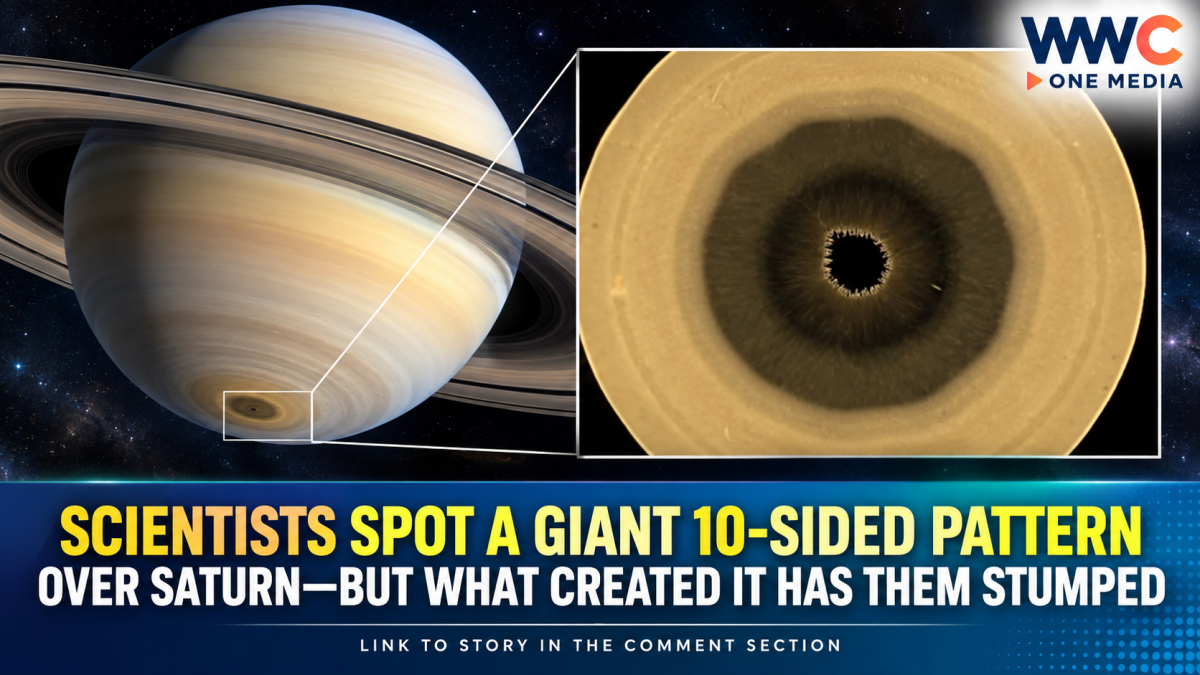
WASHINGTON — Saturn has stunned astronomers once again, this time with a gigantic 10-sided atmospheric wave swirling around its south pole—a newly identified phenomenon that could challenge what scientists thought they knew about the gas giant’s bizarre weather.
NASA’s Hubble Space Telescope has captured detailed observations of the feature, known as a decagon, revealing an enormous geometric pattern embedded in one of Saturn’s powerful jet streams. Unlike a physical object, the structure is made of moving gases and clouds in Saturn’s atmosphere.
NASA said the wave extends through multiple layers of the atmosphere, suggesting that the phenomenon is far more than a simple feature appearing at the visible cloud tops.
And there is an even bigger mystery: scientists are not yet sure why the decagon formed.
A giant atmospheric shape emerges
The discovery is particularly intriguing because Saturn has long been famous for another extraordinary geometric feature—the enormous six-sided jet stream at its north pole.
The northern hexagon was first spotted by NASA’s Voyager spacecraft in the early 1980s and has remained visible for more than four decades. NASA estimates that the northern feature spans roughly 20,000 miles (30,000 kilometers) and is associated with winds reaching around 200 mph.
For decades, researchers searched for a comparable polygonal structure at Saturn’s south pole but came up empty.
That changed when Saturn’s southern hemisphere gradually became easier to observe from Earth as the planet moved through its long seasonal cycle.
Researchers analyzing ground-based observations first noticed a subtle, undulating band around the south pole in 2024. Additional observations in 2025 strengthened the evidence that the feature was developing into a distinct 10-sided pattern.
Hubble then provided the high-resolution observations needed to confirm the structure and trace evidence of it back to 2023.
It may have formed surprisingly recently
One of the biggest surprises is that the decagon does not appear to have been around for decades.
NASA notes that observations from the Cassini spacecraft, which orbited Saturn from 2004 until 2017, showed no indication of a long-lived southern counterpart to the northern hexagon. Researchers therefore suspect the new feature may have developed sometime between 2017 and 2023, although its exact formation date remains uncertain.
That makes the phenomenon especially valuable scientifically.
Instead of studying a pattern that has already reached a stable state, astronomers may have caught Saturn’s atmosphere in the middle of creating a giant planetary-scale wave.
NASA scientist Amy Simon described the difference between the two polar structures as significant: while the northern hexagon has persisted for more than 40 years, the southern feature appears to be strengthening and evolving.
Bigger than Earth in scale
The dimensions of the feature are difficult to comprehend.
According to reporting on the research, a single side of the decagon stretches more than 10,000 miles (16,700 kilometers). Other measurements put the overall structure at more than 100,000 miles across, making it vastly larger than Earth.
But despite its enormous size, the decagon is not moving like a solid shape.
The structure is associated with a powerful eastward jet stream. AP reports that the decagon itself drifts eastward at only about 6 mph (10 km/h), while winds within the surrounding jet stream are dramatically faster.
That difference is crucial: the geometric shape is a pattern produced by atmospheric motion, not a gigantic stationary object hanging over Saturn’s pole.
Why does Saturn make geometric weather patterns?
This is where the mystery deepens.
Scientists have long believed that Saturn’s famous northern hexagon is connected to atmospheric waves trapped within a powerful jet stream. Earlier NASA research described the hexagon as potentially behaving like a stationary atmospheric wave embedded in a sharply defined eastward jet.
The newly discovered southern decagon appears to involve similar atmospheric dynamics, but researchers still do not know exactly what triggered its formation.
The research team investigated possible mechanisms, including the influence of nearby atmospheric disturbances, but no single explanation has yet reproduced the observed structure perfectly.
That leaves astronomers with a remarkable natural laboratory.
If scientists can watch the decagon evolve over the coming years, they may be able to determine how large-scale waves develop, strengthen and eventually disappear inside the atmospheres of gas giants.
Saturn may not be the only planet with strange polar weather
The discovery could also help researchers understand atmospheric behavior elsewhere in the solar system.
Jupiter, for example, has gigantic cyclones clustered around its poles. NASA’s Juno mission revealed remarkable arrangements of storms at Jupiter’s south pole, demonstrating that giant planets can produce atmospheric structures vastly different from anything seen on Earth.
Researchers are now interested in whether Saturn’s polygonal waves and Jupiter’s polar cyclones might share some underlying atmospheric physics.
But Saturn remains unique in one particularly striking way: it appears capable of producing atmospheric patterns with remarkably defined polygonal shapes.
The biggest question: How long will it last?
The northern hexagon has survived for more than 40 years—longer than a complete Saturnian year, which lasts about 29.5 Earth years.
Scientists do not yet know whether the southern decagon will enjoy anything close to that longevity.
For now, researchers can confirm that it remains present and appears to be changing.
More observations from Hubble, along with future observations from other powerful telescopes, could reveal whether the decagon stabilizes, transforms into another pattern or eventually disappears.
And that is what makes this discovery so exciting.
Astronomers are not simply looking at another strange picture of Saturn.
They may be watching a planetary-scale atmospheric phenomenon develop in real time—and whatever happens next could help explain why one of the solar system’s most mysterious planets keeps drawing geometric shapes in its clouds.
WWC ONE MEDIA J.M.S

Leave a Reply