
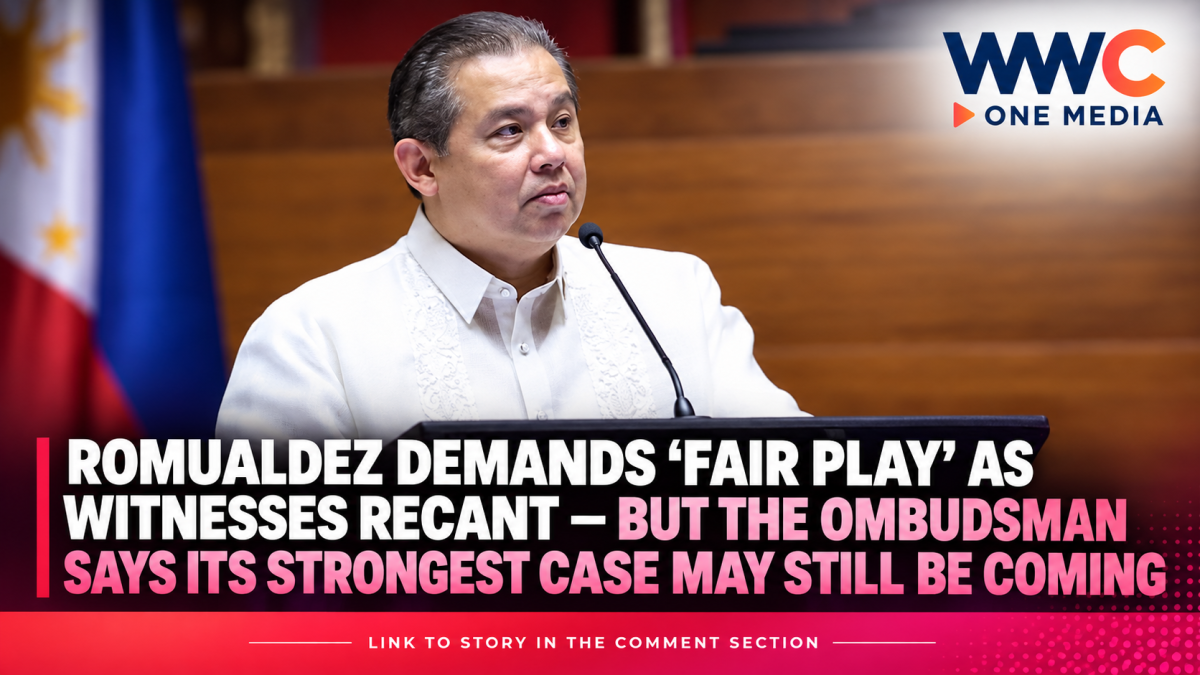
MANILA, Philippines — The legal battle surrounding former House Speaker Ferdinand Martin Romualdez is entering an increasingly contentious phase, with his camp renewing its demand for “fair play” as Ombudsman Jesus Crispin Remulla signals that cases connected to the massive flood-control controversy are moving closer to filing.
The appeal comes amid a rapidly changing investigation marked by witness recantations, conflicting accounts and the controversial emergence of former Public Works Secretary Manuel Bonoan as a potential government witness.
The Manila Standard reported Sunday that Romualdez’s camp again appealed to the Office of the Ombudsman to treat the Leyte congressman fairly as the anti-graft investigation moves forward.
Romualdez’s lawyers argue that the Ombudsman should decide the case solely on evidence formally presented and tested during the proceedings — not on public declarations that, according to the defense, could create the impression that the former Speaker has already been judged.
That accusation has now become one of the central battles surrounding the investigation.
Romualdez camp says Ombudsman may have ‘prejudged’ case
Romualdez lawyer and spokesperson Ade Fajardo has repeatedly challenged public statements from Ombudsman officials, particularly descriptions portraying the former Speaker as a central figure or “mastermind” in the alleged flood-control scheme.
Fajardo argues that such statements risk creating a perception of prejudgment while the complaints are still being evaluated.
GMA News reported that the defense believes the Ombudsman may have already reached a conclusion and is effectively searching for evidence to support it — an allegation that remains the position of Romualdez’s lawyers, not an established fact.
The Philippine Star separately reported Fajardo’s argument that using the “mastermind” label before the evidence has been fully evaluated could undermine the appearance of impartiality in the proceedings.
Romualdez has denied wrongdoing.
The controversy involves allegations of corruption surrounding government flood-control spending and alleged kickbacks. The former Speaker has been investigated in connection with possible plunder, graft, bribery and money-laundering offenses, but accusations remain subject to legal proceedings and the presumption of innocence.
Ombudsman isn’t backing down
The Ombudsman, however, has given no indication that the investigation is collapsing.
On Sept. 3, Remulla said cases connected with the alleged flood-control anomalies involving Romualdez were forthcoming despite the recantation of several potential witnesses.
“We’re not stopping, and we have not stopped,” Remulla told reporters, according to the Inquirer, while stressing that investigators were still assembling what he described as a strong case.
Remulla also characterized some of the recantations as a distraction from the broader evidence being gathered.
That creates a direct clash between the two sides.
Romualdez’s defense says the prosecution’s witness foundation is falling apart.
The Ombudsman says its investigation extends well beyond the witnesses who withdrew their statements.
Following the recantation of former security aide Orly Guteza, the Ombudsman said it still had 28 witnesses prepared to provide direct or material information relevant to the investigation.
The defense disputes the strength and credibility of the remaining evidence.
The ‘Maleta Boys’ problem
Much of the public controversy has centered on men who identified themselves as former security personnel of ex-Ako Bicol Rep. Zaldy Co.
Some had previously claimed they transported suitcases containing cash allegedly connected with the flood-control controversy.
Several later recanted.
Among them was Guteza, a retired Marine who withdrew his earlier account that he had delivered cash-filled suitcases to Romualdez’s residence.
Other former security personnel have also withdrawn or disputed earlier accusations.
Romualdez’s lawyers argue these reversals fundamentally weaken the accusations.
Fajardo previously said that dozens of former Co personnel had either withdrawn accusations or provided statements favorable to Romualdez, and the defense has submitted recantations as part of its counter-affidavits.
The Ombudsman sees the situation differently.
Its officials have publicly maintained that recantation is not unusual in major criminal investigations and that investigators can compare original statements, subsequent recantations and other evidence when determining which accounts are credible.
That means the recantations themselves do not automatically end the investigation.
Then came Manuel Bonoan
The most significant new complication may be former DPWH Secretary Manuel Bonoan.
The Sandiganbayan Fifth Division allowed Bonoan to be removed as an accused in plunder and graft cases involving approximately P573 million in alleged kickbacks from flood-control projects.
The move potentially clears the way for prosecutors to use him as a government witness in related cases.
Bonoan was subsequently ordered released from hospital detention and left the PNP General Hospital in Camp Crame on Sept. 4.
That immediately triggered another offensive from the Romualdez camp.
Fajardo described the development as “alarming, surprising and disturbing,” arguing that Bonoan had not previously implicated Romualdez during congressional inquiries, the Independent Commission for Infrastructure investigation or proceedings before Ombudsman investigators.
The defense is questioning how Bonoan could suddenly become a potentially important witness against Romualdez when, according to Fajardo, he had not earlier identified a specific project in which the former Speaker supposedly intervened.
Again, that is the defense’s contention.
The Ombudsman has a different explanation.
Why prosecutors want Bonoan
Assistant Ombudsman Mico Clavano said as early as June that investigators believed Bonoan could help build a stronger case involving Romualdez because of the former public works secretary’s knowledge of the alleged scheme.
Clavano said Bonoan had initially not been cooperative but was potentially valuable because of his alleged involvement in the transactions under investigation.
The Sandiganbayan later permitted prosecutors to remove Bonoan from the Fifth Division cases.
But his legal problems have not disappeared entirely.
Bonoan continues to face a separate graft case before another Sandiganbayan division, and he has entered a not guilty plea in that proceeding.
That distinction is crucial: Bonoan’s release from detention and removal from one set of cases do not amount to a blanket declaration that he is free of all criminal allegations.
Palace distances itself from the fight
Malacañang has sought to keep the executive branch outside the escalating dispute.
Palace Press Officer Claire Castro said Romualdez’s camp has the right to express concerns over how the investigation is being conducted, but maintained that due process and evidence should govern the proceedings.
The Palace has also stressed that the Office of the Ombudsman is independent and that the President cannot dictate decisions of the Sandiganbayan.
Regarding the court’s handling of Bonoan, Castro said the decision falls outside President Ferdinand Marcos Jr.’s authority because of the separation of powers.
Earlier, Malacañang had similarly said it would not interfere with the Ombudsman’s consideration of Bonoan as a potential state witness provided legal procedures were followed.
A case increasingly being fought in public
The dispute is therefore no longer simply about whether there is evidence linking Romualdez to alleged flood-control corruption.
It is also becoming a battle over how the investigation itself is being conducted.
Romualdez’s camp is arguing that public statements by Ombudsman officials, witness recantations and the attempt to turn Bonoan into a government witness raise serious questions about impartiality and evidentiary strength.
The Ombudsman says investigators still possess multiple witnesses and are deliberately taking their time because a case involving a former House Speaker must be strong enough to withstand aggressive legal challenges.
Remulla has made clear that he does not intend to rush a weak case into court.
That leaves one question hanging over the controversy:
What evidence does the Ombudsman have that has not yet been publicly revealed?
If investigators eventually file charges supported by independent documents, financial records or testimony that survives scrutiny, the witness recantations may prove less damaging than Romualdez’s defense believes.
But if the eventual case depends heavily on accounts that have repeatedly changed, the defense’s accusations of prejudgment and evidentiary weakness could become increasingly significant.
For now, neither side has won that argument.
The Ombudsman says the investigation is moving forward.
Romualdez’s camp says it welcomes a legitimate investigation — but insists that the former Speaker must receive the same fundamental guarantee demanded in every high-stakes prosecution:
a decision based on evidence, due process and fair play rather than public accusation.
And with Bonoan potentially entering the picture as a government witness, the most consequential phase of the flood-control investigation may still be ahead.
WWC ONE MEDIA M.J.E


Leave a Reply