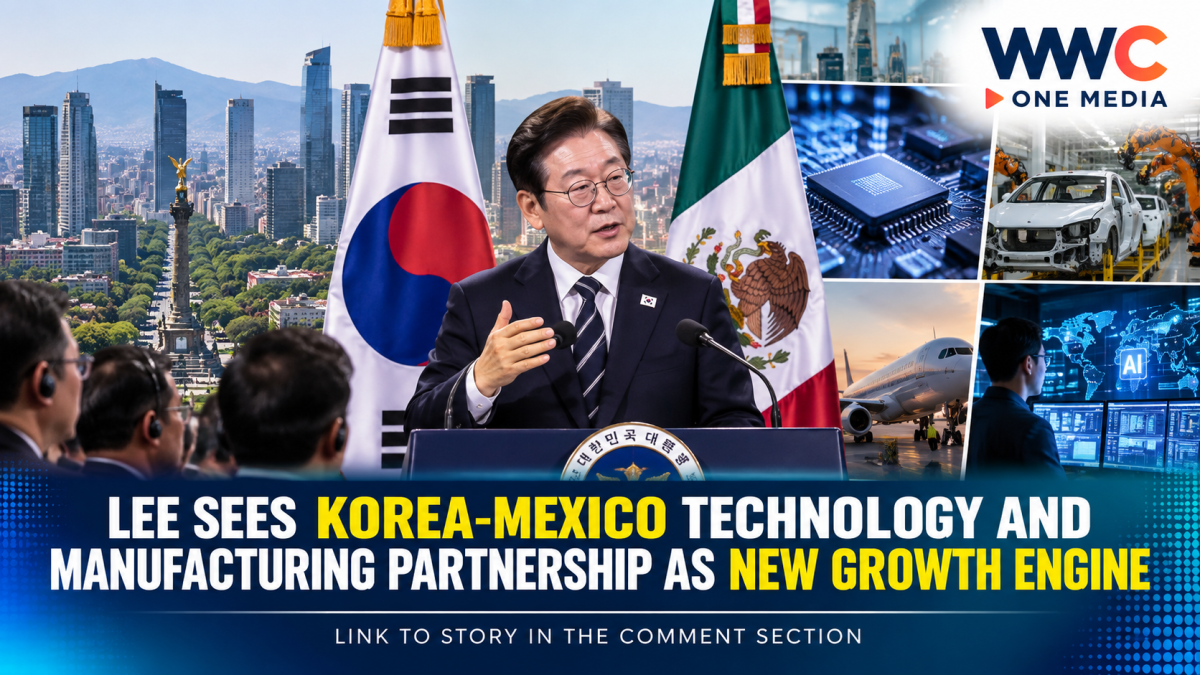
MEXICO CITY — South Korean President Lee Jae Myung is looking to deepen economic ties with Mexico by combining South Korea’s technological capabilities with Mexico’s manufacturing and industrial base, as Seoul seeks new sources of growth and stronger global supply chains.
Lee arrived in Mexico City on Wednesday for the first state visit by a South Korean president to Mexico in 16 years. He is scheduled to hold summit talks with Mexican President Claudia Sheinbaum on Thursday, with trade, investment, supply chains, energy, critical minerals, artificial intelligence and digital technology high on the agenda.
The visit comes as both countries explore ways to move their economic relationship beyond traditional trade and toward deeper industrial and technology cooperation.
Korea’s technology meets Mexico’s manufacturing base
Lee has highlighted the potential for South Korean technological strengths to work together with Mexico’s established industrial infrastructure.
Mexico is already an important production hub for international manufacturers and a gateway to the wider North American market. Seoul says roughly 560 South Korean companies operate in Mexico, while Yonhap describes Mexico as South Korea’s largest trading partner in Central and South America.
That existing corporate presence gives the two governments a foundation for expanding cooperation in advanced industries.
The agenda includes AI, digital technology, aerospace and industrial cooperation, alongside efforts to strengthen trade and investment and improve the environment for Korean companies operating in Mexico.
Critical minerals and supply chains move higher on the agenda
Supply-chain security is another major focus of the visit.
Lee and Sheinbaum are expected to discuss cooperation in energy and critical minerals, resources that are increasingly important for advanced manufacturing, electronics and other technology industries.
The Korean government has also emphasized the need to build more resilient supply chains as companies navigate geopolitical and trade-related risks.
The two countries are therefore looking at cooperation that could connect Mexico’s industrial and geographic advantages with Korean companies’ technology, manufacturing expertise and global supply networks.
Mexico offers access to North America
Mexico’s location gives the partnership another strategic dimension.
South Korean officials have described Mexico as a key gateway for Korean businesses seeking to expand into the North American market. The country’s established manufacturing networks are particularly relevant to Korean companies already operating in sectors such as automobiles, electronics and industrial production.
Reuters reported ahead of Lee’s visit that Seoul was seeking stronger cooperation with Mexico in areas including trade, energy, aerospace and culture, while also exploring opportunities linked to Mexico’s modernization of its industries.
Mexican media also reported that the countries are preparing a broader 2026–2030 bilateral action plan, with areas including innovation, artificial intelligence, digital governance and aerospace among the proposed priorities.
AI emerges as a central area of cooperation
Artificial intelligence is becoming one of the most prominent themes in South Korea’s international economic strategy.
Lee has promoted Seoul’s AI policies during his overseas trip, including at the Korea Investment Summit in New York before traveling to Mexico. His administration is seeking to position South Korea as a technology and investment hub while encouraging greater international cooperation in advanced industries.
For Mexico, closer ties with Korean technology companies could support industrial modernization, while Korean companies could gain from Mexico’s manufacturing ecosystem and access to regional supply chains.
The potential relationship therefore extends beyond simple imports and exports.
A broader economic partnership
The Mexico visit is also expected to produce agreements covering several areas of bilateral cooperation.
Lee and Sheinbaum are scheduled to oversee an exchange of memorandums and make a joint announcement following their summit. Lee will also attend a business forum in Mexico City and visit a K-Expo event during the three-day state visit.
South Korea and Mexico established their strategic partnership in 2005, and Seoul has described the current visit as an opportunity to open a new phase in bilateral relations.
The challenge now is turning the growing list of cooperation areas into concrete investments, technology partnerships and supply-chain projects.
For Lee, the Mexico visit represents an effort to connect South Korea’s technology and industrial expertise with Mexico’s manufacturing capacity and geographic position — a combination Seoul sees as capable of creating new opportunities for both economies.
If agreements reached during the visit translate into actual projects, the relationship could increasingly center on technology, manufacturing and supply-chain integration rather than traditional trade alone.
WWC ONE MEDIA G,A