
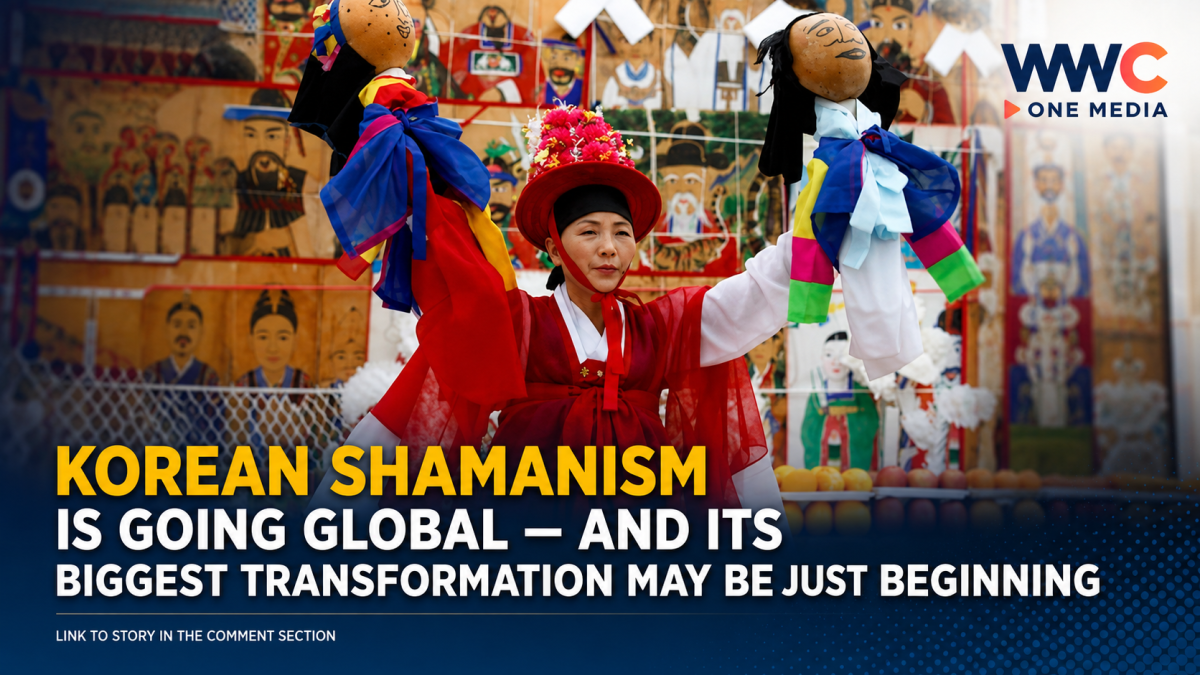
For generations, Korean shamanism existed largely outside the global spotlight. Today, that is changing rapidly.
Known in Korea as musok, the tradition is reaching international audiences through films, streaming platforms, social media and practitioners working outside the country. At the center of one remarkable story is Andrea Kalff, a German woman who became the first European initiated as a Korean shaman after studying under the late master Kim Keum-hwa.
But Kalff’s story is only one part of a much larger transformation: Korean shamanism is no longer being encountered solely as an unfamiliar spiritual tradition. Increasingly, it is appearing as a recognizable element of global Korean culture.
From Germany to Korea: Andrea Kalff’s extraordinary journey
According to The Korea Times, Kalff was raised in a Catholic family in Bavaria and had little previous familiarity with Korean shamanism.
Her path changed after she attended an international shamanic gathering in Mondsee, Austria, where she met Kim Keum-hwa, one of Korea’s most renowned shamans.
Kalff has described experiencing health problems and other personal difficulties before meeting Kim. In her account, Kim interpreted those experiences through the Korean shamanic concept of sinbyeong, sometimes described as a form of “spirit sickness” associated within the tradition with people destined to become shamans.
Kalff later traveled to Korea with her husband in December 2006 and underwent 11 days of preparation, prayer, testing and initiation known as Naerim Gut.
The Korea Times reported that, 19 days after the ceremony, Kalff was advised to see a doctor and was subsequently told that a tumor had grown and required surgery. The surgery was successful.
These events are part of Kalff’s personal account and should not be interpreted as medical evidence that a shamanic ritual caused or cured an illness.
Her apprenticeship, however, continued. She has since lived primarily in Germany and Hawaii while repeatedly returning to Korea for ceremonies and further training.
A tradition crossing borders
Kalff’s experience is significant because Korean shamanism has been spreading beyond Korea for decades, particularly through Korean diaspora communities.
Academic research published on overseas Korean shamanism has documented the development of New York Musok, including lineages involving Korean American practitioners and shamans working with clients from different cultural backgrounds.
Researcher Liora Sarfati has likewise examined Korean shamans operating within an increasingly global spiritual marketplace. Her research found that some practitioners serve non-Korean clients and adapt their explanations and practices to international audiences while maintaining connections to Korean ritual traditions.
This suggests that the globalization of Korean shamanism did not begin with Netflix or K-pop. Popular culture has accelerated a process that was already underway.
Then came the K-content boom
The newest wave is being driven by Korea’s extraordinary cultural reach.
The 2024 Korean film “Exhuma” brought shamanic rituals, feng shui and Korean spiritual traditions to mass audiences. The movie became a major box-office success in South Korea, surpassing 10 million admissions.
Then came “KPop Demon Hunters,” whose fantasy world draws on Korean cultural imagery and spiritual traditions.
The film helped introduce international viewers to concepts and imagery associated with Korean folklore, spirits and shamanic traditions. The Korea Tourism Organization specifically highlighted how the movie introduced overseas audiences to a distinctly Korean supernatural aesthetic.
The USC U.S.-China Institute also held a 2026 seminar examining the relationship between Korean shamanism and KPop Demon Hunters, reflecting growing academic and cultural interest in the subject.
The result is a striking cultural feedback loop: Korean traditions inspire entertainment, entertainment generates international curiosity, and that curiosity sends audiences back toward the traditions themselves.
Social media is changing the mudang’s audience
The transformation isn’t happening only on movie screens.
Reuters reported in 2024 that younger Korean shamans were using social media platforms such as YouTube to connect with new audiences. The trend showed how an ancient practice was adapting to a highly digital society.
For younger audiences, encounters with mudang can now begin online rather than through family networks or traditional community relationships.
That doesn’t necessarily mean the tradition itself has become digital.
Rather, technology has become another doorway into it.
And that distinction matters.
AI enters the picture
The newest question may be even more complicated.
AI-powered fortune-telling and online spiritual services are increasingly becoming part of the modern landscape surrounding Korean spirituality.
But Kalff argues that technology cannot reproduce the human relationship at the center of a traditional gut ritual.
Her point highlights a larger tension facing musok: technology can distribute information, generate interpretations and connect people across borders, but traditional rituals involve people, relationships, performance, community and lived experience.
In other words, the internet may help people discover Korean shamanism. It does not necessarily reproduce what happens inside the tradition itself.
Why the world is suddenly paying attention
There are several reasons Korean shamanism is resonating internationally.
First is the enormous reach of the Korean Wave.
K-pop, Korean films, dramas and online content have created an audience already interested in Korean culture. Once viewers encounter elements such as mudang, gut rituals, spirits and traditional symbolism in entertainment, some naturally become curious about their origins.
Second is the visual and performance-based character of musok.
Traditional rituals can incorporate music, dance, costumes, percussion, prayer, symbolism and dramatic movement. Those elements translate particularly well to film, television and digital media.
Third is the growing international interest in spiritual traditions outside conventional religious institutions.
That does not mean everyone consuming K-shamanism-themed entertainment is becoming a believer. Much of the interest remains cultural, artistic or entertainment-driven.
Researchers have emphasized that globalization can also transform the tradition itself, as practitioners reinterpret Korean shamanism for audiences with different cultural backgrounds.
The tradition behind the trend
Despite its new global visibility, Korean shamanism is not simply a new K-pop trend.
It is a longstanding Korean folk tradition involving mudang who serve as intermediaries between humans and the spiritual world. Ritual practices vary, and Korean shamanism has evolved over time alongside other religious and cultural traditions.
Kim Keum-hwa played an important role in bringing international attention to Korean shamanic traditions. Beginning in the 1980s, she participated in festivals, conferences and cultural events in numerous countries.
Her international work helped establish a bridge between Korean shamanism and audiences who might otherwise never have encountered it.
Her influence also extended through students such as Kalff.
From ancient ritual to global culture
Perhaps the most interesting part of this story is not whether Korean shamanism is becoming “mainstream.”
It is how an ancient tradition is being translated across cultures.
A person in Europe can discover musok through a practitioner. A viewer in North America can encounter Korean spiritual imagery through a film. A fan elsewhere in the world can become curious about Korean folklore after watching a streaming series.
And a younger Korean audience can encounter its own traditional culture through social media or entertainment.
That is a very different pathway from the traditional transmission of religious knowledge.
The Korea Times report describes Kalff’s work as an attempt to create dialogue between Korean ritual practice and contemporary fields including psychology, psychiatry, anthropology and medicine. She has also emphasized the responsibility of representing the tradition without reducing it to stereotypes.
That may ultimately be the biggest challenge facing K-shamanism’s global rise.
As Korean shamanism reaches audiences far beyond Korea, will international curiosity lead people toward a deeper understanding of musok — or will the tradition increasingly be defined by the entertainment that made the world notice it in the first place.




Leave a Reply