
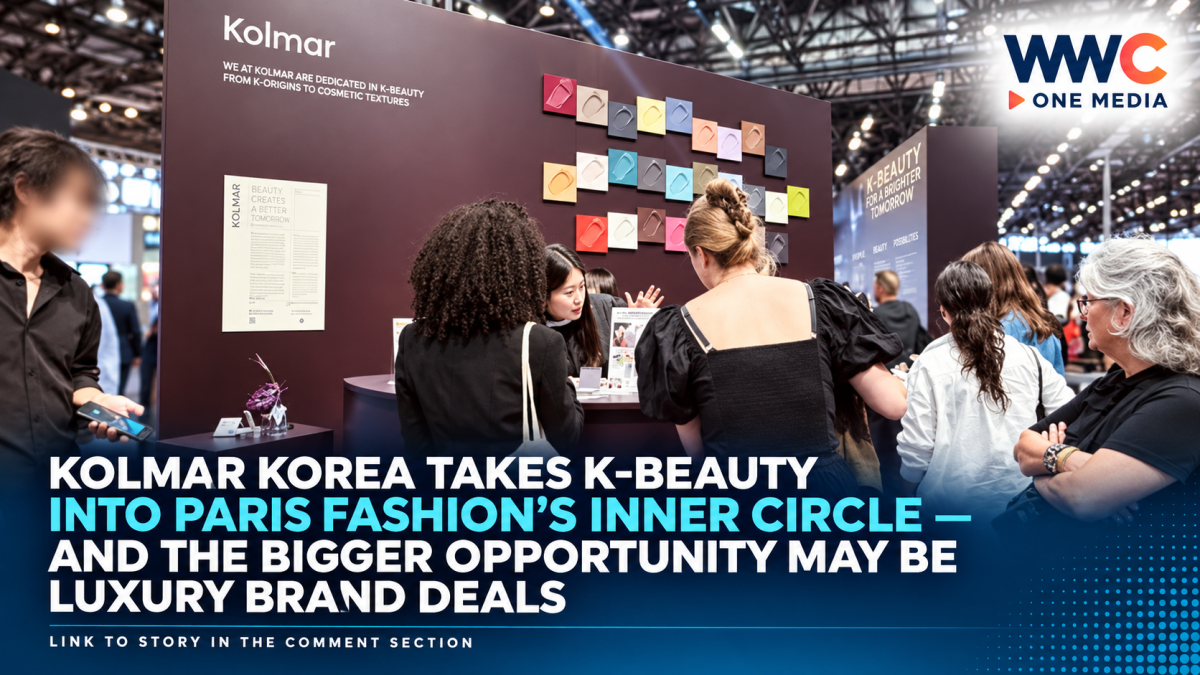
Kolmar Korea has made its debut at Première Vision Paris, one of the world’s most influential fashion sourcing events, becoming what the company describes as the first Korean cosmetics manufacturer invited to the show.
The appearance matters for more than prestige.
Première Vision is increasingly encouraging fashion companies to expand beyond clothes and accessories into beauty, fragrance, skincare and wellness — sectors that can turn a fashion label into a much broader lifestyle business. Kolmar’s arrival puts one of South Korea’s largest cosmetics manufacturers directly in front of the designers, sourcing teams and luxury groups looking for exactly that kind of expansion.
And the timing could hardly be better.
South Korea’s beauty exports are already breaking records.
Kolmar Brought 27 Colors Built Around Fashion’s Next Season
At the Paris event, held from September 1 to 3, Kolmar Korea showcased 27 colors inspired by Première Vision’s fall-winter 2027-28 trend direction, together with color cosmetics, textures and product-development technologies.
Visitors from international fashion and luxury companies were able to create their own color combinations and test Kolmar lip products, according to both Korea Herald and Korea Times.
That hands-on approach highlights what Kolmar is really selling.
It is not simply finished lipstick or makeup.
Kolmar is primarily an ODM — original development manufacturer — meaning it helps beauty companies develop products from concept and formulation through R&D and manufacturing.
Première Vision describes the Korean company as a partner capable of supporting brands from trend analysis and product planning through finished-product manufacturing. The event organizer says Kolmar works with more than 4,800 beauty brands and operates through a manufacturing network spanning South Korea, North America and China.
That makes its Paris appearance potentially much more commercially significant than a conventional product showcase.
Every fashion company exploring a cosmetics line is a possible customer.
Why a Fashion Fair Suddenly Wants Cosmetics
Première Vision Paris has traditionally been associated with the materials behind fashion — fabrics, yarns, leather, accessories, manufacturing and design.
The September edition still featured more than 900 exhibitors across eight industry sectors, but organizers added beauty as part of a deliberate expansion of the event.
Première Vision says the show reaches around 20,000 professionals representing 130 nationalities, making it an unusually concentrated meeting point for global fashion buyers, designers and suppliers.
This year also marked the launch of a dedicated Cosmetic Village, developed with France’s Cosmetic Valley industry cluster.
The logic behind the initiative is straightforward: fashion houses increasingly want to sell more than clothing.
Beauty products allow brands to extend their identity into lipstick, fragrance, skincare and wellness products — categories that can reach consumers who may never purchase an expensive handbag or designer dress.
Première Vision explicitly describes beauty as a way for fashion companies to strengthen brand identity, create new consumer experiences and develop additional sources of growth.
That is precisely where companies such as Kolmar can enter the equation.
Kolmar Was Positioned Beyond the Cosmetic Village
There is another detail that makes Kolmar’s presence noteworthy.
Korea Times reported that Kolmar did not simply occupy a stand inside the newly created Cosmetic Village. Instead, the company was given its own space in the show’s Prospective Area, where Première Vision highlights future-facing materials, concepts and seasonal trends.
Première Vision’s own website also listed Kolmar as a featured beauty participant in the Prospective Area.
The distinction reinforces how the company wanted to position itself: not just as another contract manufacturer, but as a partner in trend development, color research and product creation.
A major part of that pitch is Chroma Kolmar Studio, the company’s proprietary color-development platform.
Kolmar says the system allows clients to fine-tune pigments and shades during product development, helping brands create customized cosmetics for different markets and skin tones. Its sustainability reporting says the studio was established in 2024 as an offline color-development center using smart color-matching technology.
For global fashion houses, that capability could be especially attractive.
A fashion brand already works with seasonal color palettes.
Kolmar’s proposition is essentially to turn those same colors into cosmetics.
K-Beauty’s Export Boom Makes the Paris Debut More Important
Kolmar’s European push is happening while South Korea’s cosmetics industry is expanding rapidly overseas.
South Korea exported about $7 billion worth of cosmetics during the first half of 2026, the highest first-half figure on record, according to the Ministry of Food and Drug Safety.
The momentum accelerated further in August.
Government trade data show Korean cosmetics exports reached approximately $1.31 billion during the month, up 52.1% from a year earlier, setting a record for August.
That growth follows an already historic 2025.
South Korea exported $11.4 billion of cosmetics last year, up 11.8% from 2024, according to the country’s food and drug regulator. The government says that performance made Korea the world’s second-largest cosmetics exporter, moving ahead of the United States.
The United States was Korea’s largest individual cosmetics export market in 2025 at about $2.2 billion, followed by China at roughly $2 billion and Japan at around $1.1 billion.
Those figures show why K-beauty companies are no longer simply trying to export more Korean brands.
They are increasingly selling Korea’s technology, formulations and manufacturing infrastructure to foreign companies as well.
The Bigger Opportunity May Be Behind the Brands
That distinction is crucial for understanding Kolmar’s strategy.
Consumers may know the name printed on a cosmetics package.
They usually do not know the manufacturer that developed what is inside it.
ODM companies such as Kolmar operate behind the scenes, providing research, formulation, color development and manufacturing for multiple brands.
And as global fashion houses push more aggressively into beauty, that behind-the-scenes position could become even more valuable.
A luxury company does not necessarily need to build its own cosmetics laboratory and factory.
It can outsource much of that process to an established manufacturer.
Première Vision’s new beauty initiative is effectively creating a meeting place where those two sides can find each other.
Paris Could Be More Than a Showcase
Kolmar described the exhibition as an opportunity to introduce its color-cosmetics technology and development capabilities to global customers.
But the strategic opportunity is larger.
Fashion and beauty are converging.
Korean cosmetics exports are reaching record levels.
And K-beauty manufacturers are becoming increasingly important not only as sellers of Korean products, but as technology and production partners for international brands.
For Kolmar Korea, appearing at one of Paris fashion’s major sourcing events therefore may not simply be about demonstrating 27 new shades.
It could be about convincing the companies setting tomorrow’s global fashion trends to let a Korean manufacturer create the beauty products that go with them.
And if that happens, the next phase of the K-beauty boom may carry European fashion labels on the package — while Korean technology remains behind what is inside.
WWC ONE MEDIA M.J.E




Leave a Reply