
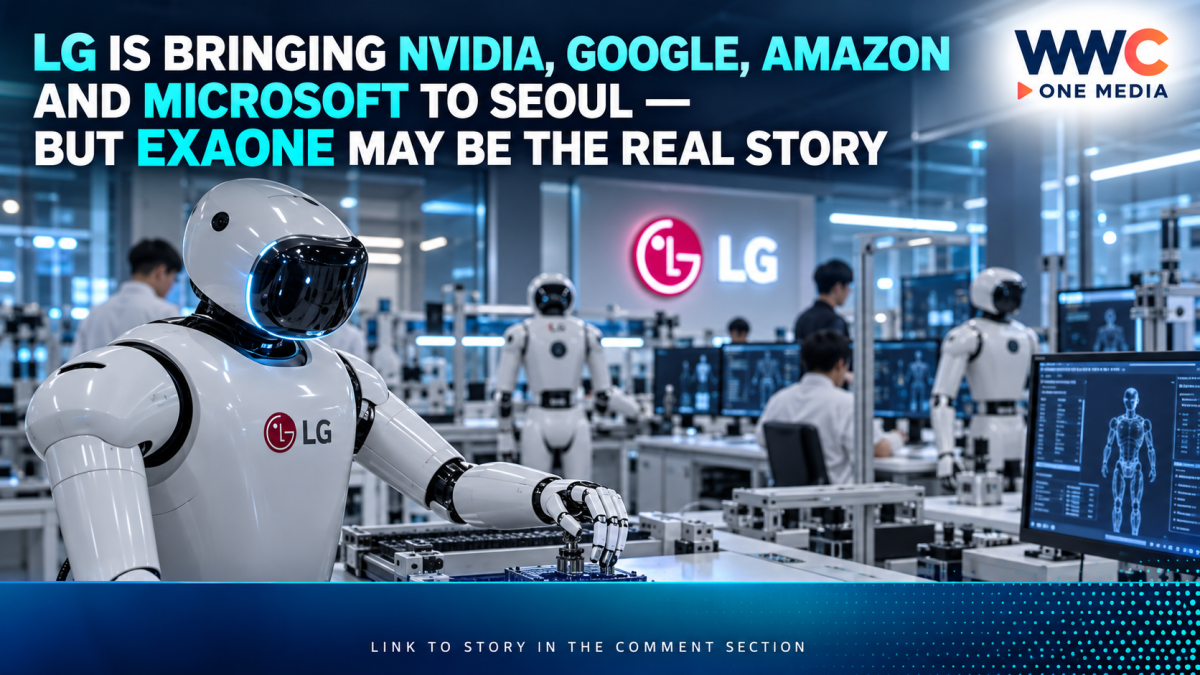
South Korea’s LG Group is turning its biggest annual technology gathering into something much more ambitious: a showcase of how artificial intelligence could reshape everything from household robots and factories to data centers, cars and corporate work.
LG SPARK 2026, scheduled for Sept. 7 to Sept. 17 at LG Sciencepark in Magok, western Seoul, will bring together LG researchers and executives with developers and representatives from some of the world’s largest technology companies, including Nvidia, Google, Amazon and Microsoft.
But the biggest story may not be the guest list.
Behind the festival is a much broader effort by LG to turn its proprietary EXAONE artificial intelligence technology into a platform that can operate across industrial AI, robotics, enterprise software and potentially much of the group’s sprawling business empire.
And that strategy is becoming increasingly visible.
LG Spark Is Becoming an AI Event
LG SPARK traces its roots to technology-sharing events held after LG Sciencepark opened in 2018. Those programs were consolidated under the SPARK name in 2023, combining technology, science, culture and the arts.
The event has since become LG’s largest annual gathering, attracting approximately 60,000 participants in 2025, according to LG. This year’s edition has been reorganized much more explicitly around AI transformation, or AX.
Five major programs will run across the festival:
- LG Tech Fair — Sept. 7–8
- LG AX Fair — Sept. 10–11
- LG AI Talk Concert — Sept. 14–15
- LG AI DevCon — Sept. 15–16
- Culture Week — Sept. 15–17
Together, they effectively turn LG Sciencepark into an 11-day demonstration of how the conglomerate wants AI to move from research labs into products and actual business operations.
41 Technologies — With Physical AI Taking Center Stage
The opening LG Tech Fair will showcase 41 research and development technologies from LG affiliates.
Thirteen will fall under a new “One LG” category organized around three strategic areas: physical AI, AI data centers and mobility. Another 28 will involve future-growth fields including artificial intelligence, biotechnology and clean technology.
One of the most visually striking demonstrations will involve LG’s CLOiD home robot interacting with AI-enabled appliances.
LG says the system can coordinate tasks such as cleaning, managing indoor air quality and transporting household items — an example of physical AI moving beyond software and into machines capable of interacting with real environments.
That demonstration is particularly important because LG’s robotics ambitions are already extending well beyond a technology fair.
Nvidia and LG Are Already Building Something Much Bigger
In June, Nvidia disclosed that it and LG Group were working together on what the companies describe as an AI factory designed to support robotics, autonomous driving, data centers and GPU cloud services.
According to Nvidia, the infrastructure is intended to let LG train, simulate, validate and deploy AI applications using accelerated computing.
The collaboration extends into robotics simulation, factory digital twins, autonomous manufacturing and mobility systems.
LG Electronics is also exploring Nvidia’s Isaac robotics technologies and GR00T models for its robotics development, while other LG companies are participating in areas ranging from sensing components to AI data-center infrastructure.
That makes Nvidia’s appearance at LG SPARK more meaningful than an ordinary conference partnership.
The two companies already have substantial strategic work underway.
Then Come 68 Examples of AI Doing Actual Work
The LG AX Fair on Sept. 10–11 may provide an even clearer picture of what LG means when it talks about AI transformation.
LG companies will present 68 cases involving AI already being applied across development, marketing, sales, manufacturing, quality management, strategy and planning.
Among the examples:
LG Electronics will present AI designed to flag potential compliance problems in marketing content.
LG Innotek will demonstrate vision AI capable of identifying workplace safety and environmental risks.
LG Chem will show an AI agent designed to assist with planning and evaluating R&D projects.
And LG Uplus will demonstrate technology aimed at reducing or optimizing the token costs involved in operating AI models.
Combined with the 41 R&D technologies at the Tech Fair, that means LG is putting 109 technology demonstrations and AI-transformation use cases on display across those two programs alone.
But EXAONE Could Be the Bigger Reveal
The most strategically important sessions may arrive on Sept. 14 and 15.
LG’s AI Talk Concert will focus on EXAONE, the company’s proprietary AI model family, including examples of how it is already being deployed in different industries and — importantly — LG’s future AI development roadmap.
That comes at a significant moment for LG’s AI ambitions.
On July 31, LG AI Research released K-EXAONE 2.0, a 750-billion-parameter foundation model developed as part of South Korea’s sovereign AI initiative.
LG AI Research says the model is more than three times the size of its earlier 236-billion-parameter version and has been released under an Apache 2.0 license, allowing broad commercial use.
LG reported an average score of 70.1 across 24 benchmarks, compared with 63.3 for the previous version. Those are LG’s published benchmark results and should therefore be understood as company-reported performance rather than independent validation.
LG has also been expanding EXAONE beyond conventional language models.
In August, the company announced specialized models called EXAONE Tabular and EXAONE Forecast, aimed at working with structured data and predicting future data patterns for applications including manufacturing, finance and other industries. LG says both achieved leading results on selected international benchmarks.
That industrial specialization is one reason the coming EXAONE presentation matters.
Nvidia, Google, Amazon and Microsoft Join the Developer Event
The LG AI DevCon on Sept. 15–16 will bring developers from Nvidia, Google, Amazon and Microsoft together with LG engineers to discuss AI technologies, trends and development practices.
LG has expanded what had previously been its Software Developer Conference into an AI-focused DevCon, reflecting the group’s shift toward AI development across multiple businesses.
LG will also run its Promptathon Challenge 2026.
Ten finalist teams will use EXAONE and prompt engineering to develop AI services addressing real problems involving LG products, services and workplace processes.
The company says it will consider turning the strongest projects into actual commercial or internal services.
That’s an important distinction.
LG is not presenting the competition purely as a coding exercise; it is looking for projects that could potentially make the jump from prototype to deployment.
AI Data Centers Are Becoming Another Major LG Bet
The second major theme running through LG SPARK is AI infrastructure.
Among the technologies being presented are semiconductor hybrid-bonding equipment and heat-dissipating adhesive materials designed for high-performance computing and AI semiconductor applications.
That aligns with the wider Nvidia-LG partnership.
Nvidia said in June that LG Electronics, LG Energy Solution, LG Uplus and LG CNS are pursuing projects involving AI-factory cooling, energy systems, accelerated computing and large-scale AI data centers.
LG Electronics has since received Nvidia validation for a 600-kilowatt coolant distribution unit, part of its push into the rapidly expanding market for liquid cooling systems required by powerful AI servers.
So the data-center technology appearing at SPARK is not merely experimental research.
It connects directly to businesses LG is already trying to commercialize.
The Bigger Picture: LG Wants AI Across the Entire Group
What makes LG’s strategy unusual is the breadth of businesses it can connect.
The group operates in electronics, batteries, chemicals, telecommunications, automotive components, IT services and advanced materials.
Its developing AI ecosystem therefore stretches across several layers at once:
EXAONE provides AI models.
LG Electronics and LG CNS provide robotics and enterprise technology.
LG Uplus contributes telecommunications and data-center infrastructure.
LG Energy Solution contributes energy technology.
LG Innotek supplies sensing and automotive components.
And Nvidia supplies much of the accelerated computing and software infrastructure underneath the effort.
That could allow LG to pursue something more difficult than simply building another chatbot.
It can attempt to embed AI into physical products, industrial processes and infrastructure businesses that already operate at massive scale.
LG Sciencepark Is the Laboratory Behind the Push
That strategy is concentrated at LG Sciencepark.
The Magok research complex covers around 170,000 square meters of land, roughly equivalent to 24 football fields, and hosts R&D operations from LG Electronics, LG Display, LG Innotek, LG Chem, LG Energy Solution, LG Household & Health Care and LG Uplus.
Around 25,000 employees, partners and startup workers are based there, according to LG.
That concentration of researchers helps explain why LG is positioning SPARK as more than a conventional corporate exhibition.
It is effectively becoming a public window into technologies the group hopes can eventually move across its entire industrial ecosystem.
And That Is Why EXAONE Matters
Nvidia, Google, Amazon and Microsoft will generate the international headlines when LG SPARK opens.
The robots will probably produce the best photographs.
And the 109 technologies and business-AI examples will demonstrate just how aggressively LG is pushing automation throughout its operations.
But the question that may matter most comes later:
Can LG turn EXAONE from a powerful Korean AI model into the intelligence layer connecting its factories, robots, vehicles, appliances and data centers?
SPARK 2026 may offer the clearest answer yet.
Because LG is no longer simply trying to prove that it can build artificial intelligence.
It is trying to prove that it can build an entire business ecosystem around it.
WWC ONE MEDIA M.J.E

Leave a Reply