
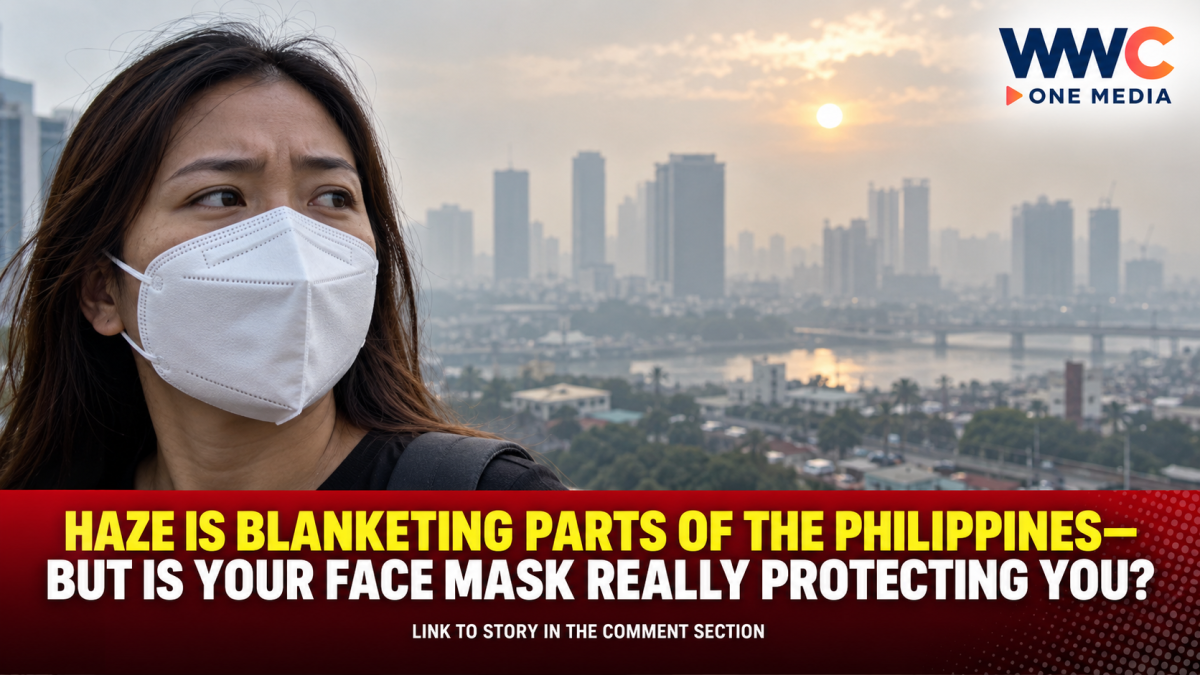
What looks like ordinary mist or smoke in the air could be carrying particles small enough to penetrate deep into the lungs—and health authorities are urging Filipinos to take the haze seriously.
Parts of the Philippines have recently experienced transboundary haze linked to wildfires in Kalimantan, Indonesia, with prevailing winds carrying smoke and fine particles toward parts of Luzon and the Visayas.
The haze has raised concerns over respiratory health, particularly as some areas have recorded unhealthy to acutely unhealthy levels of PM2.5, or fine particulate matter measuring 2.5 micrometers or smaller.
What exactly is haze?
Haze is a mixture of fine particles and pollutants suspended in the atmosphere. In the current situation, authorities have linked the haze affecting parts of the Philippines to smoke from forest and land fires in Indonesia.
One of the biggest concerns is PM2.5.
These particles are extremely small—far smaller than ordinary dust—and can travel deep into the respiratory system. GMA News reported that PM2.5 can reach the lungs and potentially enter the bloodstream.
The World Health Organization likewise says wildfire smoke contains particulate matter and other pollutants that can cause a sudden deterioration in air quality and affect communities far from the original fires.
What can haze do to your health?
For some people, exposure may initially feel like nothing more than an irritation.
But increasing exposure to polluted air can trigger:
- Coughing
- Throat and nasal irritation
- Watery or irritated eyes
- Wheezing
- Shortness of breath
- Chest discomfort or pain
- Asthma attacks or worsening asthma
- Other respiratory problems
The WHO says wildfire-smoke exposure can cause respiratory-tract and eye irritation, wheezing, shortness of breath and chest pain. More serious cardiovascular effects have also been associated with exposure to particle pollution.
The people who need to be especially careful include children, older adults, pregnant women, and people with existing heart or lung conditions, including asthma and chronic respiratory disease.
So, will your ordinary face mask protect you?
This is where many people may be getting confused.
A regular cloth or surgical-type face mask is not designed to provide the same protection against fine particles as a properly fitted respirator.
The DOH has urged people who need to go outdoors amid poor air quality to use an N95 mask or equivalent respirator. GMA’s interview with DOH’s Dr. Gabriel Borlongan also reported that if an N95 or another respirator is unavailable, ordinary face masks may be used as a fallback, with double masking advised in that specific guidance.
However, international guidance makes an important distinction.
The WHO says ordinary face coverings are not considered effective personal protective equipment against air pollution and recommends respirators for certain high-pollution situations.
CDC/NIOSH guidance similarly says cloth masks, surgical masks, bandanas and similar coverings are not designed to seal against the face or filter very small smoke particles. Properly fitted N95 or P100 respirators can provide substantially better protection against particulate matter.
In other words: a regular mask is better viewed as a backup—not a substitute for a properly fitted respirator when fine-particle pollution is high.
Why the fit of an N95 matters
Simply putting an N95 over your nose and mouth does not automatically provide maximum protection.
A respirator works best when it forms a good seal around the face. Gaps around the nose, cheeks or chin can allow polluted air to enter without passing through the filter.
CDC/NIOSH advises selecting a properly fitting respirator, positioning its straps correctly and performing a user seal check when putting it on.
And there is another important limitation: N95 respirators filter particles, but they do not remove all gases or vapors from wildfire smoke. That is why reducing exposure remains the primary protection.
The best protection may be staying indoors
When air quality deteriorates, health authorities are not simply telling people to put on a mask and continue their normal outdoor activities.
The stronger recommendation is to reduce exposure in the first place.
The DOH has advised the public to avoid or limit unnecessary outdoor activities, particularly in areas affected by haze. It has also advised people to monitor air quality and protect indoor spaces from polluted outdoor air.
The WHO likewise recommends reducing outdoor activity during heavy smoke conditions, protecting indoor air and seeking cleaner-air spaces when necessary.
The haze is not just a Metro Manila problem
The issue has extended beyond the capital.
Recent monitoring and reports have documented poor air quality in other parts of the country. Metro Cebu, for example, recorded acutely unhealthy PM2.5 levels, while other areas including Zamboanga were also affected.
In Iloilo, environmental authorities confirmed the presence of transboundary haze in Miag-ao, prompting the University of the Philippines Visayas to advise constituents to wear snug-fitting masks outdoors as a precaution.
The wider regional situation has also been severe. Recent reporting indicates that smoke from Indonesia’s extensive wildfires has spread across Southeast Asia, including Malaysia, Singapore and the Philippines.
What should Filipinos do when haze levels rise?
Health authorities’ advice can be boiled down to a few practical steps:
1. Check the air quality.
Do not rely solely on how clear or smoky the sky looks. Follow official air-quality advisories.
2. Limit unnecessary outdoor activities.
The less polluted air you breathe, the lower your exposure.
3. Use an N95 or equivalent respirator when outdoor exposure cannot be avoided.
Make sure it fits properly and covers both the nose and mouth.
4. Protect vulnerable family members.
Children, older adults, pregnant women and people with heart or lung conditions should take extra precautions.
5. Keep indoor air as clean as possible.
Reduce the entry of outdoor pollution and avoid adding indoor pollutants such as cigarette smoke.
6. Pay attention to symptoms.
Persistent difficulty breathing, chest pain, severe wheezing or worsening respiratory symptoms warrant medical attention.
The bottom line
The haze may appear to be nothing more than a layer of smoke hanging over the skyline—but the smallest particles are the ones that deserve the most attention.
An ordinary face mask should not be treated as equivalent to an N95 respirator for protection against fine particulate pollution. When air quality becomes unhealthy, the most effective immediate strategy is to reduce exposure, stay indoors when practical and use a properly fitted respirator when going outside is unavoidable.
And as the haze continues to move with weather and wind patterns, checking the latest official air-quality advisory may be more important than simply looking out the window.
WWC ONE MEDIA J.M.S



Leave a Reply