
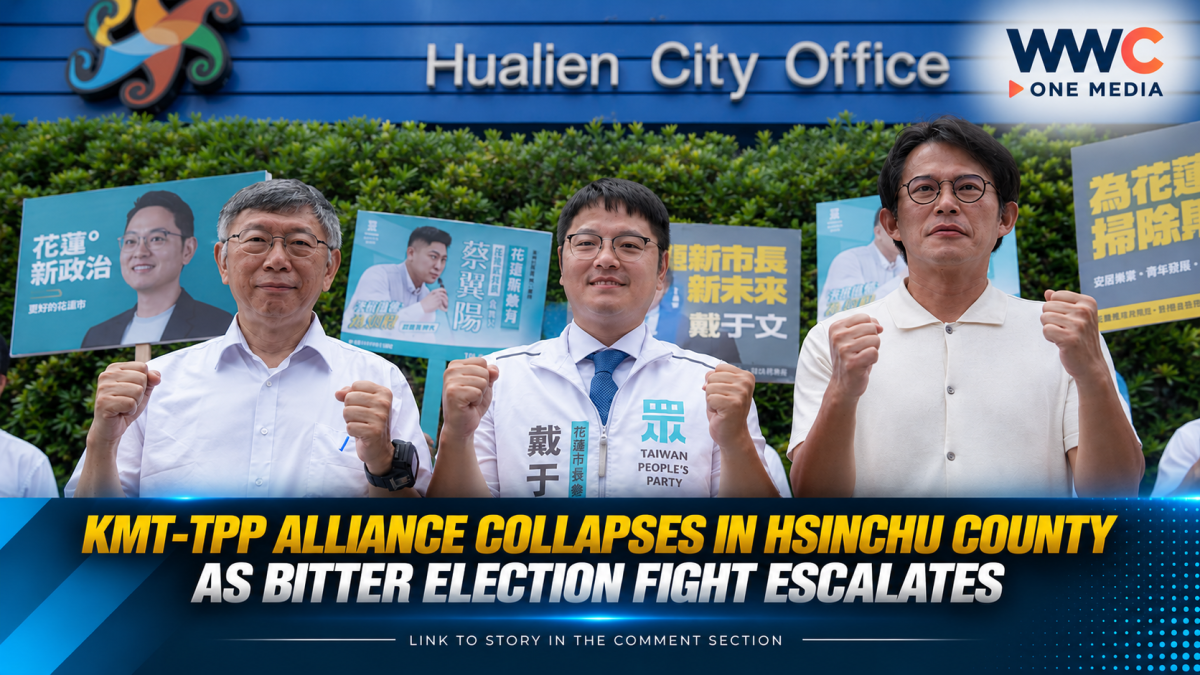
TAIPEI — Taiwan’s opposition alliance has suffered a major setback after the Taiwan People’s Party (TPP) formally suspended electoral cooperation with the Kuomintang (KMT) across Hsinchu County, exposing deepening mistrust between the two parties just months before Taiwan’s 2026 local elections.
The TPP’s Central Committee approved the decision on Sunday, Sept. 6, effectively ending the opposition cooperation arrangement in Hsinchu County and directing party officials and candidates not to campaign for KMT nominees there.
The immediate trigger was a dispute over the Zhubei mayoral race, where the KMT and TPP are running competing candidates despite earlier expectations that the opposition parties would coordinate their campaigns.
The Dispute That Broke the Alliance
At the center of the dispute are two candidates: TPP nominee Chiu Chen-yuan and KMT nominee Wu Hsu-chih for Zhubei mayor.
Both registered to run for the position, setting up a direct contest between parties that had previously sought to cooperate against the ruling Democratic Progressive Party (DPP).
The situation became even more complicated because Hsu Hsin-ying, the KMT’s candidate for Hsinchu County magistrate, had previously been viewed as part of a broader opposition coordination strategy.
The TPP says the basic understanding had been that Hsu would receive opposition support for the county magistrate race while the TPP would take the lead in the Zhubei mayoral contest.
But that arrangement ultimately failed to materialize.
The TPP now says the KMT’s actions demonstrated that the two parties no longer had the trust necessary for electoral cooperation.
A Campaign Ban Made the Break Official
The dispute escalated further after Yang Wen-ke, chairman of the KMT’s Hsinchu County branch, issued a directive prohibiting KMT members from campaigning for candidates from other parties in areas where the KMT had nominated its own candidate.
That effectively meant KMT personnel could not campaign alongside TPP candidates such as Chiu.
The TPP responded by taking its own disciplinary step.
On Sept. 6, the party decided that its members and candidates should not campaign for KMT nominees in Hsinchu County, with violations potentially carrying severe party penalties.
The result was a political divorce that had been building for weeks.
TPP Says Trust Has Broken Down
TPP Secretary-General Chou Yu-hsiu said the party had reached the conclusion that cooperation was no longer viable after the KMT’s campaign restrictions.
According to Taiwan News, several KMT lawmakers had expressed willingness to campaign for Chiu, but the local KMT’s ban convinced the TPP that there was insufficient trust to continue the arrangement.
TPP Chairman Huang Kuo-chang has also accused Hsu Hsin-ying of failing to honor what his party considers an earlier understanding.
Hsu has rejected the characterization that she had promised to clear the way for Chiu’s candidacy.
She has said that no formal agreement had been reached over who should withdraw or receive unified opposition backing in the Zhubei contest.
That disagreement over what was actually promised has become one of the defining issues in the dispute.
The Race Could Now Become a Three-Way Battle
The breakdown creates a potentially complicated electoral landscape.
Chiu Chen-yuan is running for Zhubei mayor for the TPP, while Wu Hsu-chih is the KMT nominee. The DPP has also nominated Tseng Sheng-kai, creating the possibility of a three-way contest.
That matters because opposition fragmentation can change the mathematics of a local election.
Instead of combining their support behind one candidate, KMT and TPP voters could be divided between competing opposition candidates, potentially benefiting the DPP nominee.
But the ultimate effect will depend on turnout, candidate popularity and whether voters follow party organizations or individual candidates.
Why Hsinchu County Matters
Hsinchu County is more than another local election battleground.
The wider Hsinchu area is politically important because of its role in Taiwan’s technology economy and because the opposition parties have viewed cooperation there as an opportunity to demonstrate that they can govern together.
The dispute therefore carries significance beyond the Zhubei mayoral race.
Taipei Times reported that the KMT and TPP had already been experiencing tensions over their alliance, with the Hsinchu situation becoming one of the most visible tests of whether the opposition partnership could survive local candidate disputes.
The Timing Is Especially Damaging
The rupture comes just ahead of Taiwan’s Nov. 28, 2026 local elections, when voters will choose local officials across the island.
That leaves both parties with limited time to repair the relationship — or build separate campaign structures.
The dispute is also unfolding after months of negotiations over how the KMT and TPP could coordinate their candidates.
Earlier in August, Chiu had publicly argued that the two parties needed to honor their commitments, with the proposed division of support involving Hsu’s bid for county magistrate and a TPP-backed candidate for Zhubei mayor.
Those negotiations ultimately failed.
Could This Hurt the Opposition Beyond Hsinchu?
That may be the bigger political question.
The KMT and TPP have cooperated on several major political issues in Taiwan’s legislature, but local elections are different.
Individual candidates, local party organizations and personal political networks can make national-level agreements much harder to enforce.
The Hsinchu dispute demonstrates how quickly an alliance can unravel when both parties believe their electoral interests are being threatened.
Taipei Times previously warned that tensions between the KMT and TPP were putting their broader alliance under strain, although it cautioned against assuming that every local dispute would automatically destroy the national relationship.
That distinction remains important.
The latest decision formally ends electoral cooperation in Hsinchu County, but it does not necessarily mean the KMT and TPP have permanently ended all political cooperation nationwide.
A Test for Taiwan’s Opposition Strategy
The Hsinchu fight could nevertheless become a major test of whether Taiwan’s opposition parties can coordinate effectively ahead of future national elections.
If KMT and TPP candidates continue competing against each other in areas where a unified opposition candidate might have been stronger, the split could produce political costs.
But if the parties manage to isolate the dispute to Hsinchu County, the damage could remain relatively contained.
For now, however, both sides appear determined to protect their own candidates.
The TPP has ordered its members not to campaign for KMT candidates in Hsinchu County, while the KMT has imposed its own restrictions on supporting non-KMT nominees.
The opposition alliance that once promised cooperation is therefore facing its most visible local rupture yet.
And with Taiwan’s local elections approaching, the real question is no longer whether the KMT and TPP can agree on Hsinchu — it is whether they can prevent one bitter local battle from becoming a much larger opposition crisis.

Leave a Reply