
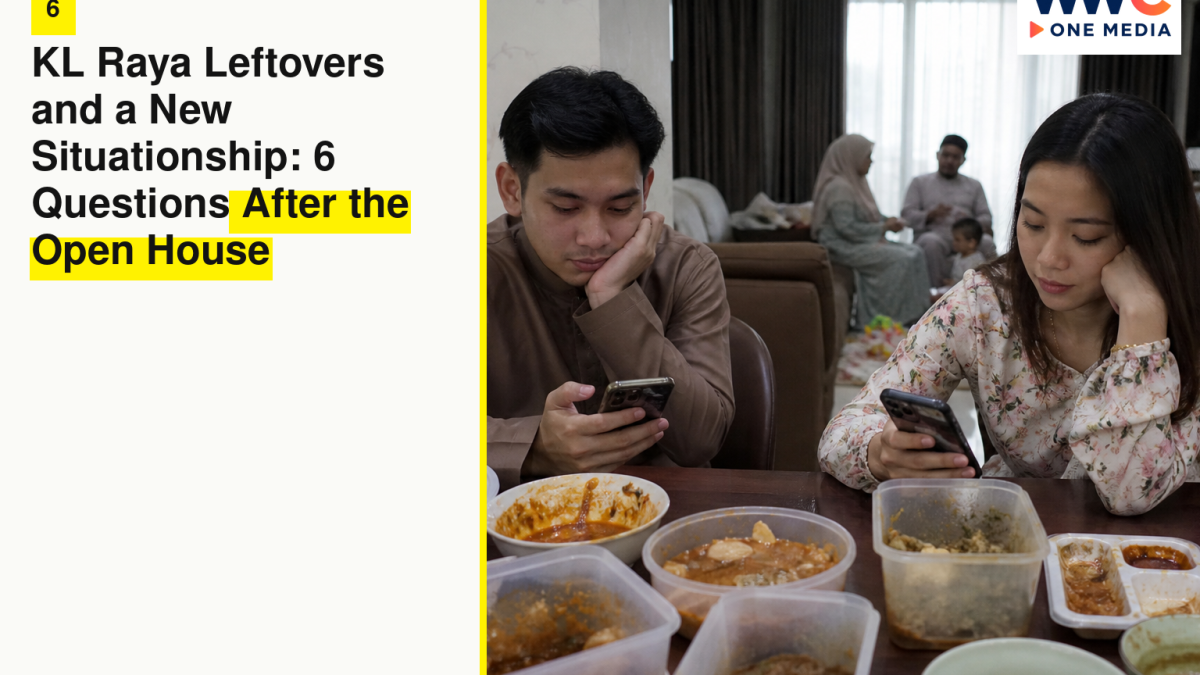
KUALA LUMPUR, Malaysia — The open house is over. Someone pressed a tupperware of kuah into your hands at the gate in Ampang. There is lemang on the counter, a paper plate in the car, a cousin who said “join us next year” in the tone people use when they are being kind and when they are being nosy. You are not sure which. KL Raya leftovers and a new situationship live in that tupperware. The festive fog made everything feel like a yes: a seat at a table in Cheras, a photo with Mak in the living room, a WhatsApp sticker from an uncle you cannot name. Then Syawal continues, the city goes back to LRT and aircon, and the situationship is still unnamed. Six questions after the open house. Not a religious ruling. Not a lecture about what a festival “must” mean. Just a calendar, a family thread, and whether the leftovers were hospitality or a plot.
Hari Raya in KL is public and private at once. Open houses pull in colleagues, neighbours, a plus-one who is not yet a title. That is the point of an open house. It is also how people get confused. Write the six questions on a weekday in Petaling Jaya, when the kuih is gone and the group chat is still adding photos.
You do not need a ustaz in this piece. You need to know if you are a guest who got fed, or a person they will mention in December.
1. KL Raya leftovers and a new situationship: was the open house a family yes, a cousin’s joke, or an empty seat?
KL Raya leftovers and a new situationship start with the invitation itself. Who asked you. A partner who said “come meet my family for Raya” is not the same as a last-minute “there’s an open house in Shah Alam, just come, plenty food.” Open house culture in the Klang Valley is real: doors open, food on the table, people rotating through. A rotating chair is not a proposal.
Ask, after, in a normal voice:
- Who knew I was coming — Mak, Abah, the siblings, or only you and the cousin who parks in the driveway.
- Was I on a list, or did I fill a gap because another friend cancelled.
- Did you tell them what we are, even a small true version — seeing each other, not official, official — or did you let the setup of Raya do the talking.
- Would I have been invited if it was a small family morning only, not the afternoon open house that also had office people.
If the honest answer is “it was an open house, anyone from work could have walked in,” then the photo with the family sofa is still a photo, not a contract. Enjoy the food. Do not build a five-year plan on a paper plate.
If the honest answer is “I wanted my mother to see you,” that is heavier. Heavier can be good. It still needs a sentence after the festival, when the house is not full of kuih and small talk.
What not to do: interrogate the mother in the kitchen about your status. She is hosting. She is tired. She may be kind to every guest with a container. Kindness at Raya is a house skill. Do not confuse it with a blessing you can screenshot.
Script, two days later, not beside the kuih table:
“I had a good time. I need the true size of it. Was I a public plus-one because it was open house, or was I someone you wanted your family to clock. I can live with a small version. I can’t live with a fog.”
Ampang, Cheras, Gombak, Shah Alam, a kampung house that is actually in a terrace in Setapak — the postcode does not decide the meaning. The invitation does.
2. What do the leftovers mean — a tupperware is not a contract
Someone sent you home with food. This is Malaysia. This is also a trap for the hopeful. KL Raya leftovers and a new situationship get mixed because a box of rendang feels like care, and it is care, and care is not always a title.
Number what leftovers can be:
- Hospitality. The house had too much. Open house math is abundance. You got a share because you had two hands.
- A mother’s habit. She packs for everyone. Your box is the same as the neighbour’s box.
- A private gesture from the person you are seeing — they chose the pieces you like, they texted “eat before you sleep,” they asked if you wanted kuah extra. That is a data point. Still not a nikah. A data point.
- A test you should not over-read. Some families watch whether you say thank you, whether you return the container, whether you eat with ordinary manners. Return the container. Wash it. That is manners, not a campaign.
What leftovers are not: a ruling on your relationship. Do not invent a religious meaning for a plastic box. Do not let an auntie’s “next year you help cook” become doctrine. Next year is small talk. Put it on a shelf.
Practical rules:
- Text thank you to the host, not only to the situationship. One or two lines. Not a paragraph about destiny.
- Return the tupperware on a normal day, or at the next easy meet, without staging a second “family moment.”
- Do not post the spread as if you are already in the family grid. A photo of your own plate at home is fine. A carousel of their living room may not be.
- If you cannot eat it all, share with your own house. Do not waste food to keep it as a relic.
Script:
“Thank you for the food, I returned the box to [name]. I’m not reading the rendang as a five-year plan. I am asking, separately, what we are after Raya.”
If they get offended that you will not treat leftovers as a symbol, you learned something. Symbols are easy during Syawal. Definitions are the work.
3. Family WhatsApp: were you added, mentioned, or cropped?
The family WhatsApp is the modern living room. After a KL open house, photos land in a thread you may never see. KL Raya leftovers and a new situationship should include a look at the digital table, without demanding admin rights.
Questions:
- Did a photo of you go into the family group. Were you named, or were you “friend.”
- Were you added to any chat — cousins, a Raya coordination group, a sibling thread — or did the phone close when you stood up.
- If someone asked “who is that,” what did they reply. You are allowed to ask for the gist, not for screenshots of Mak’s entire weekend.
- Did they crop you out of a picture that also had the official people. Cropping happens. Sometimes it is composition. Sometimes it is a decision. Ask once.
Being added too fast can also be a trap. A situationship in a family GC is a public status you did not negotiate. You can say: “I’m glad they were kind. I’m not ready to be in a family chat if we haven’t named this.” That is not cold. That is pacing.
What not to do: hunt for your face in relatives’ Instagram stories until 2am in a condo in KLCC. If they wanted you tagged, you would often know. If they did not, the story is still their Raya, not your application form.
Bangsar open houses with mixed friend groups, PJ bungalows with a driveway full of cars, a flat in Keramat with the TV on — different households, same phone problem. WhatsApp is where the meaning leaks.
Script:
“Did I land in any family chat as a name, or only as a guest in a photo. I don’t need to be added. I do need to know if I’m a secret in the thread.”
If you are a secret after they walked you through the house, that gap is the situationship. Festival fog does not excuse a double story: public seat, private delete.
4. How did they talk about you to Mak — and to the friends after you left
Two audiences. The parents. The friends who stayed to smoke at the porch, the college mates who came for the afternoon slot, the office people who said salam and left. KL Raya leftovers include the sentences said when you were in the toilet or already on the MRT back from Ampang.
You will not get a transcript. You can ask for a summary.
- To family: was I “a friend from KL,” “someone I’m seeing,” a joke, a future, a warning. If they do not know because they left the room, they can still tell you what they intended.
- To friends: did they downplay you to keep options, or did they introduce you with the same word they use in private.
- Did an uncle ask a question about work, religion, race, money, or marriage that your person laughed off instead of answering. The laugh is data. What would a real answer have been.
- Did anyone tell you “welcome to the family” as automatic Raya English. Automatic is real. It is still automatic.
This is not a request to police every relative. Uncles will uncle. Aunties will ask when you are getting married because that is their season talk, including to neighbours they met today. Do not make a stranger’s small talk into your attachment style. Do make your person’s translations count. If they let a false story stand — “just a colleague” when you are sleeping in their PJ apartment three nights a week — the leftover that matters is the lie.
What not to do: corner a sibling for intel as if they were a source. Siblings will talk. They also have their own Raya fatigue. A short “was it okay I came” is enough.
Script:
“When your friend asked who I was after I went to the car, what did you say. Say the same word to me now.”
If they cannot pick a word in Petaling Street traffic on a Saturday after Raya, they will not pick one in a calmer month. Festivals do not create courage. They reveal the lack of it.
5. After Raya, is there a weekday that is not festive fog?
Syawal has visits, more houses, a balik kampung that is actually a drive to Negeri, to Perak, to a hometown that is not KL. A situationship can hide inside that calendar for weeks: “still Raya,” “family still here,” “I have to pergi rumah tok.” Some of that is true. KL people do disappear into family logistics. Some of that is a pause that never ends.
The fifth question: when is the first ordinary plan.
- A weekday lunch near KLCC or a mall in PJ that is not an open house.
- A film.
- A walk in a park that is not a family compound.
- A conversation that uses the word you asked for in question 4.
If the only version of you that exists is festive — dressed, polite, feeding their cousins compliments — you are a seasonal guest. Seasonal guests do not get a weekday. Ask for one. Put a date, not a season.
Number the calendar check:
- This week, one ordinary meet.
- If they are still travelling between relatives, a video call that is not a crowd.
- A time after which “still Raya” will not be the reason. You do not need a fatwa for that time. You need a date on your phone.
What not to do: show up at the next open house uninvited because the first tupperware felt like a pass. Open house is still an invitation. Doors open does not mean your name is on the porch list forever.
Script:
“I liked Raya at your place. I want a Thursday that is just us, no kuih, no uncles. If Thursday can’t exist until August, tell me. I’ll believe the calendar, not the leftovers.”
Traffic after a long weekend in the Klang Valley is a useful metaphor. Everyone is going home. You should know whether you are going home together in any sense that survives Jalan Tun Razak at 6pm.
6. When the next festival comes, will this still be unnamed?
There is always another date on the Malaysian calendar. A wedding. A family death. Chinese New Year if the household is mixed. Deepavali next door. Another Raya. KL Raya leftovers and a new situationship become a pattern if you only ever meet in other people’s ceremonies.
Ask the sixth question plainly:
- If we are still in this grey, do I come to the next family event.
- What would have to be true for me to be introduced with a word.
- What would have to be true for me to stay away without a fight.
- Are we actually dating toward a known shape, or are we festival extras for each other.
You are not demanding a ring beside the ketupat. You are refusing an infinite queue of open houses that never produce a weekday name. That refusal is allowed in every language spoken in KL.
If they need time because families are complicated — race, religion, money, a previous engagement, a parent who is ill — they can say the complication. Complication is not the same as fog. Fog is “we’ll see” until you are holding another tupperware a year later.
What not to do: issue an ultimatum at their grandmother’s table. Do it on a plastic stool at a mamak in Bukit Bintang, on a walk in Taman Tasik Titiwangsa, in a car parked because you both agreed to talk. Ceremony is for ceremony. Definitions are for ordinary night.
Script:
“I will not collect a second festival as a maybe. Tell me if there is a path that includes a word, or if Raya was hospitality and we go back to unnamed. I can respect a no. I can’t keep reading leftovers.”
Scripts that fit the week after the Ampang open house
To the host:
“Thank you for having me. The food was generous. I returned the container to [name].”
To the person you are seeing:
“Open house was easy to over-read. I’m asking six things, not for a ruling. Invitation size, leftovers, WhatsApp, what you said, a weekday, the next festival. Answer when you’re not sleepy from visiting.”
When a cousin adds you and you are not ready:
“Nice to meet you at Raya. I’ll keep this chat light. We’re still figuring out our own pace.”
When they go quiet:
“I’m not chasing a sticker. When you’re back in KL for a normal week, I need the conversation. If the conversation is ‘not that,’ I’ll take it.”
What not to do with KL Raya leftovers and a new situationship
Do not turn their family recipes into your content without asking. A spread is their house.
Do not compare your plate to an official girlfriend from 2019 who still appears in someone else’s story. You will not win a ghost contest.
Do not fast-forward into religious debate as a way to force a definition. If faith practices matter to how you date — they might — that is a separate, careful talk, with respect, without you inventing a ruling you are not qualified to give. This newsdesk is not that ruling. Your auntie in the group chat is not that ruling either, unless she actually is a scholar, and even then, your relationship still needs a yes from the two of you.
Do not get drunk at the next visit to loosen the family. Loose is not honest. Honest is a weekday sentence.
Do not weaponise “I already met your mother.” Meeting is not a hostage.
Do not refuse to greet properly because you are anxious. Salam, smile, names. Anxiety is not an excuse to be rude in someone’s home.
Do not bring a gift so large it looks like a bid. Ordinary, if you bring anything. Fruit. A box from a shop. Not a performance.
Extra: office open house versus family house — KL runs both
A company open house in a hotel or a hall in the city is not Mak’s terrace. Colleagues, a buffet, a photo wall. Bringing you there can mean “I don’t mind being seen” at work. It does not mean the Cheras living room is next. Keep the two maps separate.
A friend’s open house where their parents happen to be is another middle. Middle is where situationships hide. Ask which map you were on.
A kampung visit that required a long drive is heavier than a two-hour slot in PJ. Distance is a kind of introduction. Still ask the six questions. Do not skip them because you were tired on the PLUS highway.
Extra: mixed families, different calendars, the neighbour’s festival
KL households are not one script. A Malay family open house, a mixed marriage, a non-Muslim partner at a Raya table, a Muslim partner at someone else’s festival later in the year — all of that can be ordinary and still be delicate. The rule for this piece stays social: do not invent religious law. Do ask whether the family table is a place you will be again, and whether your own family will hear a true sentence.
If you need guidance on faith practice, that is a conversation with people you trust in that area of your life. A leftovers article will not do it. A situationship should not be your only teacher.
Objections
“It was just Raya, don’t overthink.”
Raya is when overthinking is cheapest to postpone. A short list of questions is not a thesis. It is how you avoid a year of tupperware.
“My family is nice to everyone.”
Good. Then they can be nice while you two pick a word. Niceness of a household does not replace a definition between you.
“If I define it, the magic dies.”
Magic that cannot survive a Thursday in PJ was hospitality. Hospitality is lovely. It is not a relationship on its own.
“We’ll talk after all the visits.”
Name the date after the visits. If the date slides twice, you have the answer.
Bottom line
KL Raya leftovers and a new situationship need six questions after the open house: what the invitation actually was, what a tupperware is not, whether family WhatsApp named you or cropped you, what they said to Mak and to friends, whether a weekday exists after the festive fog, and whether the next festival will still find you unnamed. Ampang will pack the food. Cheras will take the photo. Shah Alam will run out of parking. None of that is a ruling. Return the container. Ask for the word on an ordinary night. If the word is no, you still ate well. If the word is yes, you will not have to keep reading rendang for signs.




Leave a Reply