
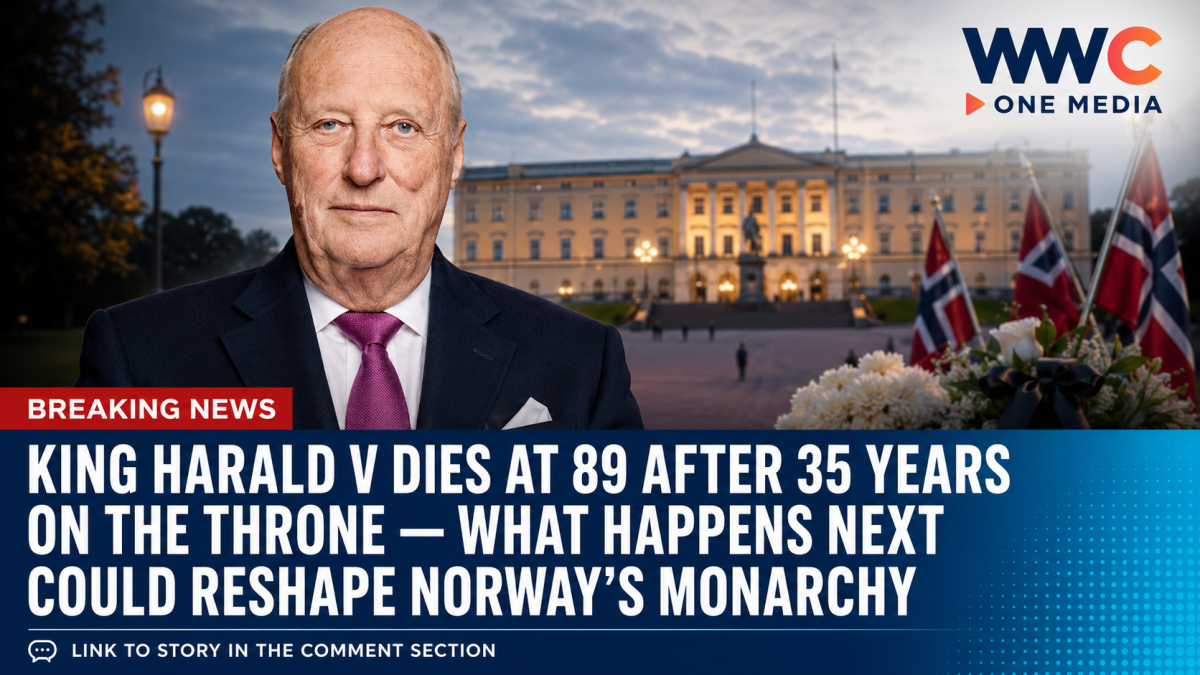
OSLO, Norway — Thousands of Norwegians filled the grounds outside Oslo’s Royal Palace with flowers, flags and handwritten messages as the country began mourning King Harald V, whose death at the age of 89 ended a 35-year reign and immediately opened a new chapter for one of Europe’s most closely watched monarchies.
Harald died peacefully at Oslo University Hospital Rikshospitalet at 6:35 a.m. on Friday, August 28, according to Norway’s Royal Court. He had been hospitalized since August 17 and had been seriously ill in the days before his death.
His 53-year-old son succeeded him automatically under Norway’s constitutional system, becoming King Haakon VIII. Haakon’s daughter, 22-year-old Ingrid Alexandra, is now crown princess and first in line to the throne.
There was no period without a monarch. Under the Norwegian Constitution, succession takes effect immediately when a reigning king or queen dies. At an extraordinary Council of State, the new monarch formally confirmed that he would reign as Haakon VIII and retain the traditional royal motto “Alt for Norge,” or “Everything for Norway.”
A nation gathers to say goodbye
Outside the Royal Palace, grief quickly became visible.
Thousands gathered despite rain, leaving growing piles of flowers, Norwegian flags and personal tributes. Some mourners described Harald as a king who seemed less distant than traditional European royalty — a figure associated with warmth, humor and national unity. CNA reported that one mourner likened him to a grandfather to the nation.
Prime Minister Jonas Gahr Støre said Norway had lost a monarch who helped hold the country together through enormous social change and some of its darkest moments.
Harald was particularly remembered for his response to the July 22, 2011 attacks in Oslo and on Utøya, in which Anders Behring Breivik killed 77 people. His addresses in the aftermath became part of his reputation as a monarch capable of speaking for a grieving country.
The Norwegian government has declared national mourning until after Harald’s funeral. Flags at royal residences, government buildings and military installations are being flown at half-staff, while churches across the country are holding commemorations. The funeral will take place at Oslo Cathedral, although officials had not yet announced the date as of the latest government guidance.
From wartime exile to the Norwegian throne
Harald’s life spanned an extraordinary period in modern Norwegian history.
Born on February 21, 1937, he was just three years old when Nazi Germany invaded Norway. He escaped with his mother and sisters, eventually spending much of World War II in the United States while his father, then-Crown Prince Olav, and grandfather King Haakon VII remained with Norway’s government in exile in Britain.
He became king in January 1991 following the death of his father, King Olav V.
Over the following three-and-a-half decades, Harald helped steer the monarchy toward a less formal and more accessible public image. His own marriage had already challenged royal convention: after years of resistance, he married commoner Sonja Haraldsen in 1968.
Harald also competed as a sailor in several Olympic Games and remained strongly associated with Norwegian sporting life throughout his reign.
Haakon VIII inherits a monarchy under pressure
The smooth constitutional succession does not mean the new king begins his reign without complications.
Reuters reports that support for Norway’s monarchy fell sharply amid controversies surrounding members of the royal family, dropping to 60% in a February 2026 Norstat poll reported by NRK before recovering to 64% in May. Harald himself remained considerably more popular than the institution surrounding him.
The new Queen Mette-Marit has faced scrutiny over her past friendship with convicted sex offender Jeffrey Epstein, for which she has apologized. Her son from a previous relationship, Marius Borg Høiby, was convicted in June of two rape counts and one count of domestic violence and sentenced to four years in prison; Reuters reported that both he and prosecutors have appealed the sentence.
That backdrop makes Haakon VIII’s accession more than a ceremonial handover.
He inherits the prestige accumulated during his father’s long reign, but also the challenge of preserving public confidence in a monarchy facing unusually intense scrutiny.
World leaders pay tribute
Condolences have poured in from governments and royal houses around the world.
Britain’s King Charles III remembered Harald as a devoted monarch who guided Norway through decades of change with warmth and humility. German Chancellor Friedrich Merz praised his role as a figure of unity, while European Commission President Ursula von der Leyen highlighted Harald’s ability to bring Norwegians together during both celebration and tragedy.
For Norway, however, the defining images are closer to home: flowers spreading across Palace Square, flags lowered across the country and ordinary Norwegians arriving to remember the man who occupied the throne for more than a generation.
King Harald’s reign is over.
King Haakon VIII’s has already begun — and the question now is whether the new monarch can preserve his father’s extraordinary bond with the Norwegian public while guiding the royal house through one of its most difficult periods in decades.



Leave a Reply