
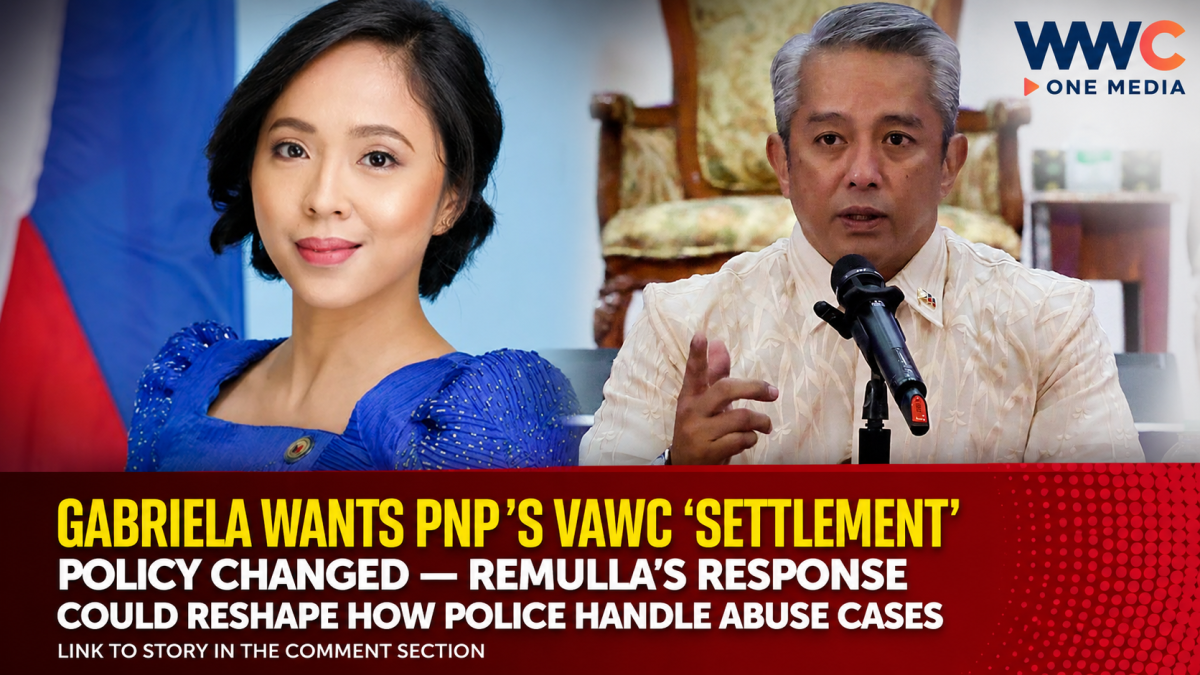
MANILA, Philippines — A policy allowing reconciliation efforts in cases involving violence against women and their children has come under scrutiny in Congress, after Gabriela Women’s Party Rep. Sarah Elago challenged the Department of the Interior and Local Government and Philippine National Police over whether alleged abuse involving police personnel should ever be treated as a dispute that can be settled privately.
The issue surfaced during the House Committee on Appropriations’ August 27 hearing on the DILG’s proposed 2027 budget, where Elago called for a review of the PNP’s handling of Violence Against Women and Their Children, or VAWC, complaints involving members of the police force.
Interior Secretary Jonvic Remulla responded by promising action against personnel accused of violence or harassment and signaling that the department would review the questioned policy.
The exchange could have implications beyond individual disciplinary cases because Philippine law places strict limits on attempts to mediate or compromise acts covered by the Anti-Violence Against Women and Their Children Act.
Elago questions reconciliation policy
According to DZRH, Elago questioned an existing PNP policy that reportedly permits reconciliation efforts — including discussions or marriage counseling — when a VAWC complaint involves police personnel.
She argued that cases involving physical abuse should not be approached like ordinary marital disagreements that can simply be resolved by bringing the parties together.
The Manila Times, Journal News and Pilipino Star Ngayon separately reported that Elago specifically asked the DILG to change its policy concerning settlement or reconciliation and pressed the department to provide stronger protection for women in the police service.
Remulla told lawmakers that complaints involving harassment within the police ranks would be treated seriously and that appropriate charges would be pursued regardless of the position of the person involved.
He also indicated that the DILG would make changes in response to Elago’s concern.
What the Anti-VAWC law actually says
The legal question is significant because Republic Act No. 9262 contains explicit safeguards intended to prevent victims from being pressured into abandoning their cases or protection requests.
Section 33 of the Anti-VAWC Act says barangay officials and courts handling applications for protection orders must not order, force or improperly influence an applicant to compromise or abandon the relief she is seeking. It also removes VAWC protection-order proceedings from the ordinary barangay conciliation provisions of the Local Government Code.
The Philippine Commission on Women explains the rule even more directly: barangay officials are not permitted to mediate or conciliate acts of VAWC, while police officers and social workers should not try to persuade victims to abandon legal action or applications for protection orders.
Supreme Court rules governing VAWC cases likewise provide that courts should not refer such cases to mediation and must not permit compromise regarding acts constituting the crime of violence against women and their children.
That does not necessarily mean every conceivable civil or collateral issue between two parties can never be resolved by agreement. But attempts to use reconciliation to extinguish, pressure, or sideline criminal allegations or protection-order remedies raise clear legal concerns under the framework of RA 9262.
The complete text of the specific PNP policy challenged during the House hearing was not reproduced in the news reports reviewed for this article, making the details of any coming amendment particularly important.
Why cases involving police personnel carry another layer of concern
RA 9262 does not merely require law enforcement officers to receive complaints.
Police and barangay authorities have affirmative duties under the law, including responding to calls for assistance, protecting victims, enforcing protection orders and, under specified circumstances, arresting suspected perpetrators when violence has just occurred and there is imminent danger.
The law also requires government agencies and local governments to provide continuing education and training to personnel dealing with VAWC cases.
The implementing rules further assign the PNP responsibility for ensuring that its procedures for handling VAWC complaints are gender-responsive.
That creates an especially sensitive situation when the person accused of abuse is himself a member of the institution tasked with protecting victims and enforcing the law.
Remulla points to case involving two policewomen
During the budget hearing, Remulla referred to a separate case involving a member of Congress and female police security personnel as an example of authorities pursuing allegations despite the status of the accused.
Multiple news organizations have identified that case as the prosecution of Marikina 1st District Rep. Marcelino “Marcy” Teodoro.
On August 18, the Department of Justice confirmed that four counts of sexual assault and one count of acts of lasciviousness had been filed against Teodoro in connection with complaints by two female police officers who previously served as his security personnel.
The charges are now before the courts.
Teodoro has denied wrongdoing. His lawyer, Alma Mallonga, has maintained his innocence and questioned aspects of the DOJ process, including the handling of the prosecution panel. The defense has said Teodoro intends to contest the allegations through the judicial process.
It is important to distinguish those charges from the Anti-VAWC policy debate: the cases reported by the DOJ involve sexual assault and acts of lasciviousness, rather than being described by prosecutors as charges filed specifically under RA 9262.
Broader questions over PNP’s approach to gender-based violence
The reconciliation controversy was not the only gender-related issue raised during the DILG budget deliberations.
Inquirer reported that Elago also criticized what she described as victim-blaming anti-rape advisories posted by police, including recommendations telling people to avoid walking alone in dark places or meeting unfamiliar people.
She argued that police messaging should instead emphasize reporting mechanisms, hotlines and available legal and psychological support.
Remulla said the questioned post had been corrected and acknowledged that improvements were still needed.
Taken together, the exchanges put renewed attention on how the country’s largest law-enforcement organization communicates about sexual and gender-based violence — and, more critically, how it responds when the alleged offender is one of its own personnel.
Violence against women remains a national problem
Recent government data underscore why the debate matters.
The Philippine Statistics Authority’s 2025 National Demographic and Health Survey found that 15 percent of Filipino women aged 15 to 49 who had ever had a husband or intimate partner reported experiencing physical, sexual or emotional violence from their current or most recent partner.
That was lower than the 17.5 percent recorded in 2022, but it still represents a substantial share of women in intimate relationships. Emotional violence was reported by 14 percent, physical violence by 5.3 percent and sexual violence by 1.8 percent of respondents in the national survey.
Separately, the Philippine Commission on Women previously reported that PNP records logged 11,585 violence-against-women-related cases in 2023, including 8,055 cases under RA 9262.
Those numbers also capture only reported or disclosed incidents and should not be interpreted as representing every case of abuse in the country.
The bigger test comes after the hearing
Remulla’s commitment before Congress may settle the immediate political question, but the larger institutional issue remains unresolved.
The crucial test will be what the DILG and PNP actually change.
If the policy challenged by Elago allows police units to steer VAWC complainants toward reconciliation in circumstances inconsistent with RA 9262, officials may need to do more than revise the wording of an internal guideline. Training, complaint procedures, supervisory accountability and protections against retaliation could all determine whether women — including policewomen themselves — feel safe reporting abuse.
Congress may therefore have opened a much larger discussion than the wording of a single policy.
The question now is whether Remulla’s promise will result in a formal nationwide directive clearly separating lawful victim support and counseling from any effort that could pressure a woman to reconcile with an alleged abuser.
For women inside and outside the police service, that distinction could determine whether a complaint leads to accountability — or quietly disappears behind a supposed “settlement.”



Leave a Reply