
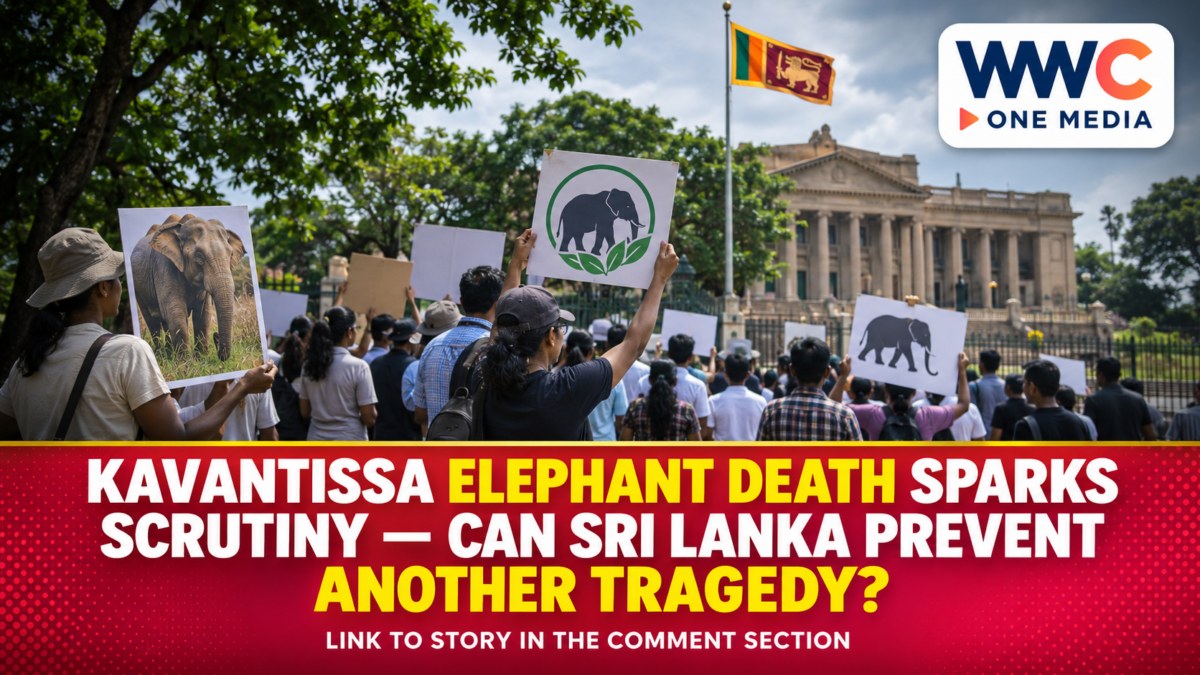
COLOMBO, Sri Lanka, Nov. 22, 2026 — The death of wild elephant Kavantissa has placed Sri Lanka’s wildlife protection policies under renewed scrutiny, with the government pledging stronger enforcement and better veterinary support. A parliamentary committee meeting on Nov. 13 also examined the elephant’s death while discussing habitat loss, blocked migration routes and practical solutions to human-elephant conflict.
The debate now reaches beyond the loss of one prominent tusker. It raises a wider question about whether Sri Lanka can translate conservation commitments into measurable protection for elephants and the communities living near their habitats.
Kavantissa Elephant Death: What Officials Confirmed
Sri Lanka’s Prime Minister, Dr. Harini Amarasuriya, addressed Kavantissa’s death during the Presidential Environmental Awards on Oct. 19, 2026.
In the government’s official account, the elephant had suffered serious gunshot injuries. Wildlife personnel and veterinary teams attempted to save him, but the administration said the injuries and subsequent infections proved fatal.
The Prime Minister pledged that environmental protection laws would be applied without preferential treatment. She also outlined plans to improve wildlife veterinary services and related professional education.
Those commitments establish the government’s position, but they do not independently resolve every question surrounding the incident.
A definitive assessment of the animal’s treatment, the circumstances of the shooting and any possible legal responsibility would require the relevant investigative and medical findings.
The distinction matters. Public concern may justify closer scrutiny, but an allegation concerning an individual or institution must not be treated as a proven finding without supporting evidence.
Parliament Examines the Broader Elephant Crisis
On Nov. 13, Sri Lanka’s Sectoral Oversight Committee on Environment, Agriculture and Resource Sustainability met under the chairmanship of Member of Parliament Hector Appuhamy.
The committee discussed Kavantissa’s death as part of a wider examination of human-elephant conflict and possible conservation improvements.
Its discussions identified habitat loss and the obstruction of traditional elephant corridors as important contributors to the problem.
When natural movement routes become restricted, elephants may increasingly enter farms and settlements while searching for food.
The consequences can be serious for both wildlife and rural communities. Conservation measures therefore need to address human safety and agricultural protection alongside the survival of elephants.
The committee discussed local coordination involving wildlife officers, village administrators and community representatives.
Analysis: This approach could offer a practical foundation for prevention if local authorities receive adequate resources and clear responsibilities.
Protecting elephants requires more than responding to individual emergencies. It also requires identifying where dangerous encounters are likely to occur and addressing the conditions that bring people and wildlife into conflict.
Can Technology Help Protect Sri Lanka’s Elephants?
One proposal discussed in Parliament involved using GPS and satellite collar technology to better understand elephant movement.
Tracking information could help conservation authorities identify commonly used routes, observe changes in migration patterns and prioritise areas needing intervention.
However, tracking an animal is different from protecting it.
Monitoring becomes useful only when authorities can act on information quickly enough to reduce risks.
The parliamentary committee also considered early-warning communication networks and stronger community participation.
These measures could help alert residents to approaching elephants while giving conservation officials more time to respond.
Similar questions about technology and prevention arise in the Philippines, where WWC ONE MEDIA has covered efforts to improve the protection of Philippine eagles through international conservation cooperation.
Analysis: Technology is potentially valuable, but the decisive measure is whether it produces fewer dangerous encounters and more effective intervention.
A monitoring programme should therefore be assessed through its operational results rather than the number of devices purchased or installed.
Veterinary Care Emerges as Another Priority
Kavantissa’s death also brought attention to the difficulties of treating large wild animals outside controlled veterinary facilities.
Parliament discussed the risks associated with anaesthetising elephants and the practical challenges faced by wildlife veterinarians.
Members considered the need for equipment including mobile veterinary units and portable X-ray machines.
These resources could make it easier to assess injuries without relying entirely on distant facilities.
Yet equipment alone would not resolve every problem.
Wildlife emergency care also depends on trained personnel, coordination, transport, reliable communications and access to the animal.
In its Oct. 19 statement, the government recognised the importance of strengthening veterinary services and education.
The issue also connects with broader conservation experience. WWC previously reported on the rehabilitation and return of rescued wildlife to natural habitats in Zamboanga del Norte.
Although the species and circumstances differ, both cases highlight the importance of veterinary assessment and suitable operational support.
Analysis: The meaningful test for Sri Lanka will be whether promised improvements produce more reliable field treatment and better emergency-response capacity.
Government Conservation Measures Face an Implementation Test
Sri Lanka’s Prime Minister outlined several existing measures intended to address human-elephant conflict.
The government said it had designated 113 forest areas as reserves, covering approximately 71,900 hectares.
It also reported work to establish three elephant corridors and a dedicated reserve for elephant management.
For field operations, the administration listed 100 pickup vehicles, 185 motorcycles and nine tractors.
The Prime Minister further identified 3,500 elephant fence assistants and 5,000 Civil Security Department personnel deployed to maintain elephant fencing.
These figures indicate the scale of government activity, but they do not, by themselves, establish conservation effectiveness.
Protected land must remain usable as habitat. Corridors must allow meaningful movement. Fencing must be maintained where it can reduce conflict without unnecessarily disrupting wildlife.
Community participation is another essential consideration.
WWC has also examined an Indonesian conservation initiative that links local participation with incentives for documenting wildlife.
While that programme operates in different circumstances, it illustrates why conservation planning cannot disregard the people who live alongside natural habitats.
Analysis: Sri Lanka’s challenge is to demonstrate that public spending, protected areas and operational programmes are achieving practical results, rather than simply expanding administrative activity.
What Happens Next?
The next important developments will be the release of authoritative findings concerning Kavantissa’s death and evidence of progress on the measures discussed by government and Parliament.
The Nov. 13 committee record documents proposals and discussion, not proof that every recommendation has been implemented.
The government’s conservation commitments likewise need to be distinguished from independently verified outcomes.
Future reporting should examine whether elephant corridors become operational, whether veterinary teams receive the necessary equipment and whether early-warning arrangements are introduced in high-risk communities.
It should also assess whether authorities publish reliable information on elephant deaths, injuries and human-elephant conflict.
Kavantissa’s case has brought a familiar conservation challenge into sharper public focus.
The question is no longer simply whether Sri Lanka recognises the danger facing its wild elephants. Its own public records show that the problem has reached the highest levels of government and parliamentary scrutiny.
The more important question is whether those discussions will produce visible, measurable improvements before another preventable tragedy occurs.
Frequently Asked Questions
What happened to Kavantissa the elephant?
Sri Lanka’s government confirmed that Kavantissa died after suffering serious gunshot injuries and subsequent infections despite veterinary efforts to save him.
Is Sri Lanka investigating Kavantissa’s death?
Official parliamentary records confirm that the death was discussed on Nov. 13, 2026. The records reviewed for this article do not establish the final findings or current status of a separate investigation.
What causes human-elephant conflict in Sri Lanka?
Parliamentary discussions identified habitat loss, blocked elephant corridors and the movement of elephants into agricultural and residential areas in search of food as important factors.
What measures has Sri Lanka announced to protect elephants?
The government has identified protected forest areas, elephant corridor development, fencing personnel, field vehicles and plans to improve wildlife veterinary care.
Can GPS tracking prevent elephant deaths?
Tracking may help authorities understand elephant movement and identify risks. Its effectiveness depends on reliable monitoring, timely intervention and cooperation with affected communities.










