
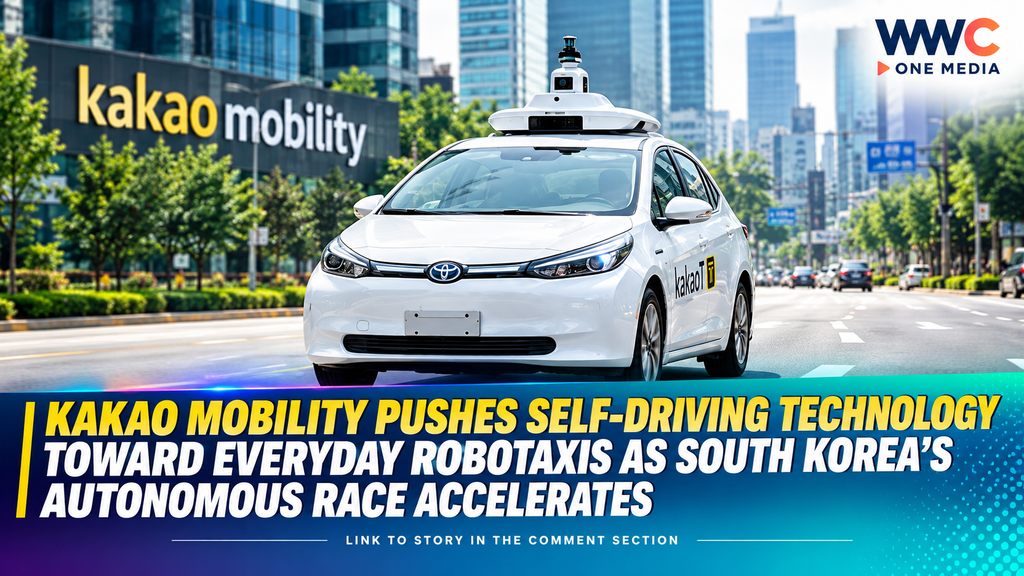
South Korea’s robotaxi ambitions are moving into a new phase, and Kakao Mobility is betting that the biggest breakthrough will not come from autonomous-driving technology alone—but from making self-driving vehicles work as part of the transportation system people already use every day.
The mobility company is developing its own Level 4 autonomous-driving technology, while expanding real-world robotaxi operations in Seoul’s Gangnam district and using data from actual roads to improve its artificial-intelligence driving systems.
The strategy could give Kakao Mobility an important advantage: instead of asking consumers to learn an entirely new transportation service, the company is integrating autonomous vehicles into Kakao T, the platform many South Koreans already use to call conventional taxis.
From robotaxi experiment to everyday transportation
Kakao Mobility has already moved beyond laboratory testing.
Its autonomous taxis operate in Gangnam, where passengers can request an autonomous vehicle through Kakao T in much the same way they would hail a conventional taxi. Seoul has also been expanding the city’s autonomous-taxi program, with Kakao Mobility increasing its Gangnam fleet from two to six vehicles as part of a broader expansion of late-night autonomous services.
The numbers suggest that the platform approach is beginning to matter.
Kakao Mobility recently reported an 82.5% vehicle-utilization rate for its autonomous taxi operation in Gangnam. The company also said 97% of users accessed the service through Kakao T rather than installing a separate application, highlighting how existing ride-hailing infrastructure can help solve one of the biggest problems facing robotaxis: finding enough passengers to keep vehicles economically productive.
That distinction is important. A robotaxi can technically drive itself, but commercial success also depends on dispatching, passenger demand, vehicle availability, charging, maintenance, remote monitoring and the rules governing where the vehicles can operate.
Kakao Mobility is increasingly focusing on that entire ecosystem.
Kakao Mobility is building its own autonomous-driving AI
The company has been developing autonomous-driving technology since establishing a dedicated autonomous-driving task force in 2018.
Its latest push centers on an end-to-end, or E2E, autonomous-driving model designed to integrate perception, decision-making and vehicle control more directly through artificial intelligence.
Kakao Mobility says it is training and validating the system using real-world driving data, with a goal of deploying the technology in its Gangnam autonomous-driving service by the end of 2026.
The approach represents a significant change from more traditional autonomous-driving architectures, in which different systems separately handle tasks such as recognizing objects, predicting movement, planning routes and controlling the vehicle.
Kakao Mobility is also developing redundant vehicle systems and simulation-based validation to improve reliability. Its broader Level 4 roadmap includes machine-learning models, vehicle redundancy, simulation, real-world testing and safety-management systems.
Why Gangnam is becoming Kakao’s autonomous-driving laboratory
Gangnam presents an unusually demanding environment for autonomous vehicles.
The area combines heavy traffic, pedestrians, motorcycles, complex intersections, illegally parked vehicles and rapidly changing road conditions. That makes it a difficult but valuable environment for collecting the kind of data needed to improve autonomous-driving systems.
Kakao Mobility is using vehicles equipped with sensors including cameras, radar and lidar to gather information from real-world driving. That data can then feed into its AI-development pipeline and help train systems to deal with the unpredictable situations that are difficult to reproduce through simulations alone.
The company has also been expanding its fleet specifically to collect more driving data. At an August autonomous-driving industry event, Kakao Mobility said it was expanding its Gangnam autonomous fleet and planned real-vehicle and public-road testing of its E2E model by the end of the year.
The hidden challenge: making robotaxis commercially viable
The technology may be impressive, but Kakao Mobility executives have repeatedly emphasized another issue: utilization.
An autonomous vehicle that spends too much time empty can become expensive to operate even if its driving technology works well.
That is where Kakao Mobility’s existing ride-hailing platform could become a major competitive asset.
Rather than building a completely separate customer base for autonomous taxis, the company can potentially use Kakao T’s existing demand, dispatch technology and transportation data to match passengers with autonomous vehicles.
The company’s reported 82.5% utilization rate has therefore become an important indicator of its commercialization strategy. However, utilization figures can be calculated differently across operators, meaning they should not automatically be treated as a direct apples-to-apples comparison with figures reported by competitors such as Waymo.
Seoul is changing the rules, too
Technology is only one part of South Korea’s robotaxi push.
Seoul has been adjusting its regulatory framework to allow autonomous taxis to operate in more parts of the city. In August, the city announced plans to increase the number of late-night autonomous taxis in Gangnam from seven to 19, with Kakao Mobility’s fleet increasing from two to six vehicles.
The city also plans to begin Level 4 autonomous-vehicle services in Sangam-dong in November under designated operating conditions.
Level 4 autonomy is particularly significant because, within a defined operational area and under appropriate conditions, the automated driving system can perform the driving task without requiring a human passenger to continuously monitor the road.
That does not mean autonomous vehicles are suddenly ready to operate anywhere and everywhere.
Instead, the industry is moving toward carefully defined operating areas in which technology, road infrastructure, regulations and fleet-management systems can work together.
Kakao is also building a wider autonomous ecosystem
Kakao Mobility’s ambitions extend beyond operating a handful of robotaxis.
The company has been developing high-definition mapping, autonomous-driving safety systems, fleet-management technology and platform APIs, while also working with Korean autonomous-driving companies.
In 2025, Kakao Mobility signed an agreement with Autonomous A2Z covering joint research, safety-management integration and autonomous-vehicle development. The companies also discussed longer-term expansion of autonomous services and vehicle deployment.
That fits with Kakao Mobility’s broader strategy of building an open autonomous-driving ecosystem involving automakers, technology companies and startups.
The goal is increasingly clear: Kakao does not want autonomous driving to remain a demonstration ride. It wants to make it part of the transportation network.
The bigger robotaxi race
Kakao Mobility is entering an increasingly competitive global market.
Waymo has already built large-scale driverless operations in the United States, while other companies are pursuing autonomous taxi services in China, Europe and elsewhere. Tesla has also begun limited Cybercab robotaxi operations in the United States, although its deployment is facing regulatory scrutiny.
South Korea therefore faces pressure to develop its own autonomous-driving capabilities rather than relying entirely on overseas technology.
Kakao Mobility’s advantage is not necessarily that it has solved autonomous driving completely. Instead, its potential strength lies in combining AI driving technology, real-world Korean road data, a huge existing mobility platform and an established passenger base.
That combination could prove just as important as the sensors mounted on the vehicle.
The road ahead
Kakao Mobility’s vision is ambitious: make autonomous transportation feel as ordinary as ordering a regular taxi.
But reaching that point will require more than a smarter AI model.
The company still has to demonstrate that its systems can operate safely and reliably across increasingly complex situations, expand beyond limited service zones, achieve sustainable economics and navigate South Korea’s evolving regulatory framework.
For now, Gangnam is the proving ground.
If Kakao Mobility can successfully turn its autonomous taxis from a limited pilot into a reliable service that people routinely choose through Kakao T, the next step could be much bigger: robotaxis becoming an ordinary part of everyday transportation in South Korea.
And that may ultimately be the real test—not whether a car can drive itself, but whether millions of people are willing to treat a driverless ride as just another taxi.
WWC ONE MEDIA G.A


Leave a Reply