Editorial presentation supported by Neuwark Communications — www.neuwarkcommunications.com
Editor’s verification note: The 15.5% figure, 13th–22nd ranking, regional interpretation and specific budget figures are retained from the supplied draft and should be checked against original survey tables and official budget records before publication. The analysis is not an election prediction.
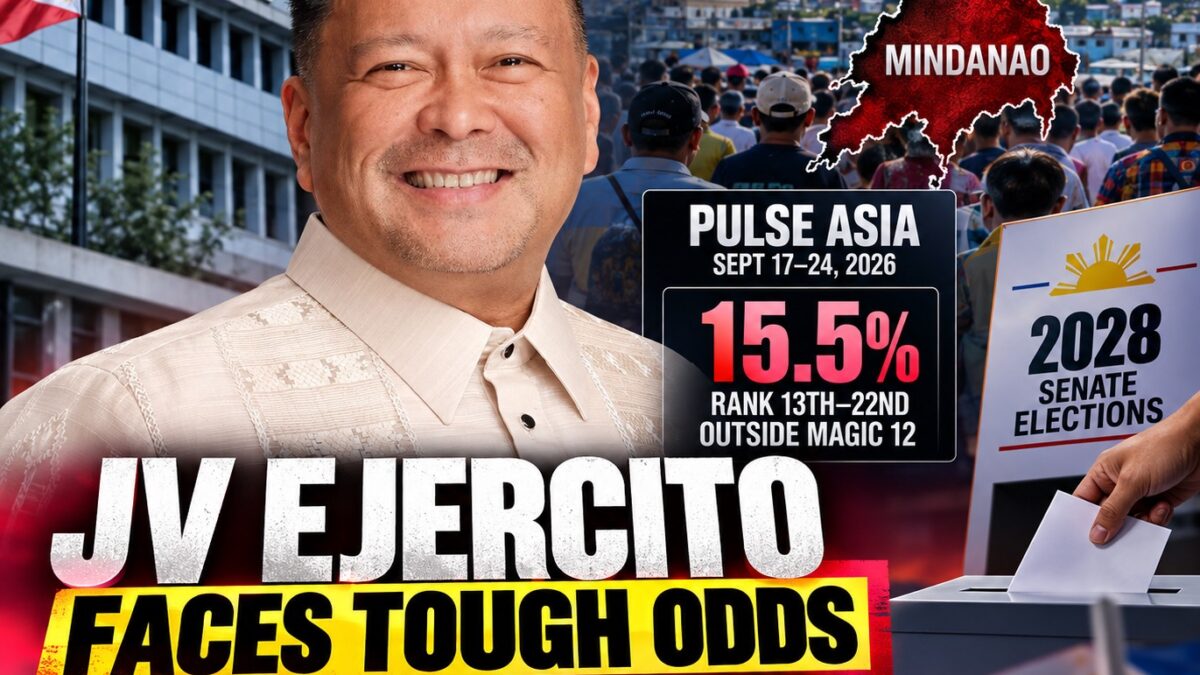
There is a real and growing chance that Senator JV Ejercito will not win a Senate seat in the 2028 elections. The latest national survey puts him well outside the top 12, and a major part of the shortfall appears to come from Mindanao, where his support is weaker than the big names currently leading the race.
What the latest numbers show
In Pulse Asia’s September 17–24, 2026 Ulat ng Bayan survey, voters could choose up to 12 names. Grace Poe led with 50.2%, followed by Alan Peter Cayetano (46.5%), Robin Padilla (45.9%), and Raffy Tulfo (44.4%). Baste Duterte registered 37.2% and Manny Pacquiao 36.5%.
Senator JV Ejercito scored only 15.5% and landed in the 13th-to-22nd ranking cluster. That places him below the clear “Magic 12” and outside the broader group of candidates the survey firm said still had a statistical chance of winning. His awareness is solid at 84%, but preference is low. In simple terms, many people know him, but relatively few currently plan to vote for him.
Earlier surveys from OCTA and Tangere also placed him in the middle-to-lower ranks, often around 11–18%. The pattern has been consistent: he is visible but not competitive enough for a top-12 finish right now.
Why Mindanao is the key problem
Mindanao accounts for roughly one-fifth to one-quarter of the country’s registered voters. In recent elections it has voted heavily as a bloc. In the 2025 midterms, Duterte-aligned candidates dominated the region’s top rankings. National polls in 2026 continue to show the same pattern: Vice President Sara Duterte regularly scores 90%+ preference in Mindanao, and her brother Baste Duterte ranks high nationally largely because of strong southern support.
JV Ejercito comes from the Estrada political family. Historically, former President Joseph “Erap” Estrada and his sons enjoyed notable support in parts of Mindanao—enough that campaign teams once treated certain Mindanao provinces as target areas. That residual base helped JV win his first Senate term in 2013 and return in 2022 (placing 10th).
Those advantages have faded. The Duterte brand now overshadows the older Estrada appeal in much of the south. Baste Duterte, Paolo Duterte, and other southern or Duterte-linked names absorb the votes that once might have gone to Estrada-family candidates. When a candidate is not competitive in a region that holds 20–25% of the electorate, it becomes very hard to make up the difference elsewhere. Luzon has more voters overall, but the top of the poll is already crowded with strong Luzon and national names (Poe, the Cayetanos, the Tulfos, Padilla). Visayas support is mixed and not a guaranteed rescue.
In short: the votes JV is missing to reach the top 12 are disproportionately coming from Mindanao.
Several additional factors make a comeback harder:
• Crowded field and name recognition wars. Media personalities (Tulfos, Revillame), celebrities (Pacquiao), and established political brands occupy the upper ranks. JV’s name still carries weight, but it no longer stands out the way it once did.
• Senate image problems. Public trust in the Senate has slipped amid leadership fights and controversies. As a senior member and Finance Committee chair, JV is tied to the chamber’s performance. He has spoken about restoring order and focusing on the budget, but voters have not yet rewarded that effort with higher preference numbers.
• Incumbency is not automatic. Philippine Senate races are highly competitive. Many incumbents who look safe early on still miss the cut when the final list solidifies and campaigns intensify. JV’s 2022 win was relatively narrow (he finished 10th with a modest margin over the 13th placer).
What the next 3–6 months (roughly November 2026 to April 2027) will likely decide
The next half-year is still early in the 2028 cycle—certificates of candidacy are expected around September 2027—but it is the period when soft rankings harden and regional gaps either start to close or become permanent.
As Senate Finance Committee chair, JV is currently deep in the review of the House version of the proposed ₱7.2-trillion 2027 national budget. He has already flagged large realignments (around ₱206 billion), cuts to foreign-assisted projects such as the Metro Manila Subway and North-South Commuter Railway, reductions in some preventive health programs, and concerns over the calamity fund.
If the Senate restores popular items (health facilities, calamity response, infrastructure that creates jobs) and the process looks clean and transparent—especially after the flood-control controversies—he can generate positive coverage that lifts his national preference numbers a few points. The reverse is also true: if the final budget is seen as still containing “insertions” or if Senate-House clashes drag on, the chamber’s already soft trust ratings will weigh on him further. Expect the real test between November and December 2026, when the Senate plenary and bicameral conference happen. How voters in Mindanao and the Visayas react to any infrastructure or health wins will matter more than the Metro Manila reaction.
Nothing in the next six months is likely to change the basic arithmetic unless JV spends real time and resources in the south. Possible moves in this window include quiet visits or project announcements in former Estrada-friendly provinces (parts of Zamboanga, Davao, Northern Mindanao, or even BARMM areas where he has previously talked about tourism and peace), and early conversations with local leaders. If major Mindanao governors and mayors stay locked into Duterte or other southern slates, JV’s path to the top 12 stays very narrow.
Other variables that can move in this period:
• New surveys (Pulse Asia, OCTA, or Tangere) by early 2027. A drop below 12–13% would signal that the race is effectively over for him; a rise toward 20%+ would show he is still in the conversation.
• Some names now ahead of him may decide not to run, creating an opening. Conversely, if more Duterte-aligned or high-visibility candidates formally signal they are running, the field gets tougher.
• His recent strong comments on the West Philippine Sea and the Chinese ambassador give him a patriotic angle that plays well in Luzon and parts of the Visayas. Sustained statements on sovereignty, plus concrete budget outcomes on health and infrastructure, are the most realistic ways he can gain ground outside Mindanao.
• Risks include further Senate leadership drama, any personal or family controversy, or a perception that he is too aligned with an unpopular administration move.
Bottom line
Based on the September 2026 Pulse Asia numbers, consistent lower rankings in other polls, and the regional voting reality in Mindanao, the probability that Senator JV Ejercito will not return to the Senate in 2028 is currently high. The next 3–6 months will show whether he can stop the slide and begin closing the Mindanao gap. If his budget work generates clear public credit and he makes a credible early push in the south, his odds of still being competitive improve. If the numbers stay around 15% and Mindanao remains solidly with Duterte-linked names, the probability that he misses the Magic 12 rises from “high” to “very high.”
Polls this far from election day can still shift. Alliances, campaign spending, local machinery, and unexpected events matter. For now, however, the data point to a clear gap, and Mindanao is the biggest piece of that gap. The budget process and any deliberate Mindanao outreach are the two levers he still controls before the race tightens.










