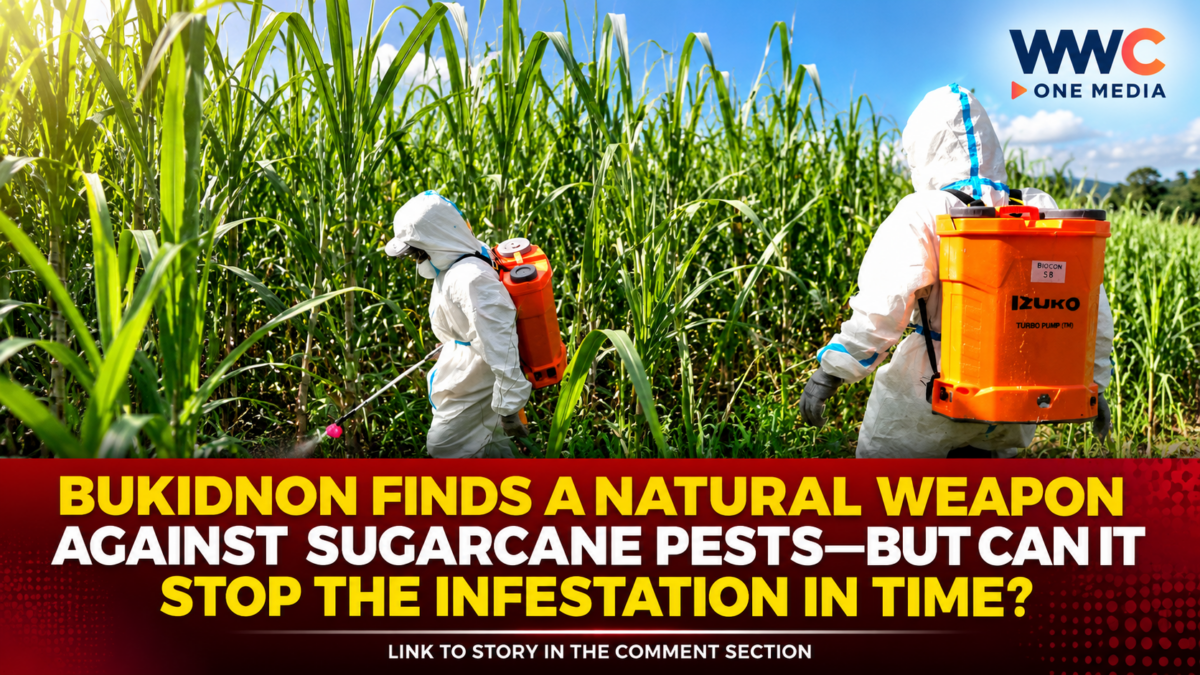
BUKIDNON, Philippines — Biological control agents are offering a promising approach in the fight against the red-striped soft scale insect (RSSI), a destructive pest that has threatened sugarcane farms in Bukidnon and other parts of Mindanao.
The reported progress provides hope for sugarcane growers seeking to protect their crops, reduce potential production losses, and contain an infestation that has raised concerns across the Philippine sugar industry.
The latest development comes as agricultural authorities, sugarcane planters, industry groups, and local governments continue coordinating efforts to manage the pest and prevent it from spreading to additional farms.
How biological control could help protect sugarcane farms
Biological control uses naturally occurring organisms, including beneficial fungi and other pest-control agents, to suppress harmful insects. Unlike conventional chemical pesticides, these methods can offer an alternative approach to pest management when properly developed and applied.
The Department of Agriculture (DA) and the Sugar Regulatory Administration (SRA) have been working to expand the use of biological control against RSSI, including the propagation of locally occurring fungi that can help suppress the pest.
In June 2026, Agriculture Secretary Francisco Tiu Laurel Jr. directed the SRA to accelerate the production of biological control agents, with a target of supplying enough to cover at least 75,000 hectares of sugarcane land.
The initiative reflects growing concern over the pest’s potential impact on sugarcane productivity and farmers’ incomes. The Department of Agriculture reported that RSSI can significantly reduce sugar content in affected sugarcane.
Infestation spread across Mindanao
The scale of the threat became clearer in data reported by the Inquirer and reproduced by the Philippine Sugar Millers Association.
As of July 31, 2026, RSSI had affected 1,306.31 hectares across four provinces in Mindanao. Bukidnon accounted for 415.31 hectares in the reported figures, while the Davao District recorded 800 hectares and Sultan Kudarat 91 hectares.
The pest was first detected in Mindanao on May 2, 2026, according to the report. Its spread prompted warnings from sugarcane industry leaders, who called for stronger monitoring and containment measures.
The infestation also raised concerns about the movement of freshly harvested sugarcane. Trucks transporting infested crops could help carry the pest between farms and milling facilities, making sanitation and transport controls important parts of the response.
Read the Inquirer report reproduced by the Philippine Sugar Millers Association.
Government and industry step up the response
Bukidnon’s response has involved agricultural authorities, local governments, sugarcane planters, and private-sector stakeholders.
Earlier reporting by the Inquirer documented efforts to strengthen monitoring, improve reporting systems, and coordinate containment measures after the infestation was confirmed in parts of the province.
Meanwhile, the DA has pushed to expand biological control production nationally. The agency’s target of covering 75,000 hectares highlights the scale of the effort needed to protect sugarcane farms.
However, production capacity and distribution remain important considerations. In July 2026, Philstar reported that the SRA’s fungal-production facility in La Carlota City could produce enough material to treat approximately four hectares daily at that time. That figure concerned the facility serving the wider biological-control effort and should not be interpreted as Bukidnon’s own treatment capacity.
A promising approach, but challenges remain
Biological control could become an important part of a more sustainable pest-management strategy. Nevertheless, encouraging results in treated areas do not automatically mean that the infestation has been eliminated or that all affected farms have recovered.
The effectiveness of the response will depend on continued monitoring, sufficient supplies of control agents, proper application, and coordination among farmers and government agencies.
The industry must also balance longer-term biological approaches with the immediate need to protect crops from further damage. The SRA has previously cautioned that biological control can take time and may not provide the rapid suppression required during a severe outbreak.
For Bukidnon’s sugarcane farmers, the priority remains containing RSSI before it causes further damage to crops and household incomes.
The crucial question now is whether biological control can be scaled up fast enough to protect more farms and keep the pest from spreading further.










