
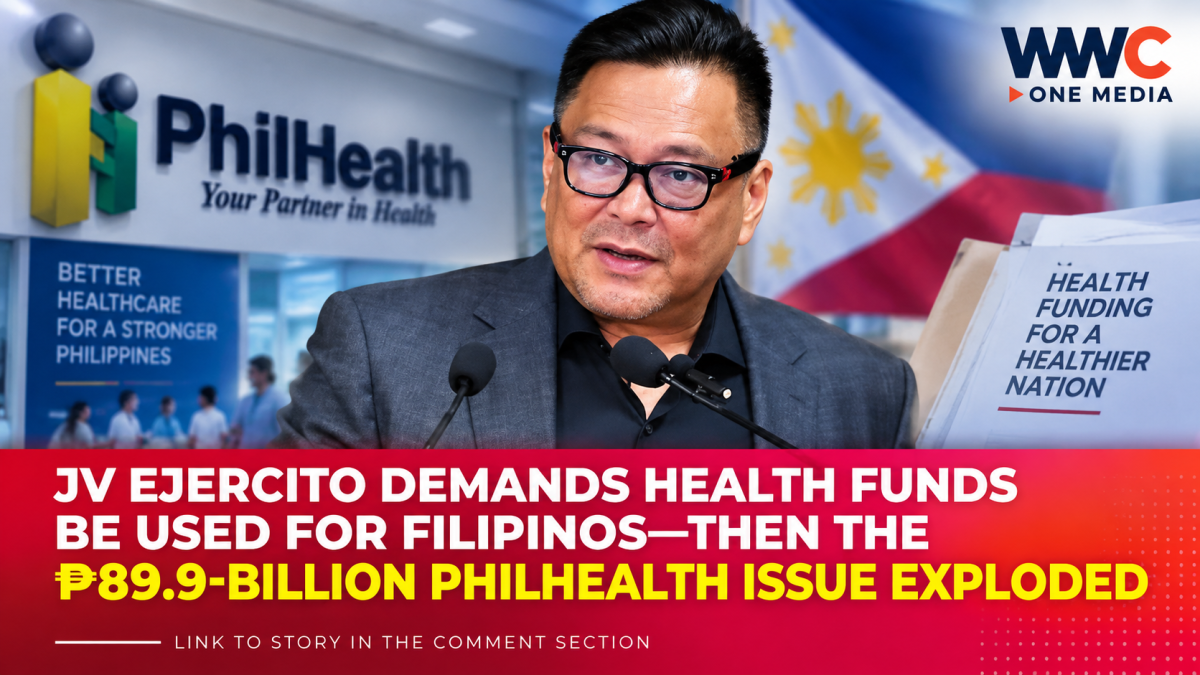
MANILA, Philippines — Senator Joseph Victor “JV” Ejercito pressed the Department of Health (DOH) to ensure that government funds intended for healthcare are actually used to improve services for Filipinos, amid growing scrutiny over billions of pesos in unused PhilHealth funds.
The senator’s call became part of a much larger controversy surrounding ₱89.9 billion in PhilHealth funds that the Department of Finance (DOF) ordered transferred to the National Treasury in 2024.
Ejercito, one of the principal champions of the Universal Health Care (UHC) Act, argued that money earmarked for health should ultimately benefit patients—through better benefits, lower out-of-pocket expenses and stronger healthcare services.
In July 2024, he questioned why PhilHealth had accumulated substantial unused funds while hospitals and patients continued to face financial pressures. He called for the government to make sure that unused healthcare resources were directed toward health programs rather than allowing them to remain idle.
The ₱89.9-billion controversy
The dispute centered on government subsidies to PhilHealth that had not been utilized during 2021, 2022 and 2023.
According to DOF data cited by the Senate, the unused government subsidies amounted to ₱27.1 billion in 2021, ₱24 billion in 2022 and ₱38.8 billion in 2023, or a combined ₱89.9 billion.
The DOF maintained that the money represented unutilized government subsidies, not members’ direct premium contributions, and that the transfer was authorized under the 2024 General Appropriations Act.
Finance Secretary Ralph Recto also said the government had obtained favorable legal opinions before implementing the transfer. The DOF argued that using idle government funds for programmed priorities could avoid additional borrowing.
But Ejercito and other lawmakers questioned whether healthcare funds should be moved away from PhilHealth while the country continued to face gaps in healthcare access and benefits.
Ejercito said PhilHealth should explain why it had failed to fully utilize the money, particularly when many patients remained burdened by medical expenses. He also advocated expanded benefit packages and lower PhilHealth contribution rates.
Ejercito’s bigger concern: make the money work for patients
For Ejercito, the issue went beyond the transfer itself.
The senator argued that PhilHealth needs to improve its ability to absorb and deploy its resources efficiently so that members actually see the benefits through expanded coverage and improved healthcare assistance.
He subsequently filed Senate Resolution No. 1087, seeking an investigation into the transfer and the utilization of PhilHealth funds. He specifically raised the need to examine PhilHealth’s absorptive capacity and whether unused resources could have been better deployed for indigent and poor patients.
His position was straightforward: if government money is intended for healthcare, Filipinos should feel its impact in hospitals, clinics and medical benefits.
Debate over where the money actually came from
The controversy intensified because different sides characterized the ₱89.9 billion differently.
The DOF said the amount came from unused government subsidies, rather than PhilHealth members’ direct contributions. Recto maintained that the transfer did not reduce members’ existing benefit entitlements.
The issue was challenged by lawmakers and health advocates who argued that PhilHealth’s accumulated resources should instead be used to expand benefits, lower contributions and reduce patients’ out-of-pocket expenses.
The Senate’s own proceedings reflected the complexity of the issue, including differing interpretations of PhilHealth’s reserve funds and the distinction between government subsidies, members’ contributions and accumulated funds.
PhilHealth was also facing pressure to improve benefits
At the time of the controversy, PhilHealth was under pressure to make better use of its resources.
During Senate deliberations, Ejercito cited expanded and enhanced benefit packages, including higher coverage for conditions and procedures such as neonatal sepsis, asthma, kidney transplantation, dialysis, breast cancer and open-heart surgery.
The Senate record also noted a 30-percent increase in approximately 9,000 case rates, excluding the separate annual check-up benefit.
PhilHealth’s current benefits framework includes inpatient and outpatient coverage, while its packages have continued to evolve to cover more medical services.
The controversy eventually reached the Supreme Court
What began as a dispute over the use of excess PhilHealth funds eventually became a major constitutional case.
PhilHealth remitted ₱60 billion to the National Treasury in three tranches—₱20 billion in May 2024, ₱10 billion in August and ₱30 billion in October—before the Supreme Court issued a temporary restraining order preventing the transfer of the remaining ₱29.9 billion.
The Supreme Court ultimately ruled in December 2025 that the transfer mechanism was unconstitutional.
The Court unanimously ordered the return of the ₱60 billion already transferred and permanently prohibited the transfer of the remaining ₱29.9 billion. It also declared the relevant provision of the 2024 General Appropriations Act and DOF Circular No. 003-2024 void.
That ruling fundamentally changed the outcome of the controversy that Ejercito and other lawmakers had raised in 2024.
The ₱60 billion is now back in the healthcare picture
The government subsequently moved to restore the ₱60 billion that had already been remitted.
In September 2025, President Ferdinand Marcos Jr. announced that the money would be returned to PhilHealth for the expansion of healthcare services. The DOF later confirmed the restoration and said the additional resources could support the government’s Zero Balance Billing initiative and expanded benefits.
The DOF also reported that much of the ₱60 billion had already been used for health and social programs while it was under the National Treasury.
Among the cited expenditures were:
- ₱27.45 billion for health emergency benefits and allowances for pandemic frontliners;
- ₱10 billion for medical assistance to indigent and financially incapacitated patients;
- ₱4.10 billion for medical equipment for DOH, LGU and primary-care facilities;
- ₱3.37 billion for construction of three DOH health facilities; and
- ₱1.69 billion for the Health Facilities Enhancement Program.
So while the fund transfer itself was struck down, government records show that a substantial portion of the money had already been directed toward health and social programs.
A new test for Universal Health Care
The controversy highlights a bigger question facing the Philippine healthcare system: Is the problem a lack of money—or the government’s ability to deploy available money effectively?
Ejercito has repeatedly argued that PhilHealth resources should translate into tangible benefits for members, including lower financial burdens and better coverage.
His push to amend the UHC Act included provisions designed to strengthen PhilHealth’s financial management, expand benefits and prevent its funds from being transferred to unrelated government programs. The Senate approved its version of the amendments in 2024, although the measure remained subject to the legislative process.
And the pressure to make healthcare spending more visible to ordinary Filipinos continues.
As of September 2026, the Department of Budget and Management has approved ₱10.377 billion for the government’s Zero Balance Billing program, covering DOH hospitals nationwide and six pilot LGU hospitals. The initiative is aimed at reducing the hospital costs shouldered by eligible patients.
The direction is increasingly clear: government health spending is being judged not merely by how much money is allocated, but by whether patients actually experience better, more affordable care.
For Ejercito, that has been the central issue from the beginning—healthcare funds should ultimately be felt where they matter most: in the hands of patients who need treatment.
WWC ONE MEDIA M.J.E
Leave a Reply