
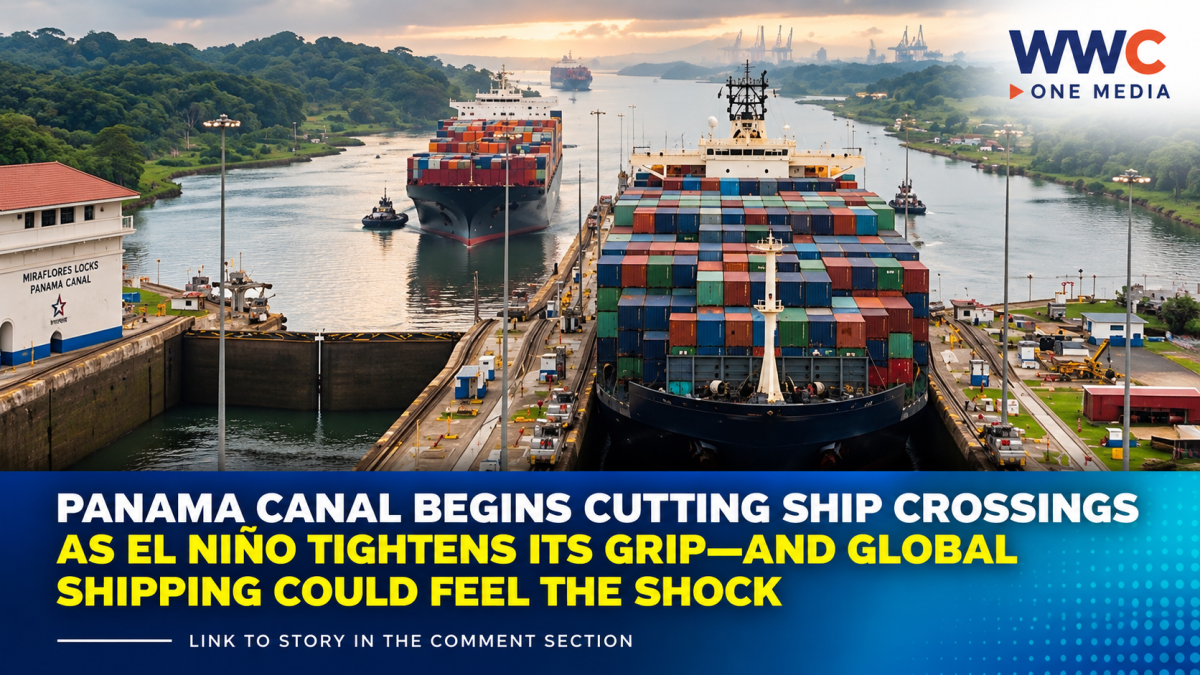
PANAMA CITY — The Panama Canal has begun reducing the number of ships allowed to pass through the vital waterway as worsening drought and a strengthening El Niño threaten the freshwater supplies needed to keep the canal operating.
Starting September 4, 2026, daily transit capacity is being reduced from the recent level of about 36 vessels to 34 ships, with another cut to 32 vessels a day beginning September 15, according to the Panama Canal Authority (ACP).
The move marks a significant warning for global shipping because the canal is one of the world’s most important maritime shortcuts, connecting the Atlantic and Pacific oceans without requiring vessels to make much longer journeys around South America.
The canal handles roughly 5% of global maritime trade and around 40% of US container traffic, making disruptions potentially significant for shipping schedules, freight costs and supply chains.
Why is the Panama Canal running short of water?
Unlike conventional sea-level waterways, the Panama Canal relies heavily on freshwater reservoirs to operate its locks.
Two artificial lakes, including Gatun Lake, provide the water required to raise and lower ships as they move between the Atlantic and Pacific.
But rainfall in the canal watershed has fallen sharply.
The ACP said precipitation from May through August 2026 was 34% below the historical average, while watershed inflows were 44% below normal. The authority warned that deteriorating rainfall conditions and the expected severity of the 2026–2027 El Niño event required additional conservation measures.
That has forced Panama to make an uncomfortable calculation: preserve enough freshwater to keep the canal functioning while also protecting water resources needed by the population.
The new restrictions
Under the ACP’s latest measures, the Neopanamax locks will have nine daily booking slots, while the older Panamax locks will have 25 slots beginning September 4.
From September 15, Panamax capacity will be reduced further to 23 slots, bringing total daily capacity to 32.
The authority has also adjusted the maximum draft permitted for large Neopanamax vessels.
The planned 14.63-meter (48-foot) maximum draft was postponed to September 2, while the subsequent reduction to 14.48 meters (47.5 feet) has been postponed until October 1.
The measures are designed to conserve water while maintaining the canal’s long-term operating capacity.
El Niño is making the problem worse
The timing is particularly concerning because the current El Niño is expected to strengthen substantially.
The World Meteorological Organization said on September 3 that El Niño is already firmly established and is expected to intensify to very strong levels later this year.
The WMO also placed the likelihood of El Niño continuing through February 2027 at nearly 100%, warning of increased risks of drought, floods and extreme heat in different parts of the world.
The Panama Canal is particularly vulnerable because its operations depend directly on rainfall and reservoir levels.
The canal authority has therefore moved earlier than it did during the previous water crisis, attempting to avoid a repeat of the severe restrictions imposed in 2023 and early 2024.
The 2023 crisis offers a warning
The current situation is reminiscent of the canal’s previous water crisis.
During the 2023 drought, authorities progressively cut vessel traffic, eventually reducing daily booking capacity to just 22 vessels during the most severe period.
At one point, vessels faced extraordinary delays as a growing queue formed outside the canal.
The disruption became particularly serious because the Panama Canal was already under pressure from ships diverted away from the Red Sea amid attacks on commercial shipping.
Reuters reported in 2024 that some ships were forced to wait as long as 21 days during the earlier crisis.
The 2026 restrictions are not yet at those 2023 levels, but the direction is worrying shipping companies: less water means fewer ships can safely transit.
Shipping costs could rise
A reduction in available transit slots does not automatically mean a global supply-chain crisis, but it can increase competition for canal passages.
Ships without secured reservations could face longer waiting periods, according to the ACP, which is encouraging customers to use its booking system to secure transit dates.
Recent events illustrate just how valuable a guaranteed passage can become.
CNA reported that South Korean company SK Gas paid US$5.3 million for priority passage of its LPG tanker G Spirit through the canal on September 1, shortly before the latest restrictions took effect.
That record payment underscores the potential economic value of a canal slot when shipping demand is high and capacity becomes constrained.
Why the Philippines and Asia should pay attention
The Panama Canal may be thousands of kilometers from the Philippines, but disruptions there can have consequences far beyond Panama.
The waterway is an important link for trade between Asia and the eastern United States and Gulf Coast markets.
When canal capacity falls, shipping companies can consider alternative routes—but those alternatives generally mean longer sailing distances, higher fuel consumption, additional transit time and potentially higher freight costs.
That can eventually feed into the prices of imported goods and the cost of moving commodities around the world.
The risk becomes even more significant when multiple maritime chokepoints are under pressure simultaneously.
Panama has already started adapting
The canal authority says the latest restrictions are temporary and will continue to be evaluated according to rainfall, watershed inflows and lake levels.
It has also introduced water-saving measures and changes to its vessel-booking system designed to maximize the efficient use of available water.
The challenge is that this is no longer simply a shipping problem.
The same freshwater resources supporting canal operations are also important to Panama’s population.
During the previous drought, researchers highlighted the difficult balance between preserving water for human consumption and maintaining commercial shipping. Lake Gatun, in particular, is crucial to Panama’s water system.
The bigger warning
The latest restrictions show how vulnerable a major piece of global infrastructure can become when its most basic resource—water—starts running short.
And the timing could hardly be more challenging.
The WMO expects the current El Niño to strengthen further, while the Panama Canal is already reporting rainfall and watershed inflows well below normal.
For now, ships are still moving through the canal.
But the question confronting global shipping is increasingly difficult to ignore:
How far will Panama have to go if the rain does not come back?
WWC ONE MEDIA M.J.E



Leave a Reply