
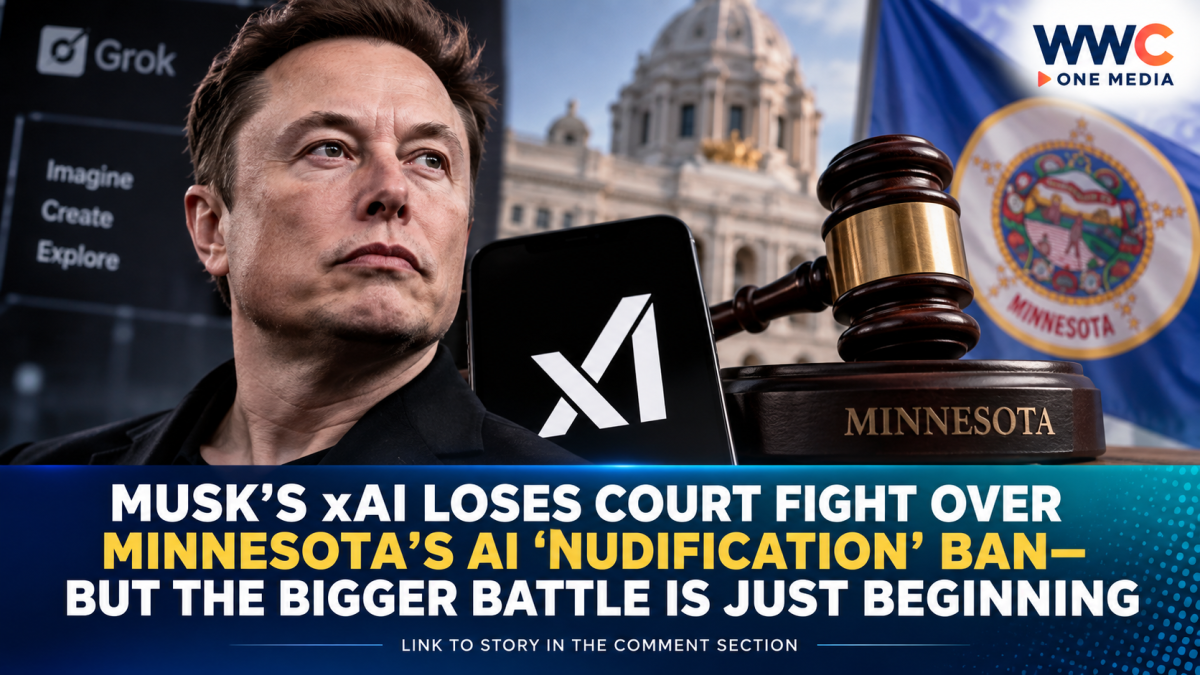
WASHINGTON — Elon Musk’s artificial intelligence company xAI has suffered another legal setback in its fight against Minnesota’s first-of-its-kind ban on AI-generated “nudification” images, after a federal judge refused to temporarily block the law while the company’s constitutional challenge moves forward.
U.S. District Judge Donovan Frank on Friday, September 4, rejected xAI’s request for a preliminary injunction, ruling that the company had not shown the kind of immediate, irreparable harm necessary to justify putting the Minnesota law on hold.
The decision means the law, which took effect on August 1, 2026, remains enforceable while xAI continues its broader lawsuit against Minnesota. xAI has indicated that it plans to appeal the ruling to the 8th U.S. Circuit Court of Appeals.
Why xAI challenged Minnesota’s AI law
The legal dispute centers on Minnesota’s new prohibition against “nudification” technology — AI tools that can alter or generate images or videos to make an identifiable person appear to have exposed intimate body parts that were not present in the original image.
The legislation, HF 1606, prohibits owners or operators of websites, applications, software, programs and other services from allowing users to access or use those services to create such images. It also addresses the advertising and promotion of nudification services.
Minnesota lawmakers approved the legislation with overwhelming bipartisan support. The Senate passed the measure 65-0, while the House approved it by a 132-1 vote before Gov. Tim Walz signed it on May 7. The law became effective August 1.
The law can carry a civil penalty of up to $500,000 for each unlawful access, download or use, while people depicted in prohibited images can pursue civil remedies, including damages and injunctive relief.
xAI argues the law goes too far
xAI sued Minnesota in July, arguing that the statute violates the First Amendment and is an overly broad, content-based restriction on protected expression.
The company has argued that the law could potentially sweep in legitimate forms of image creation and editing and does not adequately distinguish between unlawful sexualized deepfakes and other forms of expression.
In its lawsuit, xAI pointed to potential applications involving artistic, satirical, educational, scientific and other forms of expression, arguing that less restrictive alternatives could address nonconsensual sexual imagery without imposing such broad liability on AI platforms.
The company also contends that its own policies prohibit users from creating nonconsensual sexualized images.
Minnesota says the law is about preventing harm
Minnesota Attorney General Keith Ellison has defended the law as a targeted measure designed to protect people from the increasingly sophisticated misuse of AI.
The state argues that the law addresses a serious and growing problem: the use of generative AI to transform photographs of real people into realistic sexual images without their permission.
Minnesota officials have also cited concerns about AI-generated child sexual abuse material and harassment associated with so-called nudification tools.
The state’s position is that the statute regulates access to a technology that facilitates harmful conduct rather than broadly prohibiting protected speech.
Judge says the constitutional fight is far from over
Friday’s ruling does not represent a final decision on whether Minnesota’s law is constitutional.
Instead, Judge Frank determined that xAI had not met the demanding requirements for a preliminary injunction. Reuters reported that the judge described the constitutional questions surrounding the emerging technology as complex and said they deserved full consideration as the underlying case proceeds.
That distinction is important.
For now, Minnesota can enforce the law. But xAI’s underlying First Amendment lawsuit remains alive, setting up a potentially significant legal battle over how far states can go in regulating AI systems capable of generating realistic sexualized imagery.
The legal pressure on Grok is growing
The Minnesota lawsuit comes as Musk’s Grok chatbot faces increasing scrutiny over its ability to generate sexualized imagery.
Regulators outside the United States have also taken action.
In January, the United Kingdom’s communications regulator Ofcom opened a formal investigation into X after reports that Grok was being used to create and distribute undressed or sexualized images of real people, including children. Ofcom said the reported material could potentially constitute intimate-image abuse, pornography or child sexual abuse material.
The regulatory attention has continued alongside lawsuits and other challenges involving xAI and users accused of abusing Grok’s image-generation capabilities.
Reuters reported that xAI has itself begun pursuing users it alleges circumvented Grok’s safeguards to create sexual images of people without their consent.
Why this case could matter far beyond Minnesota
The dispute is bigger than one state’s AI law.
Generative AI has made it increasingly easy to manipulate photographs and produce convincing synthetic imagery. That has created a difficult policy question: where should governments draw the line between protected expression and technology that facilitates abuse?
Minnesota has chosen to place significant responsibility on the companies providing the technology.
xAI, meanwhile, is arguing that the government’s approach risks sweeping protected forms of expression into the same regulatory net.
That clash between AI innovation, free speech and protection from digital sexual abuse could eventually produce a precedent with implications well beyond Minnesota.
For Musk and xAI, the latest ruling is therefore a setback — but not the end of the fight.
The company says it plans to appeal, meaning the next major chapter could unfold before the federal appeals court as the legal battle over AI-generated sexual imagery moves into a much broader constitutional debate.
For now, Minnesota’s ban stays in force. The bigger question is whether it will ultimately survive xAI’s First Amendment challenge.
WWC ONE MEDIA J.M.S




Leave a Reply