
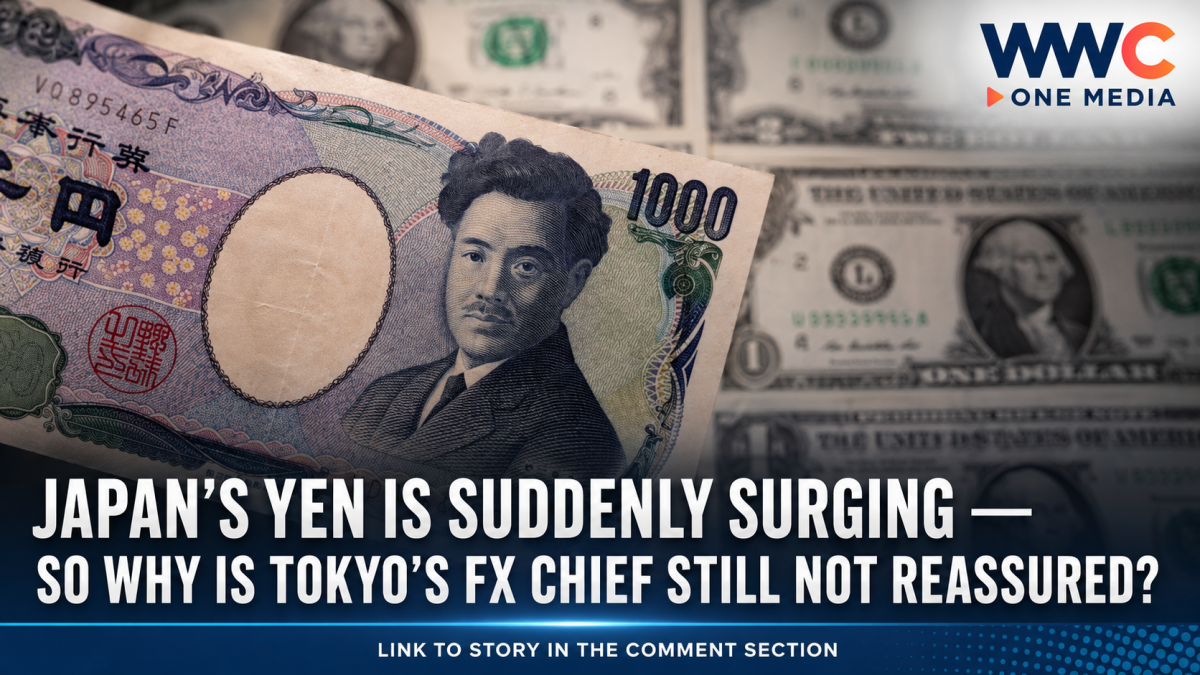
TOKYO — Japan’s yen has staged one of its sharpest rallies in weeks, speculation over another Bank of Japan interest-rate hike is exploding, and fears of fresh currency intervention are back on traders’ screens.
But Japan’s top currency official is not celebrating.
Atsushi Mimura, Japan’s vice finance minister for international affairs and the country’s chief foreign-exchange diplomat, said Thursday, September 3, that authorities remain on “heightened alert” over moves in the currency market.
Mimura declined to discuss specific exchange-rate levels and would not say whether Japanese authorities had conducted a so-called rate check, but made clear that Tokyo was not comfortable with what it was seeing.
He said he was “neither satisfied nor reassured” by recent currency-market developments.
That may sound surprising because the yen is moving in the direction Japanese policymakers have spent months trying to achieve.
Yen Suddenly Roars Back
The Japanese currency surged nearly 1.5% on Thursday and reached roughly ¥156.36 against the US dollar, its strongest level in about a month, after gaining around 0.9% in the previous session.
The move was broad enough to catch traders’ attention and immediately revive questions about whether Tokyo had returned to the market.
But there has been no confirmation of fresh intervention.
Instead, traders and analysts increasingly point to something potentially more powerful: expectations that the Bank of Japan is preparing to raise interest rates again.
That distinction matters.
Japan can spend billions buying yen to push the currency higher, but intervention does not necessarily eliminate the economic forces pushing it lower. Higher Japanese interest rates, on the other hand, could begin shrinking the enormous yield advantage investors have enjoyed by holding dollars and other higher-yielding currencies instead of yen.
That interest-rate gap has been one of the fundamental forces behind years of yen weakness.
A September BOJ Rate Hike Is Suddenly Looking Much More Real
Pressure on the Bank of Japan has intensified dramatically.
BOJ board member Hajime Takata said this week that the central bank should be willing to raise interest rates more nimbly rather than following a predictable schedule.
Takata argued that 2026 represents an important turning point as inflation risks increase and economic conditions change.
BOJ Governor Kazuo Ueda has also signaled that the central bank will closely examine inflation and economic risks when policymakers meet later this month.
Markets are now heavily betting on another rate increase. Reuters reported that expectations for a September hike have moved close to being fully priced into markets.
The timing is important.
The Bank of Japan raised its policy rate to 1% in June, its highest level in decades, before leaving rates unchanged at its July meeting. Its next scheduled monetary policy meeting will take place on September 17 and 18.
The BOJ itself has confirmed that board member Takata delivered a fresh monetary-policy speech on September 2, adding to the market’s focus on how quickly Japan could continue normalizing rates.
Why Mimura Is Still Worried
Mimura’s caution suggests Tokyo is watching more than simply whether the yen rises or falls.
Japanese officials have repeatedly emphasized the importance of orderly currency movements rather than publicly defending one specific exchange rate.
Fast, speculative swings can create problems in either direction.
A weak yen makes imported fuel, food and raw materials more expensive for Japanese households and companies. But a sudden uncontrolled surge in the currency can also hurt exporters and disrupt financial markets.
And recent history explains why officials may be reluctant to declare victory.
The yen fell to around ¥163.98 per dollar in July, its weakest level in roughly 40 years, before Japan and the United States undertook rare coordinated action to support the currency.
The joint intervention was the first coordinated US-Japan yen intervention since 2011.
Japan subsequently disclosed that it spent a record ¥15.4 trillion, or about US$96.5 billion, between July 30 and August 26 supporting the yen.
Yet even an intervention on that scale did not permanently solve the problem.
The currency later gave back a substantial portion of its gains.
That is why the latest rally may be more significant if it is being driven by changing interest-rate expectations rather than another burst of government buying.
Did Japan Conduct a “Rate Check”?
That question remains unanswered.
When reporters asked Mimura whether authorities had conducted one, he declined to comment.
A rate check occurs when monetary authorities contact currency dealers to ask for current market prices.
It sounds routine, but markets pay close attention because such inquiries can sometimes be interpreted as a warning that direct intervention is being considered.
The Japan Times reported that traders saw no clear evidence of outright intervention during Thursday’s rally, although some believed the earlier market movement could have been consistent with a rate check.
For now, there is no official confirmation that either occurred.
Washington Is Now Part of the Yen Story
Another unusual factor is the increasingly visible role of the United States.
Mimura said Japanese Finance Minister Satsuki Katayama and US Treasury Secretary Scott Bessent had held productive discussions about markets and wider G20 cooperation.
Japan and the United States had already agreed earlier this week to maintain close coordination aimed at ensuring orderly movements in the yen.
Bessent has also publicly pushed Japan toward tighter monetary policy.
Reuters reported that the US Treasury secretary urged BOJ Governor Kazuo Ueda to pursue sufficiently decisive monetary measures to contain inflation expectations and currency volatility.
That makes the situation highly unusual.
The yen is no longer simply a story about Tokyo versus currency speculators.
It increasingly involves the Japanese government, the independent Bank of Japan, global bond markets and Washington—all trying to prevent extreme currency movements while dealing with inflation and sharply different interest-rate environments.
The Bigger Question: Can the Yen Rally Without Another Rescue?
For investors, that may now be the most important question.
Japan has already demonstrated that it is prepared to spend enormous amounts of money defending the yen. The United States has demonstrated that it is willing to cooperate.
But interventions traditionally work best when economic fundamentals eventually move in the same direction.
Financial Times reporting also tied the latest strengthening to rising expectations of BOJ tightening, while The Wall Street Journal said the yen reached a near-one-month high as investors increasingly considered the possibility of a more aggressive Bank of Japan.
That means the next BOJ meeting could prove more important for the currency than another warning from the Finance Ministry.
If the Bank of Japan raises rates—and convinces markets that further tightening remains possible—the yen could finally gain structural support rather than relying primarily on government intervention.
But if policymakers disappoint investors, traders could again test Tokyo’s resolve.
That may explain Mimura’s seemingly contradictory message.
The yen is stronger. Japan’s currency chief is still worried. And the real battle may now be shifting from the foreign-exchange market to the Bank of Japan’s September meeting.
WWC ONE MEDIA MJE

Leave a Reply