
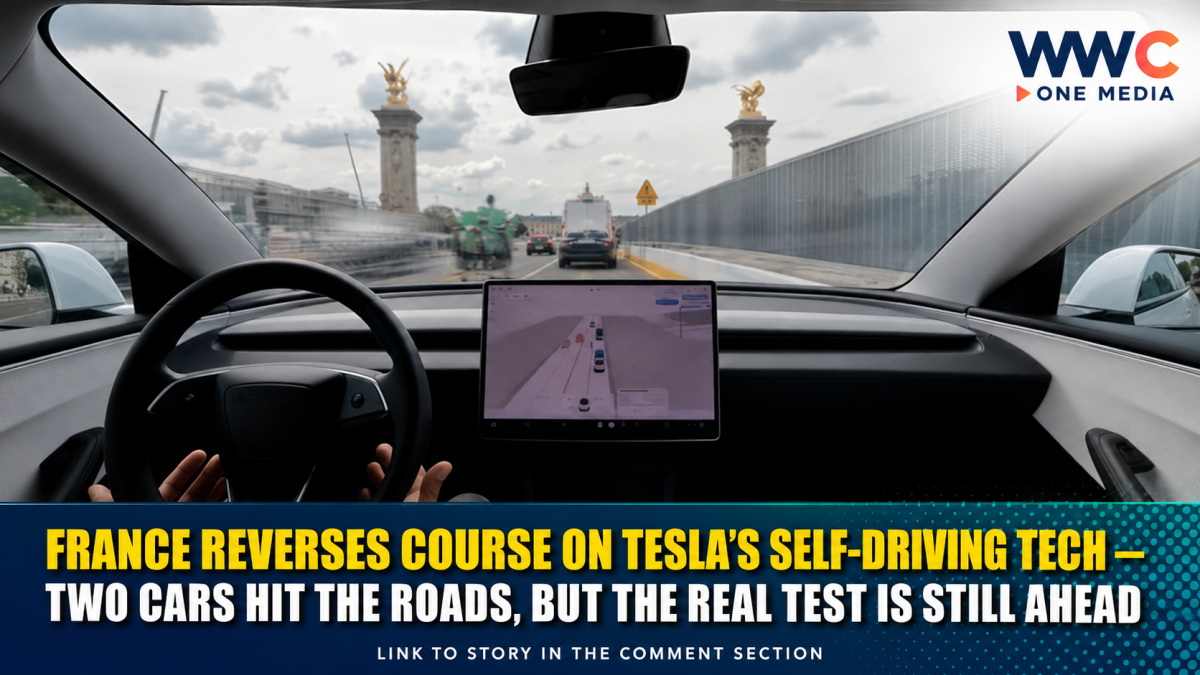
France is taking a major new step toward Tesla’s Full Self-Driving technology after previously resisting its deployment, with two Tesla vehicles now being made available for road testing as European regulators weigh the system’s wider approval.
French Transport Minister Philippe Tabarot announced the development on September 2 following a video meeting with Tesla CEO Elon Musk. According to the minister, French authorities have been working with Tesla for several months on technical changes that could address France’s concerns and allow the country to support European approval of the system.
The two Tesla vehicles equipped with Full Self-Driving, or FSD, will now undergo testing on French roads.
The move represents a notable shift from France’s position just weeks earlier.
In July, Tabarot said France was not prepared to authorize Tesla’s FSD in its existing form, arguing that the technology had made significant progress but that its safety guarantees were not yet sufficient. Among the concerns raised were how the system handles speed and whether drivers remain sufficiently attentive during complicated urban driving situations.
France is testing — not approving — Tesla FSD
The latest announcement does not mean French motorists can suddenly activate Tesla FSD.
Instead, the two vehicles will allow authorities to evaluate the system under real-world French driving conditions and determine whether Tesla’s proposed technical adaptations adequately address the concerns previously raised by regulators. French media reports say particular attention is expected to focus on speed management and driver monitoring.
Tesla itself describes FSD as a supervised driving system. Despite its name, it is not the same as a fully autonomous vehicle in which a human driver can simply stop paying attention. Tesla’s French website says the feature remains subject to regulatory approval and requires active supervision.
That distinction is crucial as the debate over autonomous driving intensifies across Europe.
Five European countries have already opened the door
Tesla’s European push gained momentum earlier this year when the Netherlands became the first EU country to provisionally approve FSD in April.
Belgium, Denmark, Estonia and Lithuania subsequently followed, creating a group of five European countries where Tesla says its supervised system has received provisional approval.
Tesla is now trying to persuade European regulators that the system can be expanded more broadly.
On September 1, the company released safety data covering more than 100 million kilometres of driving in those five countries. Tesla said vehicles operating with supervised FSD recorded 4.1 times fewer collisions than comparable manually driven Tesla vehicles.
However, the figures are Tesla’s own analysis, and their methodology has drawn scrutiny. Reuters previously reported concerns about Tesla’s safety comparisons and the use of company-generated data in its European regulatory campaign.
Why France matters
France’s position could become particularly important because approval of automated-driving technology is governed by a broader European regulatory framework.
Under the EU’s vehicle type-approval system, certification obtained through the relevant approval process can allow a vehicle type to be marketed across the bloc without each country conducting an entirely separate approval process.
That makes France more than just another market for Tesla.
If French authorities become comfortable with the technical modifications and ultimately support wider European approval, it could strengthen Tesla’s case as regulators consider the company’s next step.
But there is still a significant gap between road testing and authorization.
Tesla still faces a major regulatory test
France’s change in tone comes only weeks after the government publicly objected to approving FSD because of safety concerns.
The latest move therefore looks less like an immediate green light and more like a high-stakes evaluation.
Tesla needs to demonstrate that its system can handle French roads and traffic conditions while satisfying regulators on issues including speed control, driver attention and overall safety.
The EU’s regulatory process remains the decisive hurdle for broader deployment.
Meanwhile, Tesla is pushing aggressively on several fronts. The company is also promoting FSD passenger experiences in France, although its French website continues to state that regulatory approval is required before the technology can be made available for purchase there.
For Tesla, the stakes are enormous.
The company is increasingly tying its future growth story to artificial intelligence, autonomous driving and robotaxis. At the same time, rivals such as Waymo are expanding their own autonomous-driving operations, increasing pressure on Tesla to turn its long-running promises about self-driving technology into commercially viable services.
France has now moved from saying “not yet” to saying “show us.”
And the results of those two road tests could help determine whether Tesla’s self-driving ambitions finally move closer to becoming a European reality.
WWC ONE MEDIA MJE




Leave a Reply