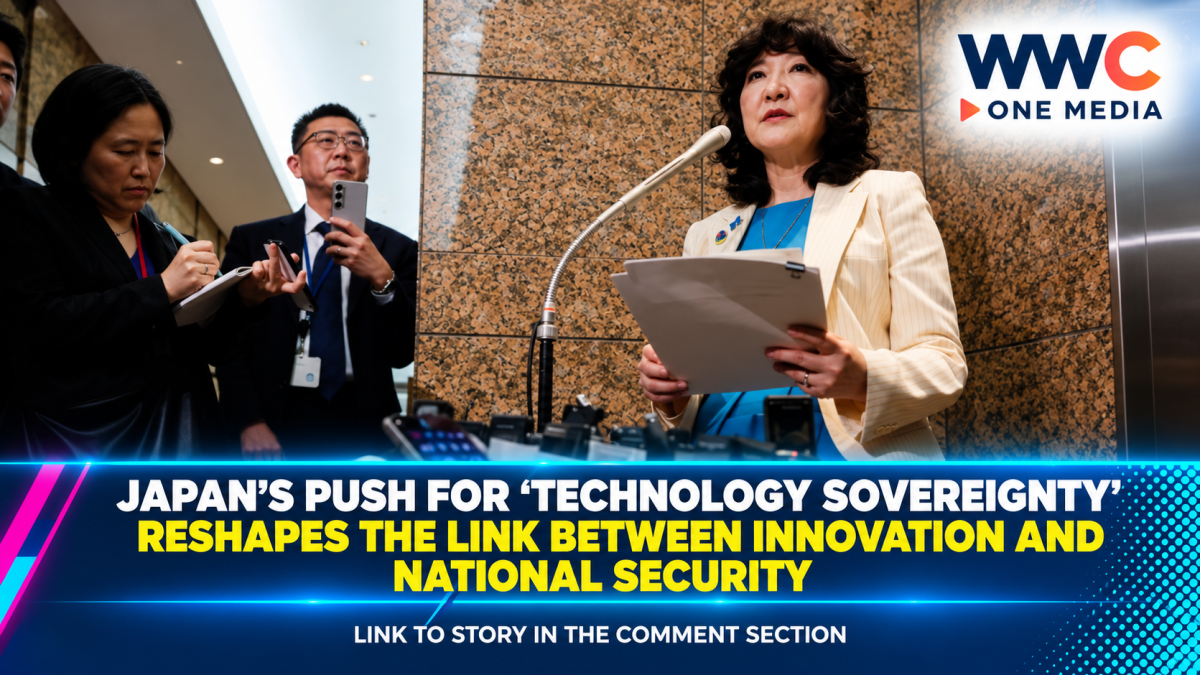
Japan is placing greater emphasis on technology as a component of national security, as governments increasingly view advanced industries and critical technologies as strategic assets rather than purely commercial tools. The shift is expanding the definition of security to include research, supply chains, industrial capacity and access to key technologies.
At the center of the debate is the idea of “technology sovereignty” — the ability of a country to maintain sufficient control over technologies that are considered essential to its security and economic resilience. The concept does not necessarily mean producing everything domestically, but reducing vulnerabilities created by excessive dependence on foreign suppliers or technologies.
The issue has become more prominent as artificial intelligence, semiconductors, robotics, quantum technologies and other dual-use fields can serve both civilian and military purposes. Investment in these areas is increasingly being viewed as a way for governments to build capabilities that could become critical during periods of geopolitical tension.
Japan’s 2022 National Security Strategy already identified technology and economic security as part of a broader national-security framework. The document states that the boundaries between military and nonmilitary areas are becoming less distinct, with economic, technological and cyber issues increasingly connected to national security.
That approach has also been reflected in Japan’s Economic Security Important Technology Development Program, commonly known as the K Program. The initiative brings together government ministries and agencies to support research and development in strategically important technologies, including projects intended to strengthen Japan’s technological advantage and reduce vulnerabilities.
The challenge is deciding where government support should be concentrated. Governments cannot realistically become self-sufficient across every part of the modern technology supply chain, making selective investment and partnerships important parts of any technology-security strategy.
Recent policy discussions in Japan have placed particular attention on strengthening research and development, developing skilled personnel, supporting startups, expanding industrial capacity and protecting sensitive technologies from unwanted transfer. A proposal released by Japan’s ruling Liberal Democratic Party in May called for stronger investment in important technologies and greater cooperation with like-minded countries while also strengthening safeguards against technology leakage.
The debate also extends beyond Japan. Other middle powers face similar questions as technological competition between the United States and China affects access to AI systems, semiconductors, industrial equipment and other strategic technologies. Analysts have argued that countries such as Japan, South Korea and European states may need enough domestic capability and collective bargaining power to preserve meaningful choices without attempting complete technological independence.
For Japan, the issue is particularly significant because its economy remains deeply integrated into global supply chains. Building technological resilience therefore involves balancing domestic research and production with international trade, investment and cooperation.
The stakes are also rising as technology becomes increasingly intertwined with military capability, economic competitiveness and critical infrastructure. Control over advanced computing, communications, robotics and semiconductor technologies can influence not only commercial markets but also a country’s ability to respond to security disruptions.
Japan’s emerging approach therefore represents a broader shift in how technological policy is being viewed: innovation is no longer solely an economic growth issue but increasingly part of national resilience and strategic planning.
The difficult question ahead is how Japan can strengthen control over critical technologies without undermining the international partnerships and open markets that have helped drive its technological development.