
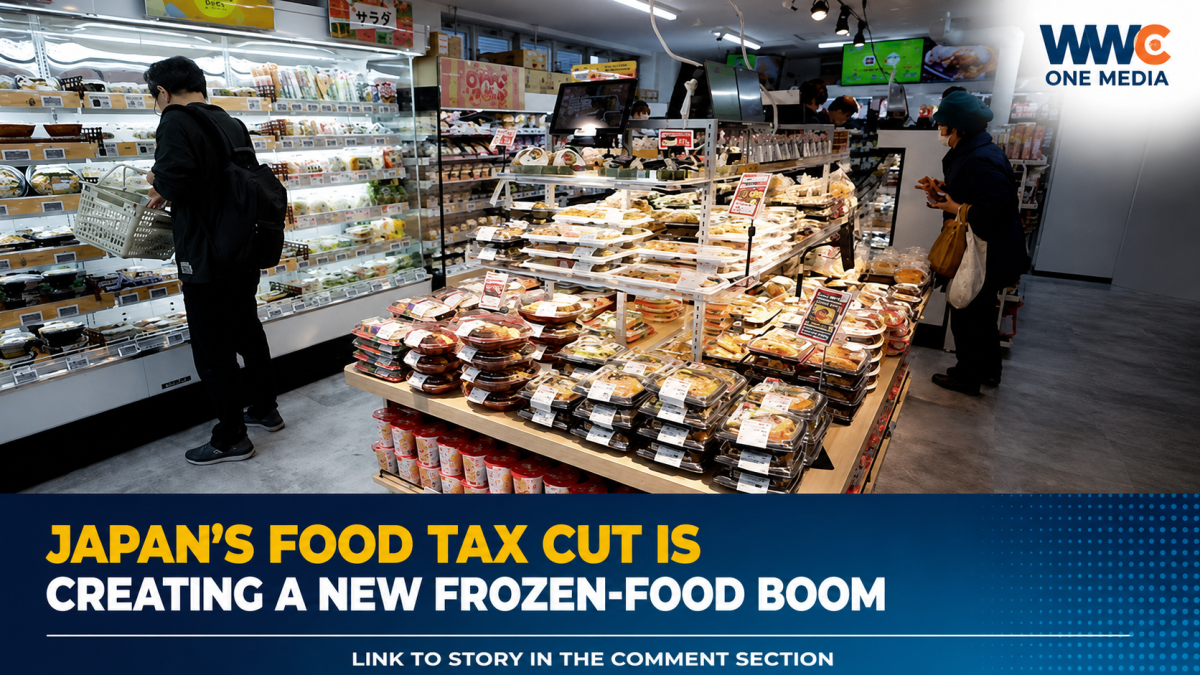
Japan’s planned reduction in the consumption tax on food is already prompting companies to rethink how Japanese households may spend their grocery budgets — and frozen food is emerging as one of the businesses looking to benefit.
The Japanese government has approved a plan to reduce the consumption tax on food and beverages from 8% to 1% for two years beginning in April 2027. The policy is intended to ease the pressure of rising living costs, while the government prepares a longer-term income-linked support system.
Why frozen food could be a big winner
The tax structure creates a significant difference between eating at home and dining out.
Under the planned system, food purchased for consumption at home, including takeout food, would be subject to the lower 1% rate, while dining at restaurants would remain subject to the 10% consumption tax.
That potential price gap is encouraging companies to look at frozen meals as an opportunity to capture more household spending.
Takashimaya has moved directly into the market, launching its first original frozen prepared-food brand, “Hyakumi Saisai,” on Sept. 2. The retailer says frozen food has increasingly shifted from being viewed mainly as emergency or stored food to becoming an everyday meal option.
The new Takashimaya brand initially includes popular prepared dishes such as sweet-and-sour pork, eight-treasure stir-fry, shrimp in chilli sauce, spicy miso eggplant and mapo eggplant. Additional hamburger and gratin products are planned for October.
Mos Burger is making its own move
Restaurant operator Mos Food Services is also entering the household frozen-food market with a new brand called MOS Deli.
The company began selling its first products on Sept. 1 through supermarkets and drugstores. The lineup includes frozen grilled rice-ball products filled with beef kalbi or chicken kinpira, designed to be prepared quickly at home.
The move is significant because it allows a restaurant brand to reach consumers outside its traditional stores and compete directly for household food spending.
It also illustrates the broader opportunity companies see in Japan’s changing food habits.
Japan’s frozen-food market is already expanding
The tax cut is not creating the frozen-food trend from scratch.
Takashimaya says Japan’s domestic frozen-food consumption surpassed 3 million tonnes for the first time in 2025, citing data from the Japan Frozen Food Association. The company also points to the growth of dual-income households and demand for convenient meals as factors supporting the market.
That means businesses are entering a market that was already expanding before the tax change.
For consumers, frozen prepared meals can offer another alternative to restaurant dining while reducing preparation time at home.
But the tax cut comes with a huge price tag
The potential benefit for consumers comes with a major fiscal challenge for the Japanese government.
The tax reduction is expected to create a revenue shortfall of roughly ¥5 trillion a year. The government has said it intends to fund the measure without relying on deficit-financing bonds, but the plan has generated concerns over Japan’s already heavy fiscal burden.
Prime Minister Sanae Takaichi has said the government intends to develop the detailed framework in September and submit legislation to an extraordinary session of the Diet, with the goal of implementing the policy in April 2027.
Reuters has also reported that the tax plan is adding to broader concerns about Japan’s fiscal policy, government bond yields and the weakening yen.
A tax change that could reshape how Japan eats
If the lower food tax is implemented as planned, the impact could extend beyond household budgets.
Restaurants may face stronger competition from meals prepared at home, while supermarkets, department stores and food manufacturers could have greater incentives to develop premium frozen products.
For companies like Takashimaya and Mos Food Services, the coming tax change could therefore represent more than just a policy adjustment.
It could become a major opening in Japan’s increasingly competitive convenience-food market.
And with billions of yen at stake, one question is becoming harder to ignore:
Could Japan’s food-tax cut trigger a much bigger shift from restaurant meals to eating at home?
WWC ONE MEDIA J.M.D

Leave a Reply