
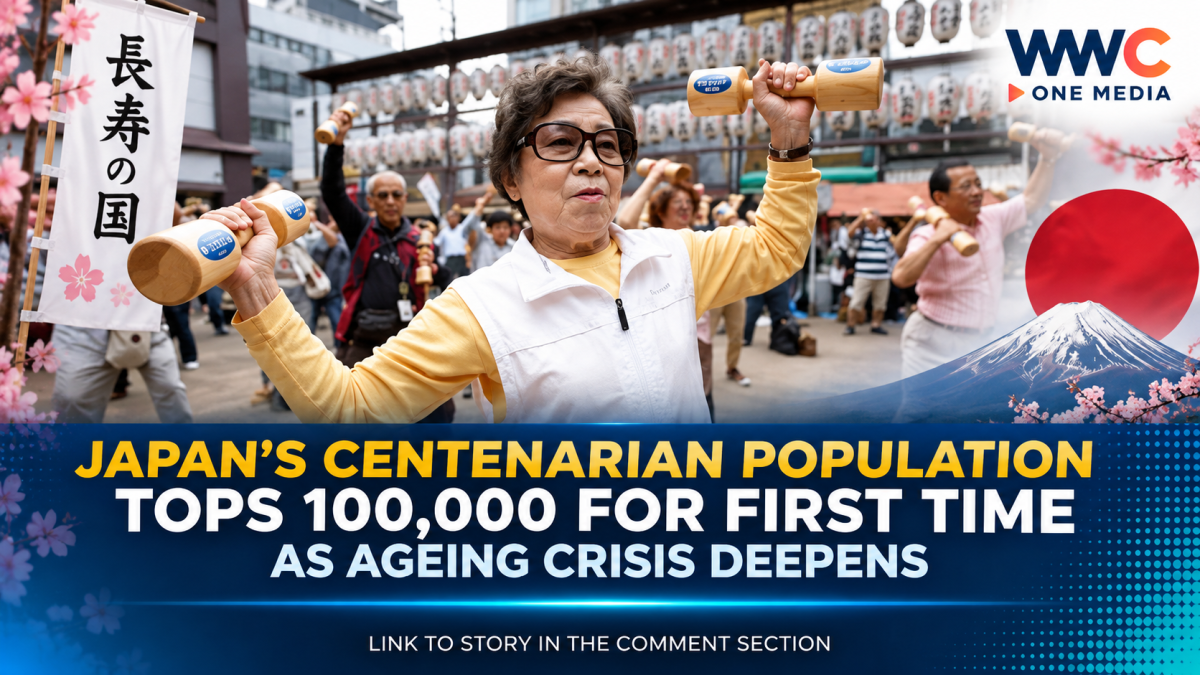
Japan has crossed a major demographic milestone, with the number of people aged 100 and above surpassing 100,000 for the first time.
The record marks the 56th consecutive year that Japan’s centenarian population has increased, highlighting the country’s extraordinary longevity but also underscoring the growing pressures created by its rapidly ageing society.
The milestone comes after the number of centenarians reached 99,763 in 2025, when women accounted for nearly 88% of the total.
Centenarians exceed 100,000
Japan’s centenarian population has grown dramatically over the past six decades.
When the government began its annual count in 1963, only 153 people aged 100 or older were recorded nationwide.
The number passed 1,000 in 1981 and exceeded 10,000 in 1998. Since then, the population of centenarians has continued to expand as life expectancy has risen and generations born during earlier population booms have reached advanced ages.
The latest milestone means Japan now has more than 100,000 people who have reached their 100th birthday.
Women make up the overwhelming majority
Women continue to account for the vast majority of Japan’s centenarians.
In 2025, 87,784 of the country’s 99,763 centenarians were women, representing roughly 88% of the total.
The gender imbalance reflects the significant difference in life expectancy between Japanese women and men.
It also means that Japan’s rapidly growing population of extremely elderly people is likely to have important consequences for healthcare, long-term care and social welfare services, particularly as many of the oldest residents live well beyond the age of 100.
Japan’s ageing population keeps growing
The rise in centenarians is part of a much broader demographic transformation.
Japan already has one of the world’s oldest populations, with almost 30% of its population aged 65 or older.
At the same time, the country’s birth rate remains low, meaning fewer younger people are entering the population to replace older generations.
The result is a growing imbalance between elderly residents and the working-age population.
As the number of very elderly people rises, Japan faces increasing demand for medical care, nursing services and social support while having a shrinking pool of workers available to provide those services.
Longevity is both an achievement and a challenge
Japan’s ability to produce such high numbers of centenarians is widely regarded as a sign of the country’s long life expectancy and improvements in healthcare and living standards.
But extreme longevity also creates difficult policy questions.
People living into their 100s may require long-term medical treatment, nursing care or assistance with daily activities.
The government therefore faces the challenge of ensuring that healthcare and social security systems remain financially sustainable as the population continues to age.
The issue is particularly pressing because Japan’s population is simultaneously shrinking.
Western Japan records higher concentrations
The distribution of centenarians is not uniform across the country.
Previous government data have shown that western Japanese prefectures tend to have higher concentrations of people aged 100 and above than major urban areas in the east.
Shimane has repeatedly recorded one of the country’s highest rates of centenarians relative to its population, while Saitama has ranked among the lowest.
The differences have been linked to variations in population structure, lifestyles and regional demographics.
A demographic milestone with a warning
Japan’s crossing of the 100,000-centenarian mark is a remarkable achievement in human longevity.
But it also serves as a powerful illustration of the demographic pressures facing the country.
The number of people living to 100 is increasing at the same time that fewer children are being born and the working-age population is declining.
That combination means Japan must prepare not only for more people living longer, but for a society in which very old age becomes increasingly common.
The record-breaking centenarian population is therefore both a celebration of longevity and a warning about the enormous economic and social adjustments Japan will need to make as its population grows older.




Leave a Reply