
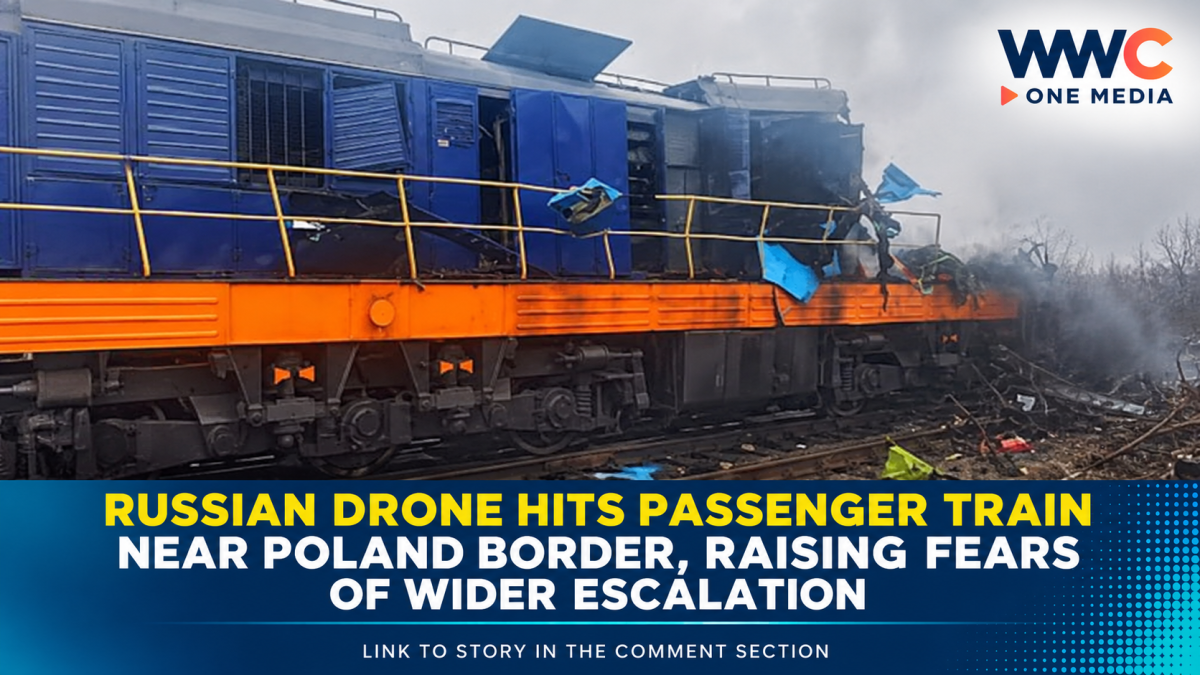
A Russian drone struck the locomotive of a passenger train travelling from Kyiv to Warsaw near Ukraine’s border with Poland, raising fresh concerns over the widening risks of Russia’s air campaign.
The train was hit on September 13 in Ukraine’s Volyn region, roughly two kilometres from the Polish border. Ukrainian railway authorities said the crew received an early warning, allowing passengers and staff to take protective measures before the strike.
No passengers or crew members were injured.
Passenger train hit near Polish border
The targeted service was travelling toward Warsaw when a drone struck its locomotive near the Yahodyn border crossing.
Ukrainian Railways said its monitoring team detected the aerial threat and warned the train crew in advance.
The strike damaged the locomotive but did not result in casualties.
The incident occurred during a much larger Russian overnight air assault on Ukraine, with hundreds of drones launched against targets across the country.
Strike came extremely close to NATO territory
The location of the attack has heightened concern in Poland because the train was struck only a few kilometres from NATO territory.
Polish Defence Minister Władysław Kosiniak-Kamysz said Polish forces detected multiple jet-powered drones operating in western Ukraine, with one strike occurring about one kilometre from the Polish border and another around five kilometres away.
Poland deployed F-16 fighter jets, helicopters and an airborne reconnaissance aircraft as a precaution.
Polish authorities stressed that the country’s airspace was not violated.
The episode nevertheless demonstrated how Russia’s expanding drone campaign is increasingly reaching areas immediately adjacent to NATO’s eastern frontier.
Diplomatic train had passed shortly before
The attack attracted even greater attention because a separate train carrying European officials had travelled through the same area shortly beforehand.
Former British Prime Minister Boris Johnson and other European figures were among those travelling by a diplomatic or charter service returning from a conference in Kyiv.
That train was stopped and partially evacuated as a precaution after drone warnings.
However, authorities have not established that the diplomatic train was the intended target, and it is important not to confuse it with the Kyiv-Warsaw passenger train that was actually struck.
The two incidents involved separate trains.
Poland responds with heightened security
The Russian strikes prompted Poland to increase its military readiness along the border.
Polish authorities temporarily restricted activity at several border crossings during the overnight attacks before normal operations resumed.
Military aircraft were also deployed to monitor Poland’s airspace and respond to any potential threat.
Poland’s armed forces later confirmed that there had been no violation of Polish territory.
The response reflects the sensitivity of any Russian military activity close to Poland, which is both a NATO member and one of Ukraine’s most important logistical and political supporters.
Ukraine calls attack a wider escalation
Ukrainian officials described the strikes near the border as part of a broader campaign against the country’s railway infrastructure.
Foreign Minister Andrii Sybiha said the attacks were not simply another strike on Ukraine but a warning directed toward Europe and NATO.
Ukrainian authorities have repeatedly warned that Russia is seeking to disrupt transportation networks used to move people, goods and military supplies across the country.
Railways are particularly important because they remain one of Ukraine’s main transportation systems during wartime.
Russia’s drone campaign expands
The train strike came during one of the larger Russian aerial assaults of the recent period.
Ukrainian officials reported more than 450 drones being launched overnight, including jet-powered drones and other long-range unmanned weapons.
Several regions were struck, with casualties and damage reported elsewhere in Ukraine.
The increasing use of drones has allowed Russia to attack targets across a wide geographic area while putting additional pressure on Ukraine’s air-defence systems.
The attacks on western Ukraine are particularly significant because the region had previously been viewed as relatively distant from the most intense fighting.
A warning for Europe’s eastern border
The passenger-train strike does not mean Russian forces crossed into Poland or directly attacked NATO territory.
But the proximity of the incident has intensified concerns about the possibility of an accidental or deliberate spillover of the war.
Poland has already experienced several incidents involving drones and other military activity connected to Russia’s war against Ukraine.
For European governments, the latest strike is another reminder that the geographic boundaries of the conflict can become blurred when long-range drones operate close to NATO borders.
For Ukraine, meanwhile, the attack demonstrates that even civilian transport routes near the country’s western frontier remain vulnerable.
The fact that no passengers were injured prevented the incident from becoming an even greater tragedy.
But the strike has nevertheless sent a powerful warning: Russia’s expanding drone war is now reaching dangerously close to NATO’s doorstep.




Leave a Reply