
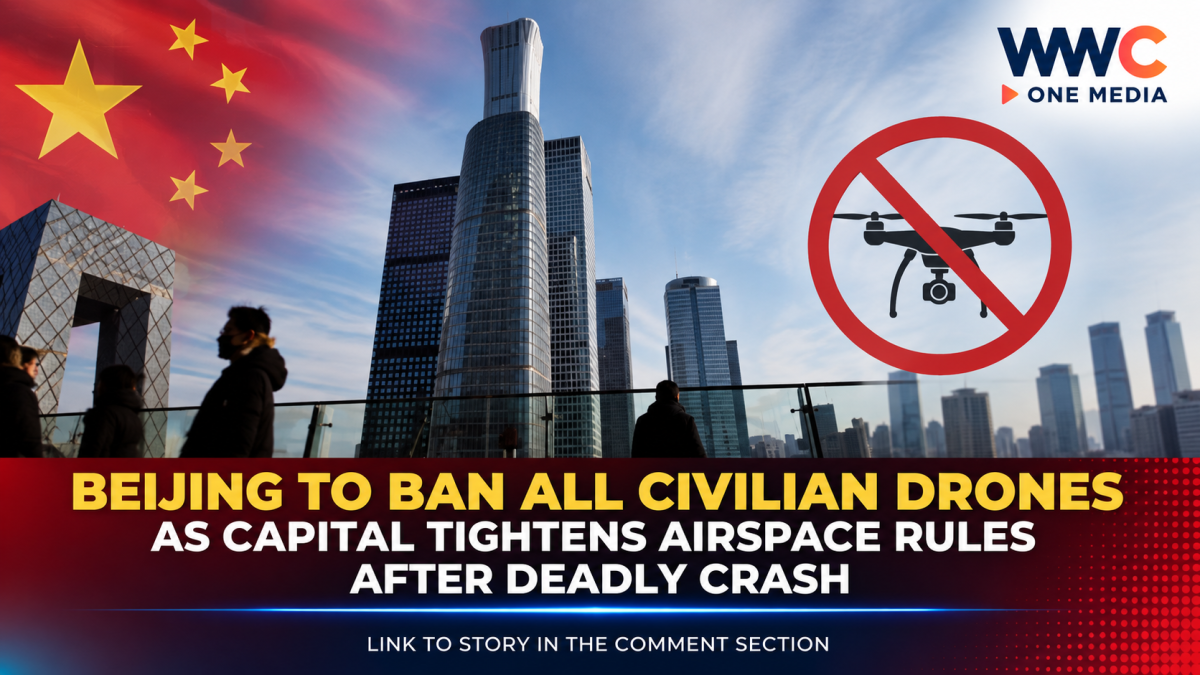
Beijing is moving toward one of the world’s strictest drone regimes, with the Chinese capital set to ban the possession, storage, transport and operation of unmanned aerial vehicles across the entire city.
The sweeping restrictions follow a deadly June crash involving a small aircraft that struck the CITIC Tower, one of Beijing’s most prominent skyscrapers, raising fresh concerns about airspace security over the densely populated capital.
The revised rules will take effect on November 15, 2026.
Beijing declares entire city a drone-controlled zone
Under the revised regulations, the entire administrative area of Beijing will be designated as controlled airspace for unmanned aircraft.
Drone flights will be prohibited throughout the city.
More significantly, individuals and companies will also be prohibited from possessing or storing drones and designated core components within Beijing.
The rules will also prohibit people from transporting or carrying drones or their core components into the capital.
The regulations go beyond simply restricting where drones can fly. They effectively remove ordinary civilian drone ownership from Beijing.
New rules follow deadly skyscraper crash
The tougher regulations come months after a small aircraft crashed into Beijing’s 108-storey CITIC Tower in June.
The 66-year-old pilot was killed and 13 people on the ground were injured in the incident.
Authorities said the aircraft had deviated from its approved flight path, intensifying concerns over the security of Beijing’s low-altitude airspace.
Although the crash involved a small aircraft rather than a conventional recreational drone, the incident added to broader concerns about controlling low-altitude aviation around sensitive infrastructure and densely populated areas.
Drone sales already restricted
The latest restrictions build on measures Beijing introduced earlier this year.
A ban on drone sales in the capital took effect in May, while owners were also required to complete real-name information verification for their aircraft.
That verification process ended on July 31.
The new rules now take the policy significantly further by requiring existing drones to be removed from Beijing before the November deadline.
Owners given several ways to dispose of drones
Beijing authorities have introduced several options for residents who already own drones.
Owners can sell their drones through government-approved buyback locations, surrender them for recycling or send them out of Beijing by post.
Those who choose to remove their drones themselves can also transport them outside the capital by road, rail or air before November 15.
The government has introduced financial incentives to encourage residents to dispose of their equipment before the new rules take effect.
For qualifying drones that have already undergone official information verification, buyback transactions completed between September 12 and October 31 can receive a subsidy equal to 30% of the purchase price, capped at 3,000 yuan per drone.
A lower subsidy applies to equipment disposed of between November 1 and November 14.
Limited exceptions for essential uses
The ban is sweeping, but it is not completely without exceptions.
Special arrangements can be granted for drones required for counterterrorism and emergency response, major events, education, scientific research, manufacturing and certain agricultural and forestry activities.
Organisations receiving special approval will be required to establish security management systems covering the purchase, transportation, storage and use of the equipment.
This means drones will not disappear completely from Beijing’s skies. Government, research and other specifically authorised operations will still be possible under controlled conditions.
Violators face fines and confiscation
The revised regulations also introduce penalties for violations.
Authorities can confiscate drones involved in prohibited flights.
Individuals who illegally possess or store drones can face fines ranging from 500 yuan to 5,000 yuan, while companies can face penalties of up to 50,000 yuan.
Violations involving prohibited sales can also result in penalties for businesses and online platforms that fail to enforce the restrictions.
A major shift for China’s drone capital
The policy marks a significant change for Beijing’s approach to civilian drone technology.
China is one of the world’s leading drone-producing countries, and drones have become increasingly important in photography, logistics, agriculture, surveying and other commercial applications.
Beijing’s decision therefore highlights the unusually sensitive security environment surrounding the national capital.
While other parts of China continue to permit drone use under registration and airspace rules, Beijing is taking a far more restrictive approach.
Beijing prioritises airspace security
The revised regulations explicitly cite the need to strengthen security and protect the capital’s airspace.
Authorities are also preparing for continued monitoring and enforcement once the new rules take effect.
For ordinary drone owners, however, the message is already clear: civilian drones will no longer be allowed to remain in Beijing after November 15 unless they fall under a specifically approved exception.
The policy transforms Beijing from a heavily restricted drone environment into a city where civilian drone ownership itself will effectively be prohibited.
The move underscores how quickly governments can tighten controls over emerging technology when concerns over public safety and national security collide with the rapid expansion of low-altitude aviation.




Leave a Reply