
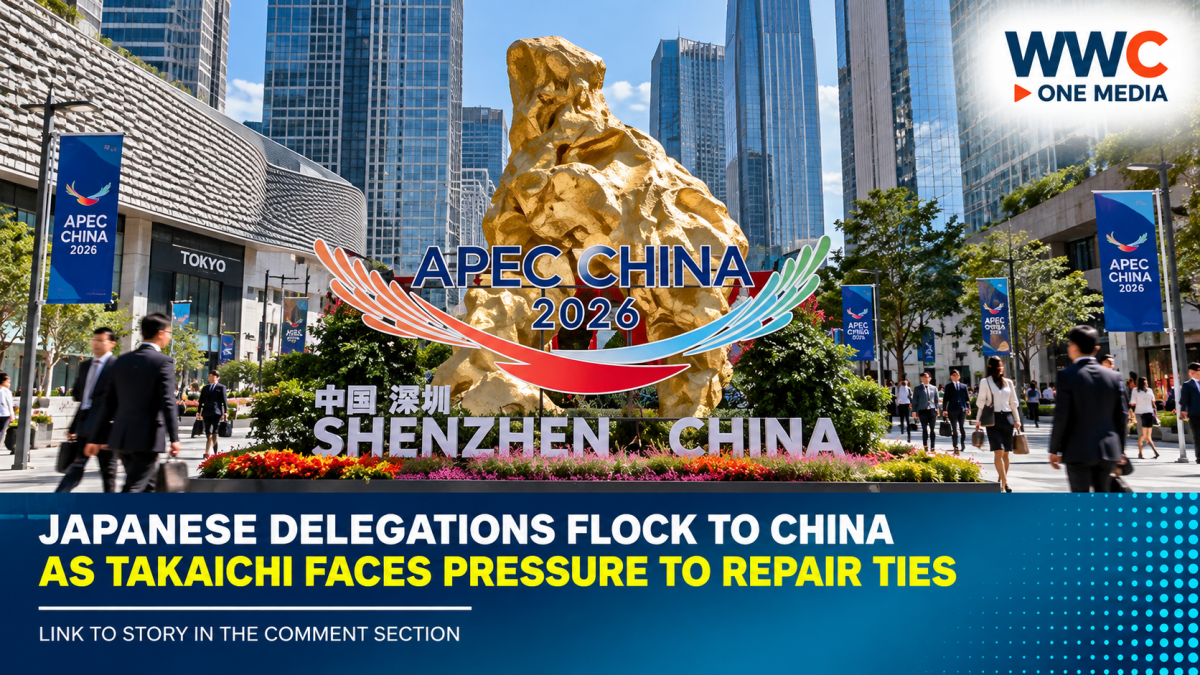
TOKYO/BEIJING — Japanese lawmakers and business representatives are increasingly looking toward China in an effort to reopen dialogue, but the growing diplomatic traffic has yet to translate into a meaningful thaw.
A series of Japanese delegations has traveled—or is preparing to travel—to China as Tokyo and Beijing try to manage one of their most difficult periods in years. Yet analysts and Chinese officials say the biggest obstacle remains political: Prime Minister Sanae Takaichi’s position on Taiwan and whether her government is prepared to soften its approach.
The renewed exchanges highlight a striking two-track strategy. Japanese politicians and business groups are trying to keep communication alive with Beijing, while the Japanese government continues to defend its security position and its alliance commitments.
Japanese lawmakers return to Beijing
A group of young Japanese lawmakers from a suprapartisan parliamentary friendship group met with a senior Chinese official in Beijing on September 14, according to Jiji Press reporting carried by Nippon.com.
The visit follows an earlier cross-party Japanese delegation that traveled to China in August in an attempt to ease tensions. It was significant because high-level political exchanges between the two countries had become increasingly difficult amid the dispute over Taiwan.
The latest diplomatic outreach comes as Japanese lawmakers and business organizations look for ways to prevent the relationship from deteriorating further.
A separate parliamentary group has also been arranging a September China visit, while Japan’s business community has been considering additional trips to Beijing ahead of the Asia-Pacific Economic Cooperation summit in Shenzhen.
That flurry of visits suggests that parts of Japan’s political and business establishment see value in keeping channels to China open—even while strategic disagreements remain unresolved.
But Beijing says Taiwan is the heart of the dispute
The problem is that dialogue alone may not be enough.
During the earlier lawmakers’ visit, Chinese officials made clear that Taiwan remains at the center of the dispute. Chinese officials have demanded that Japan revise what Beijing considers an erroneous position on Taiwan before relations can return to a more stable footing.
The tensions intensified after Takaichi made comments in Japan’s parliament concerning a potential Taiwan contingency. Beijing interpreted the remarks as a possible indication that Japan could become militarily involved if a conflict erupted across the Taiwan Strait.
China has repeatedly demanded that Tokyo retract or clarify the position.
Japan, meanwhile, has maintained that its security policy is consistent with its existing legal framework and its long-standing relationship with Taiwan.
That leaves both governments facing a difficult diplomatic equation: Beijing wants a change in Tokyo’s rhetoric, while Tokyo is reluctant to make concessions that could weaken its security posture.
Why Takaichi is central to any real thaw
The current diplomatic freeze cannot be understood without looking at Takaichi’s role.
Relations between China and Japan had shown signs of stabilization before the latest deterioration. But the Taiwan dispute sharply changed the atmosphere, with Beijing becoming increasingly critical of Tokyo and exchanges between the two countries suffering.
Japanese analysts quoted by international media have described the lawmakers’ visits as an attempt to create room for diplomacy without requiring an immediate breakthrough between the two governments.
That distinction matters.
A parliamentary delegation can meet Chinese officials, and companies can explore business opportunities, without necessarily resolving the fundamental disagreements between the two governments.
In other words, people-to-people and business exchanges may help prevent relations from collapsing—but they cannot by themselves settle the Taiwan question.
Business ties are another pressure point
The stakes extend well beyond diplomacy.
China remains an important market and manufacturing base for Japanese companies, while Japanese technology, machinery and industrial materials remain significant to Chinese supply chains.
But the political deterioration is already affecting trade.
China recently imposed provisional trade restrictions involving dichlorosilane, a chemical material used in semiconductor manufacturing, prompting Japan to formally protest. Japanese companies are major suppliers of the material, and Tokyo said it was examining the impact of Beijing’s measures.
The episode illustrates why Japanese businesses have an interest in stabilizing relations even as geopolitical tensions increase.
Companies can adapt supply chains, diversify markets and reduce dependence on China—but those adjustments can be costly and take years.
Tourism and people-to-people ties also feel the chill
The diplomatic dispute has also affected travel and cultural exchanges.
The Lowy Institute reported that Chinese tourist arrivals to Japan dropped by more than 60% year-on-year in the first quarter of 2026, underscoring how political tensions can quickly spill over into tourism and wider people-to-people relations.
That makes the renewed Japanese delegation visits especially important.
Restoring regular exchanges could provide a practical first step toward rebuilding trust—even if a comprehensive diplomatic settlement remains out of reach.
A thaw is possible—but far from guaranteed
The current situation leaves Japan pursuing what increasingly looks like a two-track China strategy.
On one track, lawmakers and business leaders are reaching out to Beijing, seeking dialogue, economic stability and continued exchanges.
On the other, Takaichi’s administration is maintaining a stronger security posture and closer alignment with Japan’s strategic partners.
That balancing act is becoming increasingly difficult.
China wants Tokyo to change its position on Taiwan. Japan wants to preserve its ability to respond to security threats while avoiding an uncontrolled deterioration in relations with its largest Asian neighbor.
Neither side appears ready to make the concession the other considers necessary.
For now, the growing number of Japanese visitors to Beijing may be a sign that both countries understand the cost of continued confrontation.
But whether those visits become the beginning of a genuine diplomatic thaw—or merely temporary damage control—may ultimately depend on whether Takaichi can find a way to reassure Beijing without undermining Japan’s own security calculations.


Leave a Reply