
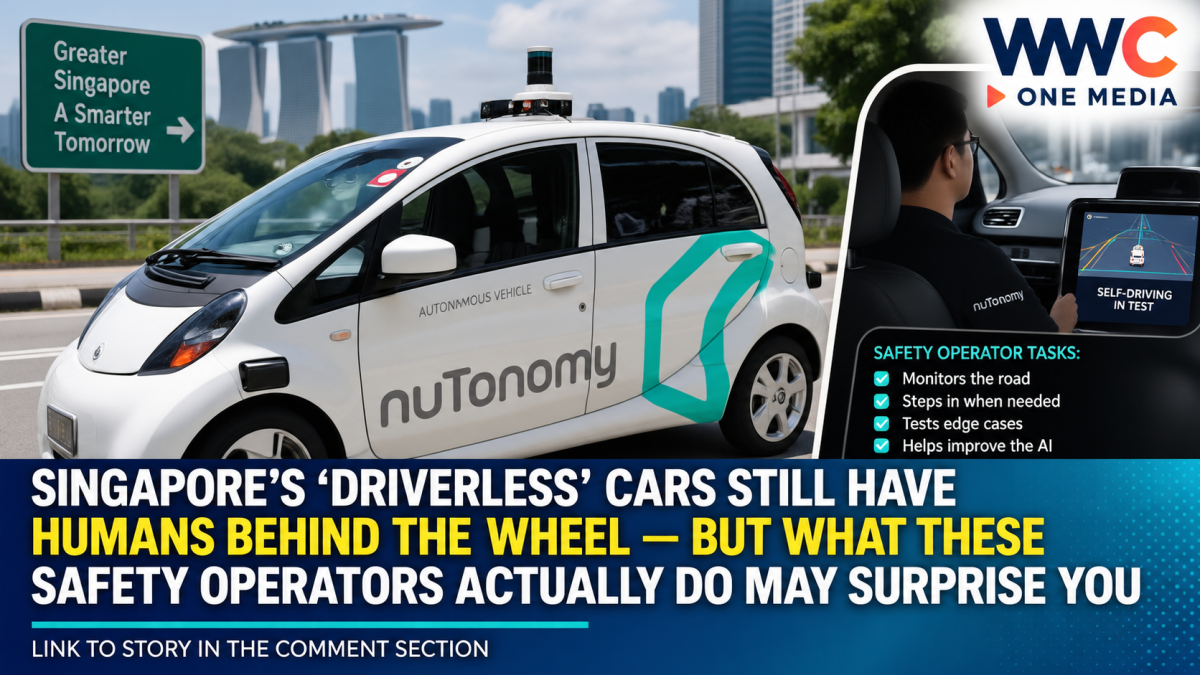
SINGAPORE — The strange thing about riding one of Singapore’s new “driverless” vehicles is that there is still a person sitting where the driver normally would.
And passengers sometimes think they have found the easiest job in transport.
Just sit there.
Let the computer drive.
Watch the scenery.
Maybe intervene once in a while.
Safety operators working on Singapore’s autonomous-vehicle rollout say the reality is almost the exact opposite.
“You have to be on higher alert,” Grab safety operator Sarah Ahmad, 45, told CNA, explaining that supervising a self-driving vehicle can demand even more concentration than conventional driving because she must constantly anticipate what the machine might do next.
Her comparison is simple:
The autonomous vehicle is the student.
The safety operator is the driving instructor.
And unlike a human learner who can explain what they are thinking, this student is controlled by cameras, radar, sensors, artificial intelligence and software.
If it does something unexpected, the human still has to be ready.
Immediately.
The irony of Singapore’s driverless revolution: humans are becoming more important before they become less visible
Singapore’s autonomous-vehicle push is accelerating rapidly.
Grab and Chinese autonomous-driving company WeRide began public autonomous rides in Punggol in April.
ComfortDelGro, working with China’s Pony.ai, followed with its own service.
Those operations are part of Singapore’s attempt to test whether autonomous technology can improve first- and last-mile connectivity while easing long-term manpower constraints in transport.
But the country is deliberately moving in stages.
AVs must first pass testing at the Centre of Excellence for Testing and Research of Autonomous Vehicles at Nanyang Technological University, before being approved to operate on public roads.
When they first enter public-road operations, a trained safety operator remains onboard.
Only after vehicles demonstrate sufficiently safe and reliable autonomous operation can they potentially progress toward truly driverless service.
So the transition is not:
human driver today, no human tomorrow.
It looks more like:
human driver,
then human supervisor,
then perhaps remote human supervisor,
and only eventually a transport system where most routine driving decisions are handled without someone sitting behind the wheel.
That transition is already creating an entirely new category of jobs.
Sarah Ahmad used to drive passengers herself. Now she supervises a machine doing it.
Sarah had spent about three years as a Grab private-hire driver when the company asked whether she wanted to join its autonomous-vehicle initiative.
She had never worked with AVs.
Her training began in November 2025.
One of the first complications was surprisingly basic.
The WeRide vehicles came from China and were left-hand drive, whereas Singapore’s cars normally have the steering wheel on the right.
So Sarah had to learn to operate a vehicle configured differently from the cars she was accustomed to driving.
Then came something even stranger:
learning not to drive.
For an experienced driver, taking both hands off the steering wheel while the vehicle begins moving on its own can run directly against years of instinct.
CNA reported that Sarah initially had to suppress the reflex to grab the wheel when the autonomous system took control.
Eventually, that discomfort turned into a different kind of skill:
watching everything around the vehicle without physically controlling it.
That may actually demand more attention, not less
When humans drive, much of the interaction becomes physical and intuitive.
Hands feel the steering.
Feet control acceleration and braking.
Drivers continuously sense what the vehicle is doing.
A safety operator loses some of that feedback.
The machine is making the immediate decisions instead.
That means the human must simultaneously monitor traffic, pedestrians, road conditions and the AV’s behaviour while deciding whether intervention is necessary.
ComfortDelGro safety operator Sherman Seng, 24, told CNA that operators need almost continuous concentration because their job is to prevent unexpected situations from escalating.
His training included about a month in Singapore followed by another three weeks in Guangzhou, where autonomous driving is considerably more mature.
There, he encountered intentionally challenging conditions, including pedestrians crossing and motorcycles approaching at high speed, designed to test reaction time and judgment.
That sounds less like being paid to sit inside a self-driving taxi.
It sounds closer to supervising an experimental aircraft.
The job begins before the vehicle even moves
A safety operator’s work does not start when the passenger gets inside.
CNA reported that operators begin by checking vehicles and making sure cameras, sensors and other systems are unobstructed and functioning correctly.
They may drive manually while moving out of parking areas before activating autonomous mode.
During operation, they watch the vehicle’s decisions.
During familiarisation runs, they help the autonomous system build familiarity with roads and local conditions.
And after rides, they provide feedback about how the AV performed.
That feedback can lead directly to software or operational changes.
Sarah, for example, noticed earlier this year that one AV was braking too sharply when approaching red traffic lights.
After feedback was passed along, its behaviour was adjusted so it approached lights more gradually, reducing the need for harsh braking.
That is a crucial point about the job.
Safety operators are not only emergency backups.
They are effectively part of the vehicle-development process.
Singapore roads keep producing situations AI has never seen exactly the same way before
Autonomous vehicles are often impressive when dealing with predictable traffic.
The hard part is everything that is not predictable.
Roadworks.
A police officer waving traffic through.
A delivery vehicle blocking half a lane.
Someone suddenly stepping into the road.
An ambulance approaching from behind.
A cyclist behaving unpredictably.
And apparently, chickens.
CNA reported one case in which a chicken walked in front of Sherman Seng’s AV and stopped there.
The vehicle refused to move until the bird cleared the road.
That is arguably exactly what a cautious autonomous system should do.
But it also illustrates a fundamental difference between humans and current AI driving systems.
A human may interpret an ambiguous situation using context and informal social signals.
An AV tends to follow defined safety logic.
When uncertainty gets high enough, caution wins.
A construction worker’s hand gesture can still defeat sophisticated AI
One of Sarah’s interventions came near roadworks.
A traffic marshal gestured for the vehicle to proceed.
A human driver would probably understand the motion instantly.
The autonomous vehicle did not.
It detected the person in front and hesitated rather than interpreting the hand signal as permission to continue.
Sarah took manual control and drove through.
That small example captures one of the biggest unresolved problems in autonomous driving.
Roads are not governed solely by painted lines, traffic lights and formal signs.
Humans constantly negotiate.
A driver waves another car through.
A construction worker points.
A pedestrian makes eye contact.
Two motorists communicate through slight movements.
An officer overrides normal traffic rules.
AI must eventually learn how to interpret that messy human language safely.
Until then, the person sitting behind the wheel is not decorative.
Singapore already learned how complicated human-machine handovers can be
The most notable Punggol AV incident so far actually involved manual intervention.
On Jan. 17, a ComfortDelGro autonomous vehicle undergoing testing collided with a road divider along Edgedale Plains.
Nobody was hurt.
LTA’s investigation found that the AV had detected what it believed was an object and manoeuvred into an adjacent lane as a precaution.
Simulation showed that the autonomous system would likely have completed the manoeuvre and returned safely to its route.
But the safety operator, seeing the AV change lanes without an obvious reason, took manual control.
The operator was unable to complete the manoeuvre before hitting the divider.
That finding is highly relevant to the safety-operator debate.
The accident was not simply evidence that autonomous driving failed.
It illustrated something more complicated:
the transition between machine control and human control can itself introduce risk.
LTA and ComfortDelGro subsequently reviewed procedures governing when operators should take over and how autonomous-to-manual transitions should be handled.
That creates a difficult psychological problem
Safety operators need to trust the autonomous system enough not to intervene unnecessarily.
But they must also remain alert enough to intervene when they genuinely need to.
Those requirements pull in opposite directions.
Intervene too often and the technology never gets a chance to operate as designed.
Wait too long and a preventable incident may occur.
This is why training cannot simply involve teaching someone where the emergency brake is.
Operators must learn how the AV behaves.
They have to understand what looks unusual but is actually deliberate.
And they have to recognize when behaviour has crossed the line into something requiring human action.
It is closer to learning a colleague’s decision-making style than simply driving another vehicle.
The public is already surprisingly comfortable with the technology
Despite the novelty, early passenger feedback has been extremely positive.
LTA said that by July 12, more than 11,500 unique riders had taken the Punggol autonomous shuttle services.
Among around 900 people responding to LTA’s post-ride surveys that month, 99% said they felt safe and would recommend the ride to others.
The bigger complaint was not safety.
It was convenience.
Nearly 60% of the Punggol residents surveyed said they wanted to choose where they board and alight, while around 40% wanted more direct routes.
That feedback is now pushing Singapore’s AV experiment into its next phase.
Punggol’s fixed loops are becoming on-demand robotaxi-style rides
Grab plans to move beyond shuttles following predetermined loops.
Its new on-demand trial will allow passengers to book a dedicated autonomous vehicle between selected pickup and drop-off locations in Punggol.
Instead of completing an entire shuttle circuit, the vehicle will take the most direct permitted route.
The trial is expected to open progressively to the wider public in the fourth quarter of 2026, when commercial fares are introduced. Existing fixed-route rides remain free for now.
That evolution matters.
A fixed route limits the number of situations an autonomous vehicle must master.
An on-demand service increases variation.
More streets.
More intersections.
More pickup points.
More combinations of journeys.
And therefore more edge cases.
Which means more learning — and for the moment, more need for people who understand how these systems behave.
Grab is about to multiply the experiment fivefold
The scale is increasing quickly.
Grab said on Sept. 14 that its AV fleet will rise from 10 WeRide GXR vehicles to 50 over the next six months.
It also hopes eventually to take autonomous services beyond Punggol, though expansion elsewhere in Singapore will require regulatory approval.
Grab’s autonomous fleet had already accumulated more than 110,000km on Singapore roads and served over 12,000 unique passengers by the announcement.
More than 1,000 people had joined a waitlist for new AV experiences.
The company is also considering making Singapore a regional centre for AV localisation and deployment.
It says that could create hundreds of jobs in engineering, design and operations.
This is why the argument that autonomous vehicles simply “remove drivers” misses a large part of what is already happening.
Some driving jobs may eventually shrink.
Other roles are appearing around the machines.
Grab has already trained former drivers for those jobs
GrabAcademy said in August that 23 people completed its autonomous-vehicle Safety Operator programme, all of them existing Grab driver or delivery partners.
Six also completed Remote Operator training.
By mid-September, The Business Times reported that Grab and WeRide had certified 30 safety operators, including six qualified as remote operators.
The career ladder is therefore already beginning to appear:
a conventional human driver can become a safety operator;
a safety operator can become a remote operator;
and experienced AV workers could potentially move into fleet management, supervision, training or technical operations.
This is the employment transition policymakers are betting on.
A remote operator may be one of the most important jobs in the truly driverless future
Removing the human from the car does not necessarily mean eliminating human supervision.
Remote operators can monitor vehicles from an operations centre and assist when a car encounters a situation it cannot resolve itself.
CNA noted that such operators could potentially take control or guide an AV to safety from a remote location.
That model could dramatically change the economics of transport.
Today, one human driver generally controls one vehicle.
In a mature autonomous system, one remote operations team might support an entire fleet.
Humans would no longer spend every minute physically steering.
Instead, they would intervene only when vehicles encounter exceptions.
That is a huge productivity gain.
It is also the reason some traditional driving jobs could eventually disappear even though new AV roles are created.
One remote operator may ultimately support more than one autonomous vehicle.
The government is preparing for that labour transition before mass automation arrives
Singapore is explicitly trying to avoid waiting until drivers lose work before retraining them.
In July, MOT announced a manpower transition package developed with the Ministry of Manpower, NTUC, Grab and ComfortDelGro.
A new Career Conversion Programme for AV Specialists is intended to prepare taxi and private-hire drivers for roles including safety operator, remote operator and fleet management.
Employers participating in Career Conversion Programmes can receive up to 90% salary support during eligible reskilling periods.
A separate training incentive scheme starts in January 2027.
Eligible drivers will be able to receive S$20 per training hour for up to 80 hours, or as much as S$1,600, to offset some of the income and vehicle-rental costs they give up while attending courses.
That is unusually early intervention.
Mass autonomous taxi deployment has not happened yet.
Singapore is already building the retraining mechanism for when it does.
But the government is also careful not to say that every driving job is safe forever
MOT’s language is deliberately balanced.
It says AV adoption will be gradual and that strong demand for human-driven taxi and private-hire services will remain.
At the same time, it acknowledges that technology changes jobs and is preparing pathways for people who want to move into new occupations.
That is probably more realistic than either extreme.
“Autonomous cars will destroy every driving job” is unsupported.
“Autonomous cars will never affect driver employment” is equally difficult to defend.
The outcome depends on how quickly autonomous vehicles become safe, cheap and scalable enough to replace human driving economically.
And that last point remains unresolved.
Driverless technology still has to prove it is cheaper, not merely impressive
Autonomous vehicles contain expensive hardware.
High-resolution cameras.
Radar.
LiDAR.
Multiple computers.
Redundant systems.
Continuous mapping and communications infrastructure.
Remote support.
Maintenance.
Cybersecurity.
Insurance.
Software engineers.
Fleet supervisors.
A car with no human driver can still have a very large human workforce behind it.
Singapore University of Social Sciences transport economist Walter Theseira told CNA earlier this year that widespread deployment is possible even before AVs become cheaper than human drivers — if society is willing to subsidise their benefits.
But he said it remains difficult to predict exactly when autonomous operation will become economically cheaper than hiring a person to drive.
That question ultimately determines how quickly jobs change.
Technology does not replace workers merely because it works.
It generally has to work better or cheaper at sufficient scale.
Singapore has another reason to keep pushing: it does not have unlimited drivers
The country’s interest in autonomous transport is not based solely on futuristic ambition.
Transport operators face manpower constraints.
Bus companies need drivers.
Logistics companies need drivers.
Taxi and private-hire services depend on a labour pool that is ageing in parts of the industry.
Autonomous vehicles therefore offer Singapore something different from countries with plentiful low-cost driving labour.
They may help maintain transport services even when workers become harder to recruit.
That changes the politics of automation.
A robot replacing a worker who desperately wants a job raises one kind of debate.
A robot filling a job employers increasingly struggle to staff raises another.
Singapore is likely to encounter both situations.
Bus drivers may be harder to automate than taxi drivers
Driving is only part of what a bus captain does.
Bus drivers assist passengers.
They handle elderly commuters.
They respond to emergencies.
They deal with people who fall ill.
They judge whether it is safe to open doors when a stop is crowded.
They adjust when roads are blocked.
They interact with people.
A&S Transit bus driver Muhammad Naz Farihin told CNA that he was impressed by the technical driving performance of an autonomous vehicle, but remained skeptical that it could replace the service role of a human bus captain anytime soon.
That distinction may become increasingly important.
AVs can automate driving before they automate every responsibility performed by a driver.
Punggol’s chicken problem is really an AI problem
Consider the chicken that refused to cross.
For a human, it is funny.
For software, it is a philosophical challenge.
What probability of movement should the system assign to an animal standing in the road?
Should it creep forward?
How close is safe?
What happens if the animal suddenly changes direction?
The conservative answer is simple:
stop.
That keeps the chicken safe.
It may also keep passengers waiting.
Scale that problem up from one chicken to thousands of daily ambiguous interactions and the challenge becomes clear.
An AV that is too aggressive is dangerous.
An AV that is too cautious may be unusably slow.
Human drivers constantly make informal risk judgments somewhere between those extremes.
Teaching software to do that safely is one of the hardest parts of autonomy.
Singapore’s human drivers may also behave differently once they know the car will always yield
There is another strange problem researchers worry about.
If people know autonomous vehicles are programmed to be exceptionally cautious, they may start exploiting them.
Drivers could cut in front because they know the AV will brake.
Pedestrians could step out because they assume it cannot intentionally hit them.
Other road users might become more aggressive because the robot is predictable.
Theseira warned CNA that this could create a perverse situation where better AV safety behaviour encourages worse human behaviour around it.
That would mean the AV must learn not just Singapore’s traffic rules.
It must learn Singaporeans.
Fully autonomous operation also creates a legal question Singapore has not completely answered yet
Traditional road law assumes someone is driving.
If that person drives negligently and causes an accident, responsibility can generally be investigated using familiar concepts.
What happens when software drives?
Was the manufacturer responsible?
The fleet operator?
The owner?
The programmer?
The company supervising remotely?
The safety operator?
A defective sensor supplier?
Singapore’s Ministry of Transport opened consultations this year on a new AV legal framework covering safety requirements, accident compensation and responsibility between different parties.
For the moment, conventional negligence and product-liability principles still do much of the work.
That is manageable when a safety operator sits behind the wheel.
It becomes more complicated when nobody does.
Parliament is keeping the AV sandbox alive while those questions are worked out
A Bill introduced this month proposes extending Singapore’s existing regulatory sandbox for road-based autonomous vehicles until Dec. 31, 2028.
MOT says the extension is designed to prevent ongoing AV deployments from being interrupted while a more comprehensive legal framework is developed.
That is another indication that Singapore does not view Punggol as a short-lived experiment.
The country is building the regulatory runway for a much larger rollout.
But it is also refusing to jump directly from trials to unrestricted deployment.
The approach remains deliberately incremental.
And that explains why safety operators may be around longer than people expect
Sarah Ahmad believes Singapore is still a long way from a situation where autonomous vehicles can roam the entire island with nobody onboard.
Every new area must be mapped and tested.
Each road network introduces different behaviours.
And every expansion creates new situations the system must learn.
She also points to jobs behind the scenes:
maintenance,
vehicle testing,
mapping,
remote operations,
fleet supervision.
Sherman Seng similarly expects safety operators to transition rather than simply disappear, potentially becoming remote operators, trainers or team leaders.
Their optimism does not guarantee every current driving job will survive.
But it reveals an important part of technological change that headlines about “driverless cars” often miss.
The work does not disappear all at once.
It moves.
The first jobs AVs create may eventually be the first jobs AVs remove
There is an irony here.
Safety operators exist because autonomous vehicles are not yet ready to operate fully independently.
Their job is to help make the technology better.
If they perform that job successfully, they help create a system that eventually needs fewer onboard safety operators.
Sherman understands that contradiction.
He told CNA he looks forward to the day when AVs can operate without the person sitting inside.
By then, he hopes people like him will have moved further up the AV operations chain.
That makes the safety-operator role something unusual:
a job whose success may partly be measured by whether the job remains necessary.
Punggol is becoming a preview of what automation may look like across Singapore
For residents, the experiment currently looks simple.
Book a ride.
Get into the purple autonomous shuttle.
Watch the steering wheel move.
Arrive at the destination.
Behind that ride sits a much larger ecosystem.
Safety operators inspect and supervise the vehicle.
Fleet managers monitor operations.
Engineers study behaviour.
Remote operators prepare for future deployment.
Technicians maintain sensors.
Regulators review safety data.
Insurers build new risk models.
Software developers improve the system.
And government agencies are already designing retraining programmes for workers whose jobs could change as the fleet grows.
That is why calling this merely a “driverless vehicle trial” understates what Singapore is testing.
It is also testing what happens to work when driving becomes software.
The next six months could make that question much harder to ignore
Grab’s move from 10 autonomous vehicles to 50 is only one step.
The company says its longer-term regional ambition involves thousands of AVs across Southeast Asia by 2030.
Singapore could become an important testing, localisation and operations base for that expansion.
If that happens, the country may get exactly what policymakers are hoping for:
more transport capacity,
new technology jobs,
less dependence on scarce driving manpower,
and potentially safer roads.
But there will inevitably be another side.
If autonomous cars become reliable enough and cheap enough, some jobs based primarily on physically steering vehicles will face pressure.
The challenge for Singapore is therefore not to pretend automation will never displace anyone.
It is to make sure people can move into the jobs created around that automation before their old ones disappear.
And in Punggol, that transition is already visible.
The person sitting behind the wheel may no longer be doing most of the driving.
But right now, that does not make the human less important.
It makes the human responsible for watching the machine that may eventually replace the steering wheel altogether.



Leave a Reply