
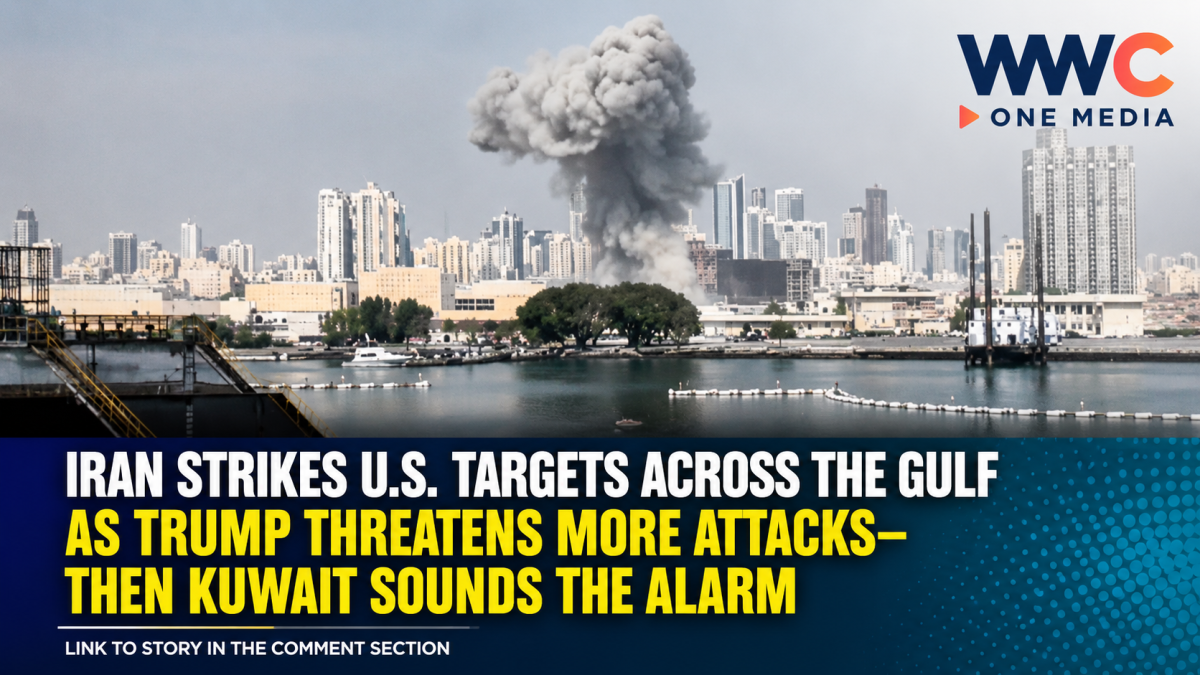
TEHRAN — The Iran-U.S. conflict has entered another dangerous phase, with Tehran launching missiles and drones toward U.S. military positions and allied locations across the Middle East after a new wave of American strikes on Iran.
The latest escalation has put Kuwait, Bahrain, Jordan, the United Arab Emirates and Iraq’s Kurdistan region on heightened alert while intensifying fears that the conflict could spread across the Gulf.
The escalation followed U.S. strikes on Iranian military positions along the country’s southern coast. U.S. Central Command said its forces struck Islamic Revolutionary Guard Corps (IRGC) air-defense sites, radar systems, maritime assets, mine-laying capabilities and communications facilities.
Iran responded by targeting U.S. military interests in several countries.
Kuwait intercepts Iranian missiles and drones
Kuwait’s military said its air defenses intercepted Iranian missiles and drones early Thursday after what it called Iranian aggression.
Iranian state media said the attacks were aimed at U.S. bases in Kuwait and described them as retaliation for American strikes on Iran. Kuwait has not reported casualties from the latest attack.
The development marks another expansion of the conflict beyond Iran’s borders and raises fresh concerns for countries hosting American military forces.
Jordan and Bahrain also targeted
Jordan reported that its air defenses intercepted 10 of 13 Iranian ballistic missiles fired toward its territory, with the remaining projectiles landing in remote areas without causing casualties, according to Jordanian authorities.
Iran said it had targeted U.S. military facilities in Jordan, including Prince Hassan airbase and a U.S. Marine facility near the Gulf of Aqaba. U.S. officials, however, reported no significant damage or injuries at one of the facilities.
Bahrain also activated its air defenses after Iranian attacks. Iran said it targeted U.S. facilities at Sheikh Isa Airbase, where American forces are stationed, while Bahraini authorities said incoming attacks were intercepted.
What about the UAE?
The United Arab Emirates has also been drawn into the escalation.
Iranian state media said Iranian forces targeted U.S. positions in the UAE. Separately, UAE authorities reported intercepting an Iranian drone over UAE waters earlier in the latest round of fighting.
Because the claims surrounding specific targets and damage remain disputed, the situation should be described as reported Iranian attacks or attempted attacks involving U.S. interests in the UAE, rather than confirmed strikes causing major damage inside the country.
A deadly strike near the Strait of Hormuz adds to the crisis
The escalation comes amid mounting danger around the Strait of Hormuz, one of the world’s most important energy chokepoints.
A Saudi Arabia-flagged oil tanker was attacked while approaching the waterway, killing two Filipino crew members, according to Philippine officials and AP reporting. The attack has added another layer of concern for thousands of seafarers and for global energy shipments moving through the region.
Shipping traffic through the Strait has also fallen sharply. Reuters reported that only four commodity vessels transited the waterway on Tuesday, compared with a 10-day average of about 13, although the figures can change because some vessels switch off their tracking systems. Before the war, the Strait handled roughly one-fifth of global oil consumption.
Trump warns Iran of more strikes
U.S. President Donald Trump has warned that Washington could launch additional attacks if Tehran retaliates.
Trump said U.S. forces had destroyed Iranian military equipment being developed around the Strait of Hormuz and warned that American forces were prepared to strike again.
The latest U.S. operation was described by CENTCOM as a response to attempted Iranian attacks on American personnel and commercial shipping. More than 50,000 U.S. service members are operating across the Middle East, according to CENTCOM.
Iran, meanwhile, has warned that its response could become broader and more severe.
Civilian casualties deepen the controversy
The latest American strikes have also triggered accusations of civilian casualties.
Iranian authorities said a U.S. strike hit a home in Kuhestak, near the Strait of Hormuz, where a wedding celebration was reportedly taking place. Iranian sources reported several deaths and dozens of injuries, although casualty figures have varied between official Iranian reports.
The U.S. military said it was aware of the allegations and stressed that American forces do not target civilians.
The disputed incident has become a major part of Tehran’s justification for retaliation.
Oil markets feel the pressure
The conflict is already affecting global energy markets.
Reuters reported that Brent crude was around $95 a barrel on Thursday as investors assessed the risks to Middle Eastern oil supplies. The Strait of Hormuz remains a critical concern because disruptions there can affect the movement of crude oil and liquefied natural gas to Asian and other international markets.
Iran has also expanded restrictions against ships it says violate its navigation rules. Reuters reported that Tehran’s Persian Gulf Strait Authority had increased its blacklist to 56 vessels, adding further uncertainty for commercial shipping.
A wider regional war remains the biggest concern
The newest exchange of fire is among the most serious escalations since the conflict began and comes after a period of relative military calm.
Diplomatic efforts remain stalled, while regional governments are increasingly being pulled into the confrontation because they host U.S. military forces or sit along vital shipping routes.
For Gulf states, the immediate priority is protecting their airspace and civilian populations. For global markets, the bigger question is whether the fighting will further restrict traffic through the Strait of Hormuz.
And with Washington warning that more strikes remain possible and Tehran promising retaliation, the next move could determine whether the latest escalation remains limited—or becomes a much wider regional confrontation.
WWC ONE MEDIA MJE



Leave a Reply