
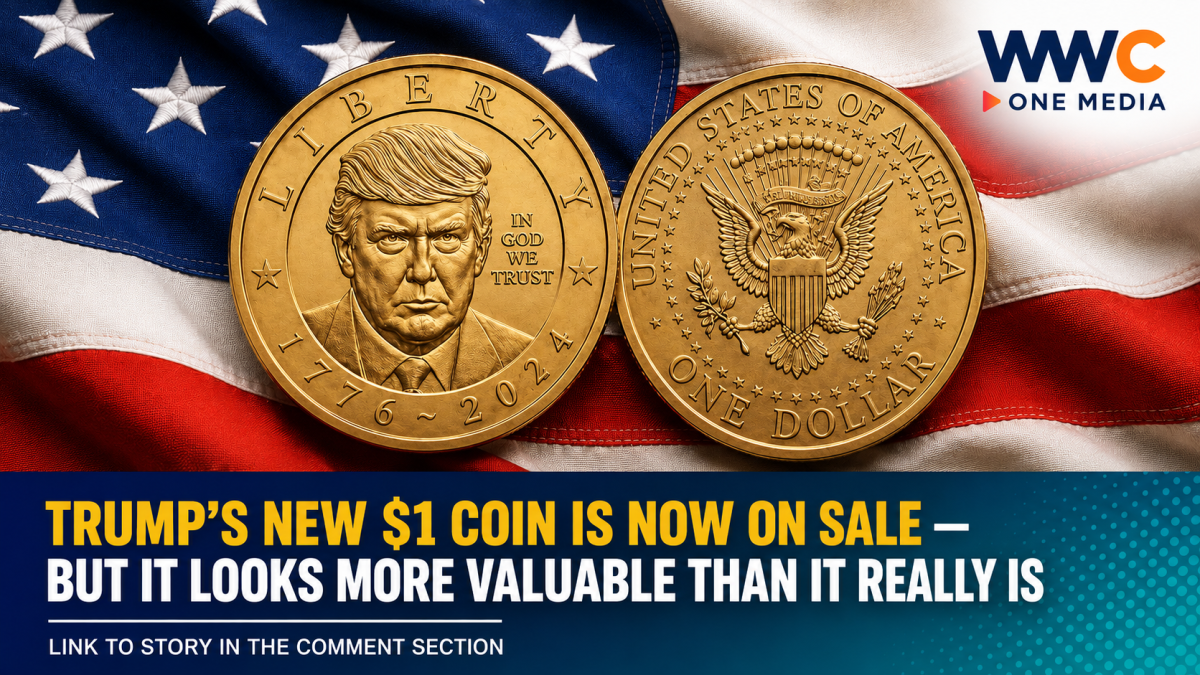
A new U.S. $1 coin featuring President Donald Trump’s portrait has officially gone on sale, turning a piece of everyday American currency into one of the country’s most closely watched numismatic releases of 2026.
The 2026 Semiquincentennial President Donald J. Trump $1 Coin was released by the U.S. Mint on September 2 as part of the celebration of America’s 250th anniversary. The coin features Trump on the “heads” side and the Great Seal of the United States on the “tails” side.
But there is an important catch: the coin may look gold, but it is not made of gold.
The U.S. Mint says the coin has a circulating finish and is composed of 6% zinc, 3.5% manganese, 2% nickel and copper for the balance. It weighs 8.1 grams and was produced at the Philadelphia Mint.
Trump’s face on the “heads” side
The obverse features a portrait of Trump, accompanied by the inscriptions “LIBERTY,” “IN GOD WE TRUST” and “1776 ~ 2026.”
The design was created by U.S. Mint Chief Engraver Joseph Menna and was inspired by an official White House photograph taken by Daniel Torok.
Flip the coin over and the design changes dramatically.
The reverse carries the Presidential Seal, including the eagle holding an olive branch and arrows. The shield on the eagle’s breast includes the number “250,” commemorating the United States’ Semiquincentennial.
Why does a $1 coin cost more than $1?
This is where the new coin gets particularly interesting for collectors.
The U.S. Mint is selling the coins in rolls and bags rather than as individual $1 pieces.
A 25-coin roll costs $61, while a 100-coin bag costs $154.50. That works out to roughly $2.44 per coin for the roll and $1.55 per coin for the bag, despite each coin having a legal-tender face value of $1.
The Washington Post also reported that the Mint’s sales prices represent substantial markups over the coins’ face value.
So while the coins are officially worth $1 each as legal tender, collectors buying directly from the Mint are paying extra for the packaging and collectible offering.
And some coins have a special “July 4th” mark
There is another detail that could make some pieces particularly interesting to collectors.
The Mint produced 250,000 coins with a special “July 4th” privy mark. Those coins were struck on July 4, 2026, and were randomly inserted into the rolls and bags being sold by the Mint.
That means buyers won’t know in advance whether their roll or bag contains one of the specially marked coins.
The controversy behind Trump’s portrait
The release has also revived a long-running question about whether a sitting U.S. president should appear on American money.
Federal law has traditionally restricted the depiction of living individuals on U.S. currency. The Trump administration has argued that the 2020 Circulating Collectible Coin Redesign Act provides authority for special coinage connected to the nation’s 250th anniversary.
The issue has already faced a legal challenge.
A federal judge in Oregon denied a preliminary injunction sought by plaintiff James Rickher, who attempted to block the Mint from producing and issuing a Trump coin. The court’s June 18 ruling focused on whether the plaintiff had established the necessary standing and did not amount to a broad judicial ruling settling every legal question surrounding the coin.
The historical argument surrounding the design also points to Calvin Coolidge, whose likeness appeared on a 1926 U.S. commemorative half dollar marking the country’s 150th anniversary.
Is it actually gold?
No.
This is perhaps the easiest detail for shoppers to misunderstand.
Although the coin has a gold-colored appearance, the U.S. Mint’s specifications show that it is a base-metal coin made primarily from copper, with zinc, manganese and nickel. It should not be confused with a solid-gold commemorative coin or an investment-grade gold product.
The bigger story: a presidential portrait meets America’s 250th birthday
The Trump $1 coin is being issued during the United States’ Semiquincentennial, the 250th anniversary of the Declaration of Independence.
The U.S. Mint describes the coin as a way to commemorate 250 years of American heritage, while its unusual design has simultaneously placed it at the center of debates over presidential imagery, American political traditions and the boundaries of commemorative coinage.
For collectors, meanwhile, the combination of a sitting president’s portrait, the 250th-anniversary theme and the limited “July 4th” privy-mark coins could make the release one of the more notable U.S. coin stories of 2026.
And despite the gold-like appearance, the most important number remains stamped right on the coin:
$1.
WWC ONE MEDIA J.M.D




Leave a Reply