
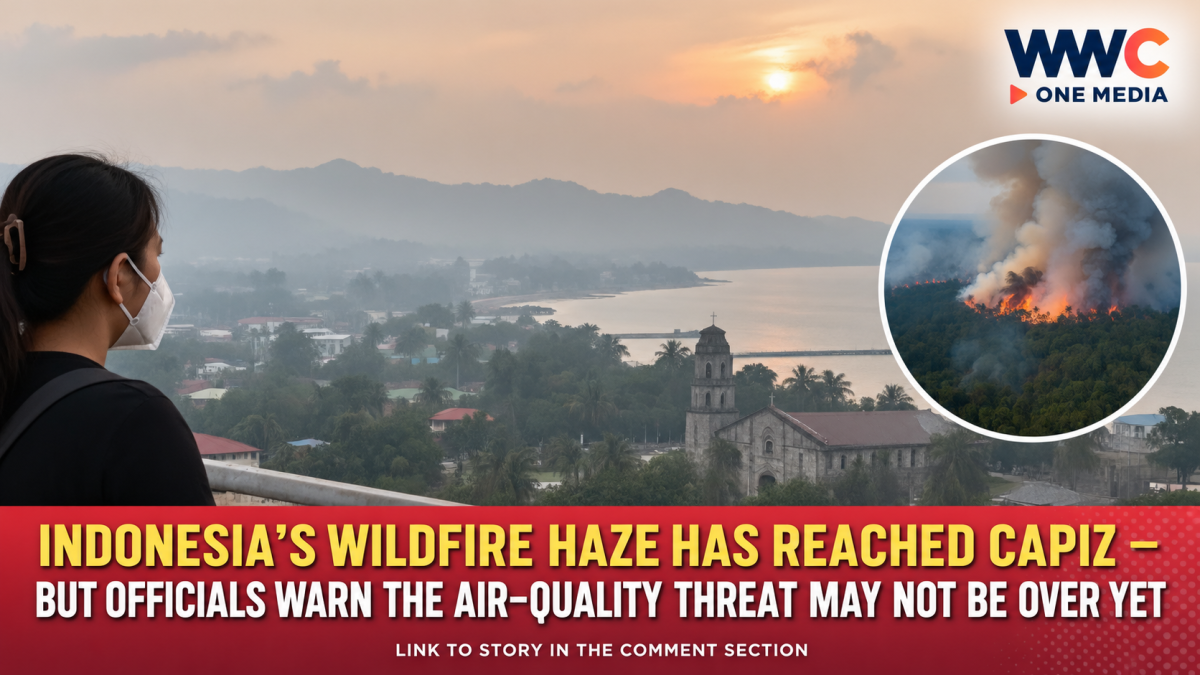
CAPIZ, Philippines — Smoke from massive forest and land fires burning hundreds of kilometers away in Indonesia has reached parts of the Philippines, prompting health authorities in Capiz to warn residents that the hazy skies could carry more than just reduced visibility.
The Capiz Provincial Health Office and the Office of Civil Defense have advised residents to reduce unnecessary outdoor exposure as transboundary haze associated with wildfires in Kalimantan, Indonesia, continues to affect parts of the region.
Provincial Health Officer II Dr. Ramon Alex Nolasco said the haze can contain smoke, fine ash and microscopic particles capable of irritating the eyes, nose, throat and lungs. People with asthma, cardiovascular disease and chronic respiratory illnesses may face greater risks when pollution levels rise.
Residents have been advised to keep doors and windows closed when haze is heavy, avoid strenuous outdoor activities and use a properly fitted N95 or similarly effective particulate mask if going outside cannot be avoided.
But the situation in Capiz is part of a much larger environmental emergency now unfolding across Southeast Asia.
Smoke From Indonesia Is Crossing Borders
The Department of Environment and Natural Resources-Environmental Management Bureau has linked elevated particulate pollution in several Philippine areas to smoke transported from fires in Indonesia.
DENR-EMB said prevailing winds have been carrying PM2.5 and other pollutants from the Kalimantan fires toward parts of the Philippines. PM2.5 refers to extremely small airborne particles that can penetrate deep into the lungs and are among the pollutants of greatest concern during severe haze events.
The phenomenon is not limited to Capiz.
Officials in Palawan have also warned vulnerable residents to minimize prolonged outdoor activities, while Puerto Galera authorities issued similar health precautions after haze was observed there.
In Western Visayas, environmental authorities earlier confirmed haze in Miag-ao, Iloilo. Metro Iloilo subsequently returned to generally “good to fair” air-quality conditions on the morning of September 2, although authorities said pollution had temporarily reached levels considered unhealthy for sensitive groups the previous afternoon.
That fluctuation is important: haze conditions can change considerably depending on wind direction, rainfall and the intensity of fires at their source.
Other Philippine Areas Have Recorded Much Worse Pollution
Some parts of the country have experienced significantly higher particulate readings.
In Metro Cebu, a DENR-EMB monitoring station in Talisay City recorded a PM2.5 Air Quality Index of 164 on August 31 and 172 by noon on September 1, both within the bureau’s “very unhealthy” category.
Northern Mindanao also recorded elevated pollution. EMB Region X reported AQI readings of 203 and 209 in Iligan City on August 31 and September 1, respectively, while other monitoring stations ranged from fair to unhealthy for sensitive groups.
Regional broadcaster CNA reported that smoke from Indonesia had traveled as far as the Philippines, while severely degraded air quality was also recorded across parts of Malaysia.
The Crisis Is Even More Severe Closer to Indonesia
The scale of the haze emergency became dramatically clearer on September 4 when Malaysia declared an emergency in Serian, Sarawak, after its Air Pollution Index climbed above 500, a level considered extremely hazardous.
Reuters reported an API reading of 519, while the Associated Press reported a reading of 521 around the time of the declaration. Kuching, Sarawak’s capital, also experienced hazardous conditions.
The emergency highlights how smoke from Indonesia’s fires can travel far beyond the actual burn areas.
The ASEAN Specialised Meteorological Centre has activated Alert Level 3 for the southern ASEAN region and warned that dry conditions in parts of the region could keep the risk of severe transboundary haze elevated.
Indonesia Is Fighting a Huge Fire Season
The source of the pollution is an unusually intense wildfire season across Indonesia.
Reuters reported that nearly 95,000 hectares burned in July alone, while more than 9,000 hotspots were detected during August. Extremely dry conditions associated with a powerful El Niño have helped fires spread more rapidly, although Indonesian authorities stress that human activity remains a major cause of many fires.
Peatland fires are particularly difficult to extinguish because flames can continue smoldering beneath the surface, producing smoke long after visible fires appear to have been suppressed.
Wildfires have now also spread close to Nusantara, Indonesia’s planned new capital in East Kalimantan. Reuters reported that roughly 400 hectares had burned near the capital area as of September 2, including about 300 hectares in Bukit Suharto, around 50 kilometers from the city center. Indonesia has deployed dozens of aircraft for firefighting operations.
Authorities are also pursuing suspected illegal burning. AP reported that Indonesian police had made 112 arrests related to suspected arson and were investigating 167 intentional-burning cases covering roughly 4,700 hectares across nine provinces. Five companies had also reportedly had their business licenses suspended.
There Are Signs of Improvement — But the Threat Has Not Disappeared
Not every indicator is worsening.
Indonesia’s Forestry Ministry reported on September 4 that areas classified as having “very unhealthy” air quality had shrunk substantially, with the remaining red-zone conditions concentrated mainly in parts of West Kalimantan. Most other Indonesian regions were categorized as having good to moderate air quality, although unhealthy conditions remained across significant areas of Kalimantan and parts of western Sumatra.
That means residents in Capiz should avoid assuming either that the crisis is continuously worsening or that it has already passed.
Smoke transport can change from hour to hour as winds shift.
PAGASA’s September 4 forecast showed the southwest monsoon affecting Luzon and the Visayas, while its Visayas regional forecast indicated moderate winds coming from the southwest.
For Capiz residents, the most useful indicator therefore remains local air-quality monitoring and official advisories rather than the appearance of the sky alone.
Who Should Be Most Careful?
Health authorities say children, older adults and people with asthma, cardiovascular disease or existing lung conditions should take particular precautions.
Residents should watch for symptoms including persistent coughing, eye or throat irritation and difficulty breathing.
Those who develop severe or worsening respiratory symptoms should seek medical attention.
The haze reaching Capiz demonstrates just how far the effects of Indonesia’s wildfire season can travel.
The fires may be burning across international borders, but the microscopic pollution they produce does not stop at them.
And with ASEAN authorities warning that severe transboundary haze remains possible as dry conditions persist across parts of the region, the bigger question for Western Visayas is no longer whether smoke from Indonesia can reach the Philippines.
It already has. The question now is how long the winds will keep bringing it back.
WWC ONE MEDIA J.M.D

Leave a Reply