
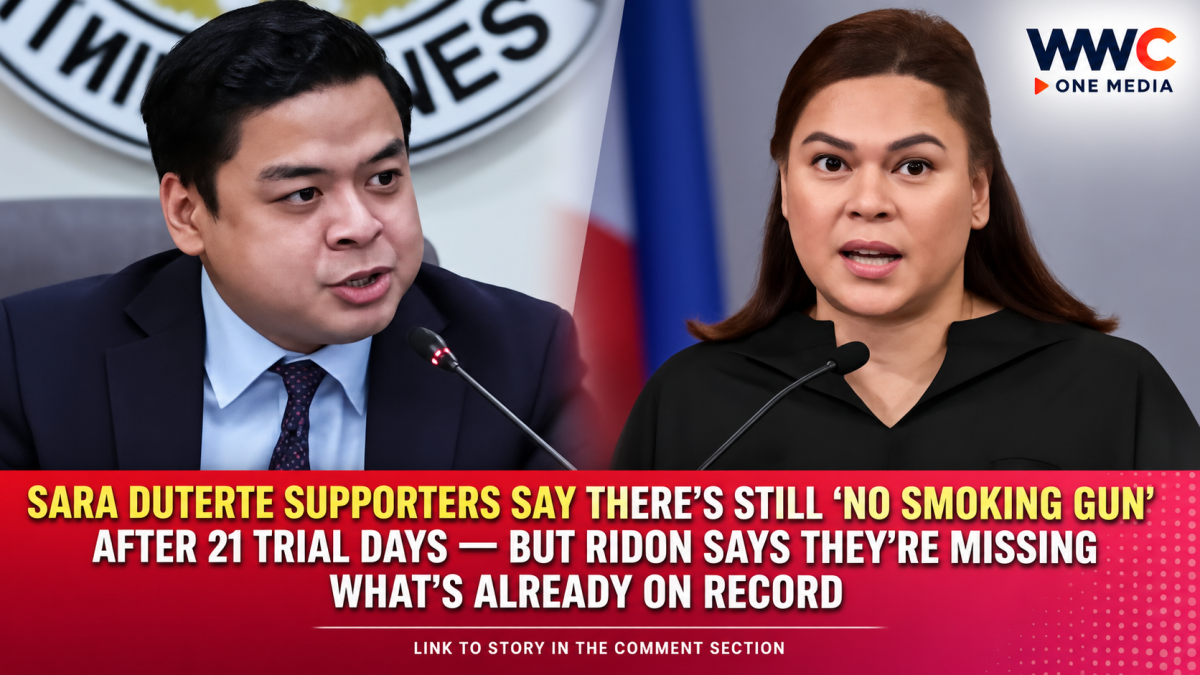
MANILA, Philippines — After 21 days of Vice President Sara Duterte’s impeachment trial, House prosecutor and Bicol Saro Party-list Rep. Terry Ridon is pushing back against supporters who insist prosecutors have yet to produce a decisive “smoking gun.”
His message was pointed: listen again to what has already been presented.
Ridon told reporters that critics claiming the prosecution has failed to establish a significant case should “unmute the video,” arguing that weeks of testimony and documentary evidence have already placed substantial information before the Senate sitting as an impeachment court. He nevertheless stopped short of publicly assessing the strength of individual evidence, citing the court’s sub judice restrictions.
Day 21 put Sara Duterte’s own defense lawyer on the witness stand
The latest confrontation came after lawyer Michael Wesley Poa, a member of Duterte’s defense team and her former Department of Education chief of staff, was called by prosecutors and declared a hostile witness by the impeachment court.
That designation allowed prosecutors to use leading questions while examining him.
Poa held several senior roles at DepEd during Duterte’s tenure as education secretary, including chief of staff, spokesperson and officer-in-charge undersecretary for finance. He also signed DepEd’s official response to a Commission on Audit inquiry involving the department’s P112.5 million in confidential funds.
The issue prosecutors tried to highlight was unusual: Poa had been responsible for communicating with state auditors about confidential-fund questions while repeatedly saying he had no firsthand knowledge of how the money was actually disbursed in field operations.
Poa said he did not know key details of the operation
During questioning, Poa testified that he did not know at the time that DepEd had a security officer involved in confidential-fund operations. He said he only learned during later House hearings about Col. Dennis Nolasco’s role.
Poa also said that when preparing DepEd’s response to COA, information came from officials connected with the confidential-fund operations rather than from his own direct knowledge. He described Duterte’s DepEd operation as highly compartmentalized.
He further acknowledged that he had not asked DepEd’s special disbursing officer whether rewards paid to informants actually resulted in successful intelligence gathering. At the same time, Poa argued that paying for information does not necessarily guarantee an immediately successful operation—an important part of the defense-side explanation of how confidential intelligence activities work.
That distinction matters. Poa’s testimony raises questions about oversight and the flow of information inside DepEd, but it does not by itself establish Duterte’s guilt. The senator-judges must ultimately determine what the testimony proves when weighed with the rest of the record.
Earlier testimony is why prosecutors reject the ‘no smoking gun’ narrative
Ridon’s response also comes after testimony from former OVP special disbursing officer Gina Acosta, who told the impeachment court that Duterte instructed her to release a P125-million confidential-fund tranche to then-security official Col. Raymund Dante Lachica.
Acosta testified that she released the money because Duterte instructed her to do so and because Lachica was trusted by the head of the office. She also acknowledged that she remained the accountable officer and that the applicable joint circular did not specifically designate security officers as disbursing officers.
GMA News separately reported that Acosta testified that the OVP’s total P500 million in confidential funds was turned over in four P125-million tranches to Lachica during the relevant period.
Prosecutors have portrayed that testimony as a direct link between Duterte and the movement of the confidential funds. Ridon previously went as far as describing Acosta’s testimony as one of the prosecution’s “smoking guns.”
The defense, however, has consistently disputed the prosecution’s interpretation of the fund records and allegations, and Duterte has denied wrongdoing. The existence of irregularities alleged by prosecutors, or testimony raising questions about internal procedures, is not the same as a final finding that she committed an impeachable offense.
The P612.5-million question at the center of Article I
Article I of the current impeachment case accuses Duterte of culpable violation of the Constitution, graft and corruption and betrayal of public trust through the alleged misuse, misappropriation and irregular liquidation of a combined P612.5 million in confidential funds—P500 million under the Office of the Vice President and P112.5 million under DepEd.
Bank witnesses earlier traced the P612.5 million to government funds and testified that the money was withdrawn through seven checks—P500 million from the OVP side and P112.5 million from DepEd. That establishes a money trail, but the central fight remains over how the cash was ultimately used, who exercised control over it and whether its liquidation complied with governing rules.
That is why the search for one dramatic “smoking gun” may oversimplify the case. Impeachment trials can turn on the cumulative weight of documents, witness testimony, audit findings and inferences—not necessarily on a single sensational piece of evidence.
Ridon says prosecution already has enough
Ridon said the prosecution considers the evidence already introduced on the first two charges it has actually presented—Article IV involving Duterte’s alleged threats and Article I involving confidential funds—“more than sufficient.”
The prosecution is also considering whether to skip or withdraw its presentation on Article III, involving alleged bribery and payments to DepEd officials, and move to Article II on alleged unexplained wealth in an effort to shorten the trial. No final decision had been made as of the latest reports.
A major new development came hours after the original Bombo report
The story also moved significantly on September 4.
A Quezon City Regional Trial Court issued an arrest warrant against Duterte on three counts of grave threats, finding probable cause to hold her for trial. Bail was set at P120,000 for each count. The criminal case concerns remarks involving President Ferdinand Marcos Jr., First Lady Liza Araneta-Marcos and former House Speaker Martin Romualdez—the same general episode underlying Article IV of the impeachment case.
Duterte’s lawyers said she does not intend to evade the law and will pursue available legal remedies. The warrant and the impeachment proceeding are separate legal processes, and a finding of probable cause in the criminal case is not a finding of guilt nor automatic proof of an impeachable offense.
The bigger question after Day 21
For both camps, “smoking gun” has become as much a political phrase as a legal one.
Duterte’s supporters can argue that prosecutors have not yet produced the single piece of evidence they believe directly establishes an impeachable act. Prosecutors counter that the Senate has already heard a chain of testimony—from auditors and bank officials to former OVP and DepEd personnel—that should be assessed together.
Ultimately, the decisive question will not be whether social media agrees that one spectacular “smoking gun” exists.
It will be whether enough senator-judges conclude that the totality of the evidence satisfies the constitutional standard required to convict the vice president.
WWC ONE MEDIA J.M.D



Leave a Reply