
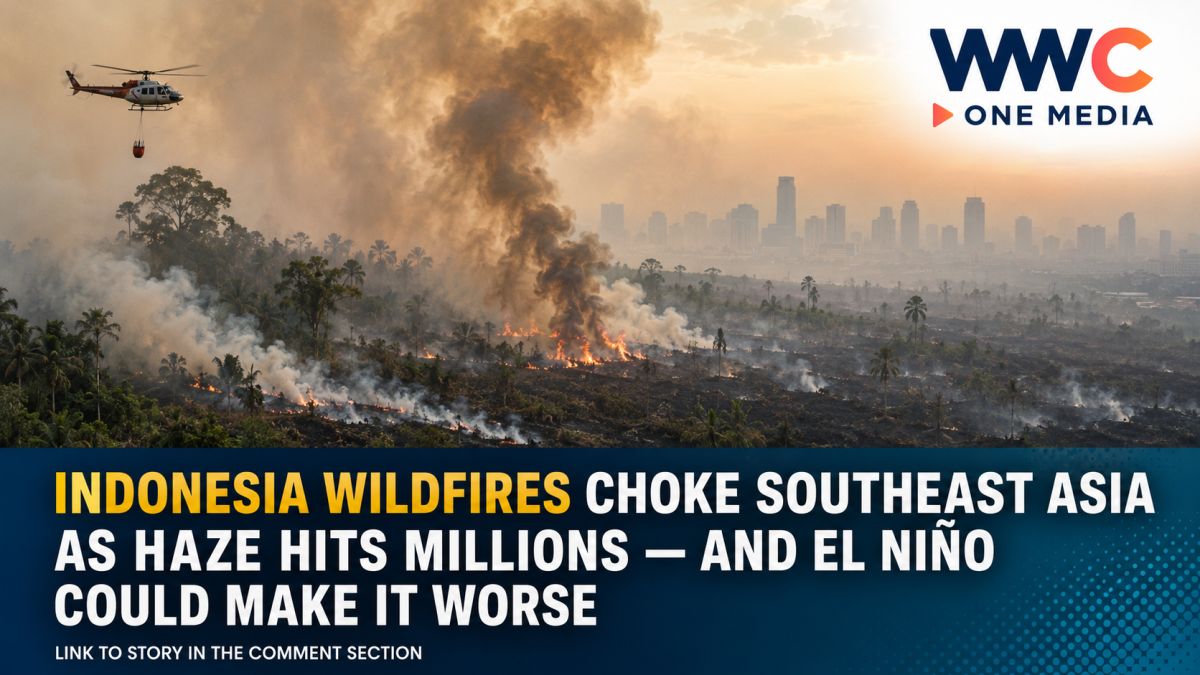
PALANGKARAYA, Indonesia — Indonesia is throwing aircraft, cloud-seeding operations, water bombs and thousands of firefighters into an escalating battle against forest and peatland fires that have already exposed millions of people to choking smoke — but regional weather conditions suggest the crisis could still intensify.
More than five million people on Sumatra and Borneo have been directly exposed to hazardous haze, while about 13,500 people were treated for respiratory infections during July and August, Indonesian Deputy Health Minister Dante Saksono Harbuwono said in reporting carried by CNA and AFP on August 28.
The health toll is particularly worrying for children, elderly people, pregnant women, people with asthma and those who work outdoors. Indonesia’s Health Ministry has distributed more than five million masks as smoke settles over communities near some of the worst fire zones.
And the threat is no longer confined to Indonesia.
Smoke from fires in Kalimantan and Sumatra has crossed international borders, worsening air quality in parts of Malaysia and raising the risk of renewed haze in Singapore. ASEAN’s regional haze monitoring centre has now activated Alert Level 3 for the southern ASEAN region — its highest alert level — after observing widespread moderate-to-dense smoke under prolonged dry conditions.
MILLIONS BREATHING THE CONSEQUENCES
The rapidly changing health numbers show how quickly the crisis has expanded.
An earlier Health Ministry tally reported by The Jakarta Post on August 26 said more than three million people across 37 cities and regencies had been directly exposed to wildfire smoke. Two days later, CNA reported the deputy health minister’s updated figure of more than five million people exposed across Borneo and Sumatra. The figures were reported at different times and should not be treated as directly comparable datasets, but both point to a major public-health emergency.
In Riau, The Jakarta Post reported PM2.5 concentrations reaching 235.7 micrograms per cubic metre, more than 15 times the World Health Organization’s 24-hour guideline of 15 micrograms per cubic metre. Fine PM2.5 particles are particularly dangerous because they can penetrate deep into the lungs.
Several Indonesian schools have temporarily shifted away from face-to-face classes as authorities try to limit children’s exposure.
MALAYSIA FEELS THE SMOKE
Across the border, Malaysia has also been struggling with deteriorating air quality.
Parts of Sarawak and the Klang Valley recorded unhealthy pollution readings this week, while some areas of Sarawak previously crossed into the “very unhealthy” category. On August 28, Malaysian authorities ordered 30 schools in Lubok Antu, Sarawak, to close after the Air Pollutant Index exceeded 200.
Earlier in the crisis, nearly 600 schools across Sarawak were temporarily closed, affecting roughly 200,000 students, according to AP.
Malaysia and Indonesia have also moved toward cross-border cooperation. Reuters reported that Jakarta granted Malaysian agencies permission to enter Indonesian airspace for coordinated cloud-seeding operations along their shared border.
SINGAPORE WATCHING THE WINDS
Singapore has so far avoided the worst conditions seen elsewhere, but authorities are watching the situation closely.
The National Environment Agency warned on August 24 that Singapore could experience occasional haze if winds carry smoke north from southern Sumatra and Kalimantan. At the time, Singapore’s 24-hour Pollutant Standards Index remained in the moderate range, though readings had been edging upward.
The bigger concern is what happens next.
Dry conditions remain widespread across the southern ASEAN region, while smoke plumes continue to emerge from Kalimantan and central and southern Sumatra. ASEAN’s haze centre has warned that strengthening El Niño conditions could further increase the risk of severe transboundary haze.
WHY THIS FIRE SEASON IS SO DANGEROUS
Indonesia’s meteorological agency, BMKG, says El Niño has reached very strong intensity.
Monitoring during the second 10-day period of August put the Niño 3.4 sea-surface temperature anomaly at about +2.99°C, a level BMKG categorised as a very strong El Niño. Large areas of Indonesia are simultaneously experiencing their peak dry season.
El Niño does not ignite forests by itself.
Instead, prolonged heat and dry weather make vegetation and peatlands dramatically easier to burn and make existing fires harder to extinguish. Indonesian disaster officials have repeatedly said human activity — whether deliberate or accidental — remains the main ignition source.
That distinction matters because Indonesia’s haze crisis is not simply a natural disaster.
72 ARRESTED AS AUTHORITIES TURN TO ENFORCEMENT
Police have arrested 72 people suspected of starting forest and peatland fires, with investigations covering 89 fire cases across provinces in Kalimantan and Sumatra, according to AP.
Investigators said they are examining whether some fires were deliberately started to clear land cheaply and whether companies or other parties financed or benefited from those activities. Four companies were under investigation in the police-led cases reported by AP.
Separately, Indonesia’s Forestry Ministry said it was processing 42 forest-fire cases and had imposed administrative sanctions on six concession holders after fires were found across more than 1,500 hectares under their management. One company’s business licence was suspended, while others were ordered to take corrective and restoration measures.
Those proceedings are distinct from the police arrests, and authorities have not established that all of the cases overlap.
The enforcement push may prove crucial. Environmental groups have long argued that water bombing and cloud seeding can suppress individual fires but cannot permanently solve a haze problem tied to land management, peat degradation and recurring use of fire for clearing.
WATER BOMBS FROM THE SKY
Indonesia nevertheless faces the immediate challenge of putting thousands of fires and hotspots under control.
AP reported that more than 24,000 ground firefighters had been deployed across Sumatra and Borneo, while dozens of helicopters and aircraft were being used for patrols, water bombing and weather-modification operations.
CNA reported that the disaster agency had poured more than four million litres of water onto burning areas in recent weeks and dispersed more than 8,000 kilograms of salt into clouds on August 26 alone as part of attempts to trigger rainfall.
Indonesia’s Forestry Ministry said more than 202,000 hectares had burned nationwide between January and July — nearly double the area recorded through June and already exceeding the January-to-July totals during recent El Niño years such as 2019 and 2023.
THE MOST IMPORTANT QUESTION IS WHAT HAPPENS NEXT
The immediate numbers may rise or fall as rain, winds and firefighting operations change conditions from day to day.
But the regional outlook remains troubling.
On August 29, Indonesia’s National Disaster Management Agency said forest and land fires were still among the dominant disaster events being handled across the country. Meanwhile, ASEAN’s highest haze alert remains active and meteorological agencies continue to warn of unusually dry conditions.
Indonesia has fought devastating haze seasons before.
The difference now is that authorities have aircraft in the sky, firefighters on the ground, criminal investigations underway and growing pressure from neighbouring countries.
Whether that is enough will depend on something water bombs cannot solve alone: stopping new fires from being started while the land remains dangerously dry.
And with the critical fire season stretching through August and September — while El Niño is expected to persist into early 2027 — Southeast Asia may not yet have seen the worst of the 2026 haze crisis.

Leave a Reply