
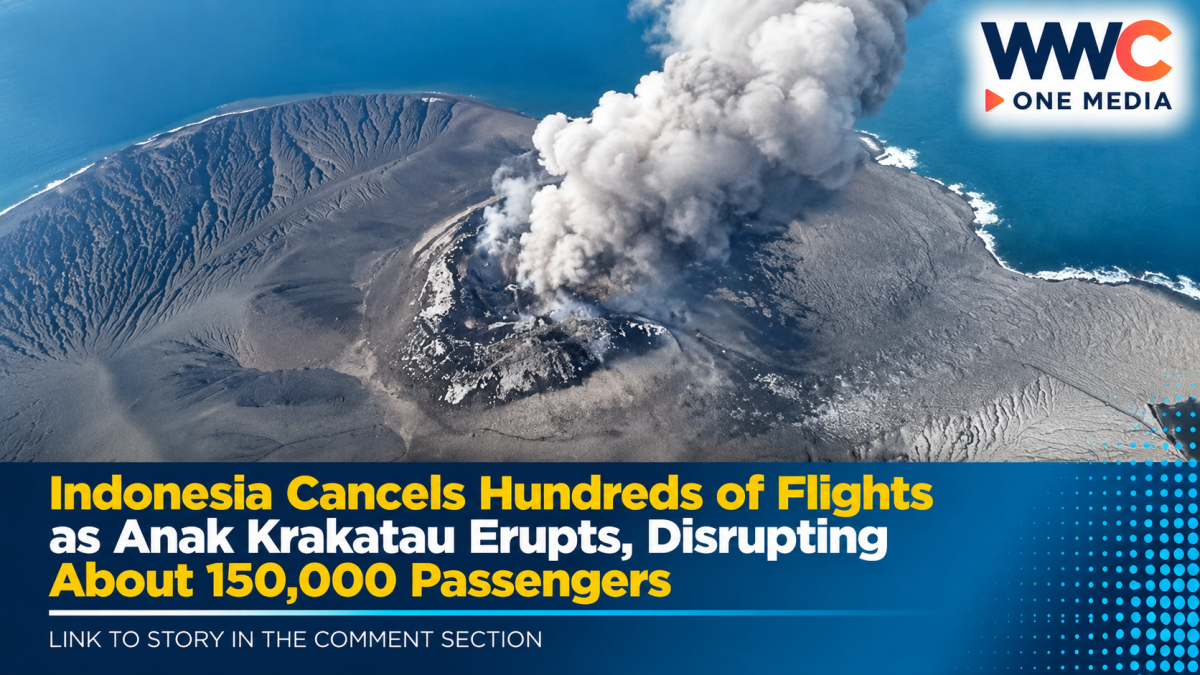
JAKARTA — Indonesia was hit by major air travel disruption after the Anak Krakatau volcano erupted, sending volcanic ash across parts of western Indonesia and forcing authorities to close airspace around Jakarta and several other airports.
The eruption disrupted hundreds of flights and affected an estimated 150,000 passengers at Jakarta’s Soekarno-Hatta International Airport alone, according to authorities.
By Saturday evening, the volcanic crisis had affected 467 flight movements at Indonesia’s busiest airport, while operations were also disrupted at other airports, including Jakarta’s Halim Perdanakusuma Airport and airports in Lampung, Bali and Medan.
The dramatic eruption has once again put the spotlight on Anak Krakatau — one of Indonesia’s most closely watched volcanoes.
Anak Krakatau Erupts Before Dawn
Indonesia’s Geological Agency said Anak Krakatau had shown signs of increased volcanic activity since Friday before erupting at 3:53 a.m. on Saturday.
The eruption reportedly lasted about 30 seconds.
Camera footage showed glowing lava flares emerging from the volcano as activity intensified.
Geological Agency head Lana Saria said Anak Krakatau’s activity had been increasing since July, with Saturday’s eruption the strongest during the current period of unrest.
Officials said the repeated eruptions indicated that magma and volcanic gases continued to move beneath the volcano.
However, authorities said it was impossible to predict whether a larger eruption would follow.
Jakarta Airports Shut as Ash Creates Aviation Danger
Volcanic ash poses a serious threat to aircraft.
Even when an eruption does not directly damage an airport, ash in the air can create dangerous conditions for engines, navigation systems and flight operations.
AirNav Indonesia responded by closing airspace around:
- Soekarno-Hatta International Airport
- Halim Perdanakusuma Airport
- Radin Inten II Airport in Lampung
- Six other airports affected by the ash cloud
The closures triggered widespread cancellations and delays.
Soekarno-Hatta International Airport, which serves as Indonesia’s main international gateway, was ordered closed until at least 9:30 p.m. on Saturday.
The disruption then threatened to create further problems as airlines worked to reposition aircraft and restore their schedules.
Nearly 500 Flight Movements Affected
The scale of the disruption quickly became clear.
Authorities said 467 flight movements at Soekarno-Hatta alone had been affected by Saturday evening.
About 150,000 passengers were impacted.
And the situation extended beyond Jakarta.
The eruption also disrupted flights connected to Bali and Medan, raising the possibility of wider travel problems across Indonesia’s vast aviation network.
Officials warned that even after airports reopened, the impact could continue.
Aviation disruptions can create a chain reaction involving:
Aircraft rotations.
Crew schedules.
Fleet availability.
Airport gates.
Terminal capacity.
One volcanic eruption can therefore affect flights far beyond the immediate danger zone.
Ash Reaches Parts of Jakarta and Lampung
Indonesia’s Center for Volcanology and Geological Hazard Mitigation said volcanic ash spread across parts of Jakarta and Lampung Province.
Authorities continued monitoring the movement of the ash cloud as it posed risks to both aviation and communities.
Despite the dramatic eruption, officials said no casualties had been reported.
No evacuation order was issued.
The nearest settlement is more than 16 kilometers away from the volcano.
However, residents and visitors were warned to remain at least 3 kilometers from Anak Krakatau’s active crater.
What Are the Main Dangers?
Officials warned that Anak Krakatau’s current activity presents several serious hazards.
These include:
- Volcanic ash
- High concentrations of volcanic gas
- Hot rocks ejected from the crater
- Other volcanic material around the active zone
Authorities urged people to stay away from the restricted area and follow official warnings.
The greatest concern for now is continued volcanic activity.
Lana Saria said scientists could not determine whether the current unrest would lead to a larger eruption.
Bali and Medan Also Feel the Impact
The disruption was not limited to Jakarta.
Flight services at Bali’s I Gusti Ngurah Rai International Airport and airports serving Medan were also affected.
That expanded the crisis beyond western Indonesia and highlighted the vulnerability of air travel in a country with more than 17,000 islands.
Indonesia depends heavily on aviation to connect its population and support its tourism industry.
Any major disruption at Jakarta or Bali can therefore have significant consequences for travelers and businesses.
The country’s civil aviation authorities said they were coordinating with airlines, airport operators, air navigation services and meteorological officials as they monitored the situation.
‘Safety Remains Our Top Priority’
Indonesia’s Directorate-General of Civil Aviation said passenger safety remained the government’s main concern.
Ministry of Transportation Director General of Civil Aviation Lukman F. Laisa warned that restoring normal flight operations could take time because of the cascading effects on airline schedules.
“Safety remains our top priority in every operational decision,” he said.
Passengers were urged to wait for updates from airlines and airport authorities.
For many stranded travelers, however, there was little they could do except wait.
Passenger Michele Gouw described the disruption as a force majeure situation.
“It’s a natural disaster,” she said, adding that travelers simply had to follow directions from airlines and airports.
Anak Krakatau’s History Makes Every Eruption Closely Watched
Anak Krakatau, meaning “Child of Krakatau,” emerged from the sea decades after the catastrophic 1883 eruption of Krakatau.
The volcano is located in the Sunda Strait between the islands of Java and Sumatra.
Because of the region’s volcanic history, every significant increase in Anak Krakatau’s activity is closely monitored.
The volcano has experienced repeated eruptions and periods of unrest over the years.
Saturday’s eruption is now being described by Indonesia’s Geological Agency as the strongest during the current period of increased activity, which began intensifying in July.
Could Another, Bigger Eruption Follow?
That remains the biggest unanswered question.
Scientists have detected continuing signs of magma and volcanic gases beneath Anak Krakatau.
But volcanic activity is notoriously difficult to predict.
Authorities have not said a larger eruption is imminent.
Instead, they are warning that the possibility cannot be ruled out.
Indonesia’s volcanic monitoring agencies will continue watching seismic activity, ash emissions and other warning signs.
For communities, travelers and airlines, the situation means uncertainty could continue even after the immediate flight disruptions end.
Indonesia’s Volcano Challenge
Indonesia sits along the Pacific’s volcanically active “Ring of Fire” and has more active volcanoes than almost any other country.
Volcanic eruptions are therefore a recurring challenge for authorities.
But the Anak Krakatau eruption demonstrates how quickly a geological event can become a major transportation crisis.
Within hours, ash concerns forced the closure of airspace around major airports.
Hundreds of flights were affected.
Tens of thousands of passengers were left waiting.
And airline schedules faced disruptions that could continue beyond the initial eruption.
The Situation Is Still Developing
For now, no casualties have been reported and no evacuation order has been issued.
But volcanic activity remains under close watch.
Authorities are continuing to monitor Anak Krakatau as airlines work to restore flight schedules and determine when normal operations can safely resume.
The immediate crisis may be focused on Indonesia’s skies.
But beneath the surface, the volcano is still sending a warning.
Magma is moving.
Volcanic gases are rising.
And scientists cannot yet say whether the strongest eruption of the current unrest will be the last.
For hundreds of thousands of travelers, the question is when flights will fully return.
For Indonesia’s volcanologists, the bigger question remains:
What will Anak Krakatau do next?
WWC ONE MEDIA J.M.D




Leave a Reply