
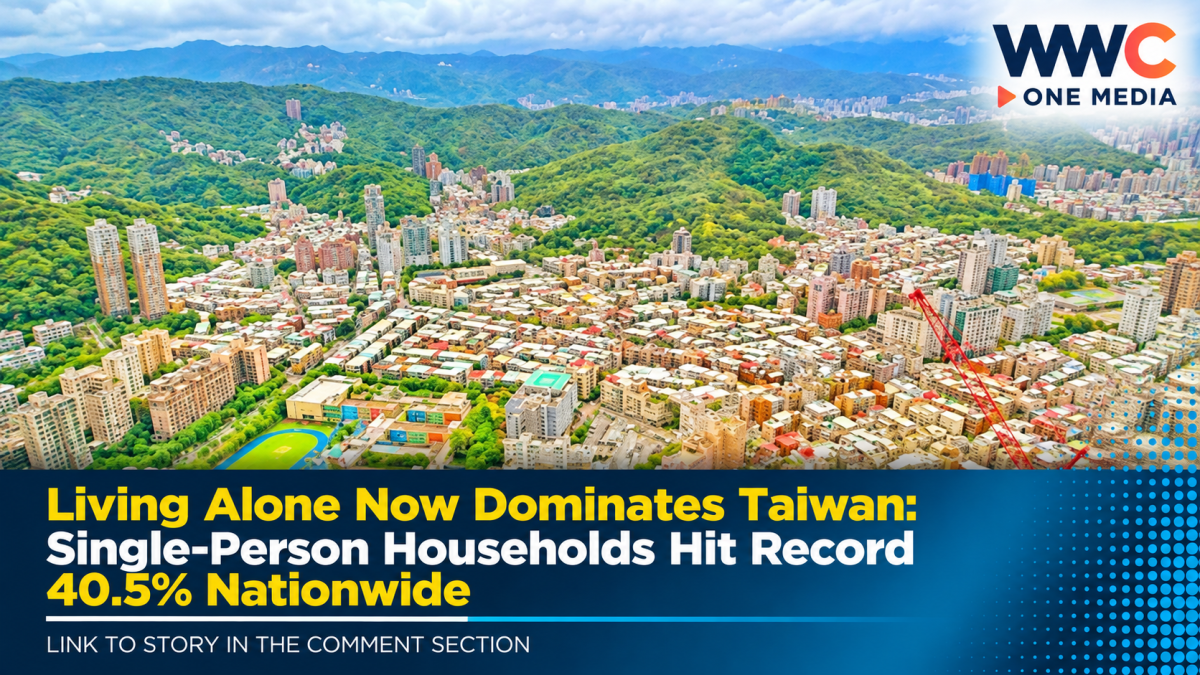
TAIPEI — Taiwan is undergoing a major demographic and housing transformation, with nearly 4 million households now registered as single-person homes, according to the latest government data.
The number of single-person households reached approximately 3.99 million last year, accounting for 40.5 percent of all registered households nationwide, data from Taiwan’s Ministry of the Interior showed.
The figure means that living alone has become the country’s dominant household structure, surpassing the share of households with two or three people.
But there is an important question behind the headline:
Are nearly 4 million Taiwanese really living alone — or is the number being distorted by Taiwan’s housing and tax system?
A Major Shift in How Taiwan Lives
Taiwan’s household structure has changed dramatically over the decades.
Large, multigenerational families were once a defining feature of Taiwanese society. Parents, children and grandparents commonly lived under the same roof.
Today, however, smaller households are increasingly becoming the norm.
The latest figures show that single-person households now account for more than four out of every 10 registered households in Taiwan.
That shift reflects a combination of demographic, economic and social changes, including an aging population, lower birth rates, delayed marriage and changing attitudes toward independent living.
Nearly 4 Million Registered Single-Person Homes
According to Ministry of the Interior data cited by the Taipei Times, Taiwan had about 3,993,100 single-person households last year.
That represented 40.5 percent of all registered households nationwide.
The scale of the increase is significant.
Single-person households have now become Taiwan’s largest household category, illustrating how rapidly the country’s traditional family structure is changing.
But Experts Question Whether the Number Tells the Whole Story
Not everyone believes the official figure accurately represents the number of people actually living alone.
A real-estate professional cited in the Taipei Times said the number could be inflated because of changes to preferential tax treatment for owner-occupied homes.
In other words, some people may be registered separately for administrative or tax purposes even if they do not actually live alone.
That means there could be a significant difference between:
A household registered as having one person.
And:
A person physically living alone.
The distinction is important because policymakers and businesses often use household statistics to understand social trends and housing demand.
Is Taiwan’s Housing System Changing the Statistics?
Taiwan’s preferential tax policies for owner-occupied housing may be encouraging some property owners to establish separate household registrations.
If a property qualifies for favorable tax treatment based on household registration, the official number of single-person households could rise without a matching increase in the actual number of people living alone.
That does not mean Taiwan’s demographic shift is not real.
It means the precise scale of the “living alone” trend may be more complicated than the headline number suggests.
Taiwan Is Still Facing a Real Demographic Transformation
Even with questions about how the statistics are calculated, Taiwan’s population structure is changing.
The country is dealing with several major demographic trends at the same time:
- Fewer children being born
- More people delaying marriage
- Smaller families
- An aging population
- More elderly people living independently
- Changing attitudes toward marriage and family life
Together, these factors are reshaping everything from housing demand to consumer spending.
The rise of smaller households means Taiwan increasingly needs homes, services and infrastructure designed for one or two people rather than large families.
What Happens When Nearly Half of Homes Have One Person?
The rise of single-person households has consequences far beyond where people sleep.
It can affect:
Housing
Demand may increasingly shift toward smaller apartments and one-person living spaces.
Retail
Consumers living alone often buy smaller quantities of food and household products.
Healthcare
More elderly people living independently could increase demand for home-based care and support services.
Real Estate
Developers may face growing pressure to build smaller, more affordable housing units.
Society
Living alone can provide greater independence, but it can also increase concerns about social isolation.
The change is therefore not just a housing statistic.
It could reshape Taiwan’s economy and society for decades.
The Rise of Independent Living
For younger generations, living alone is increasingly viewed as a lifestyle choice rather than an unusual situation.
Higher education, urban employment and changing social expectations have given more people opportunities to establish independent households.
Marriage is also occurring later for many people.
Others are choosing not to marry at all.
Meanwhile, Taiwan’s aging population is creating another large group of single-person households as older adults continue living independently after their children move away or after the death of a spouse.
These different trends are converging to create a society with dramatically smaller households.
A Challenge for Taiwan’s Property Market
The household transformation could also have major consequences for Taiwan’s already complicated housing market.
Taiwan has long faced concerns over housing affordability, particularly in major urban areas.
But the rise of one-person households creates a different problem.
A country may need more homes even if its total population is not growing.
If four people live separately instead of together, they may require four housing units rather than one.
That means falling birth rates and population decline do not automatically translate into lower housing demand.
The number of households — not just the number of people — is becoming increasingly important for Taiwan’s property market.
The Hidden Cost of Living Alone
Living independently offers freedom and privacy.
But it can also be expensive.
One-person households must often cover the full cost of:
- Rent or mortgage payments
- Utilities
- Internet services
- Food
- Transportation
- Household maintenance
Those costs cannot always be divided among family members or roommates.
The growing number of single-person households could therefore create new economic pressures, particularly for young workers and elderly people living on fixed incomes.
Aging Could Push the Numbers Even Higher
Taiwan’s rapidly aging society could make single-person households even more common in the years ahead.
As people live longer, more seniors may find themselves living independently.
That creates major questions for policymakers.
How can Taiwan ensure older adults living alone remain connected to their communities?
How can emergency services reach vulnerable seniors?
And how much housing and healthcare infrastructure will be needed?
The answers could become increasingly important as Taiwan’s demographic transformation accelerates.
A New Taiwan Is Emerging
The latest household data provides a glimpse of a country changing in fundamental ways.
Taiwan is becoming:
Older.
Smaller in household size.
More urban.
More independent.
And increasingly organized around individuals rather than traditional large families.
Yet the statistics also come with an important warning.
A registered single-person household does not always mean a person is actually living alone.
Tax rules and household registration practices could be influencing the numbers.
Still, even with that caveat, the direction of change is difficult to ignore.
One Statistic That Could Change Everything
Nearly 4 million registered single-person households.
More than 40 percent of Taiwan’s total.
The numbers reveal a transformation that could affect housing, business, healthcare and public policy for generations.
Taiwan is no longer simply a society of traditional family homes.
It is increasingly becoming a nation of smaller households — and in many cases, one-person homes.
Whether every registered household represents a person truly living alone remains open to debate.
But one thing is becoming increasingly clear:
Taiwan’s idea of what a household looks like is changing faster than ever.
WWC ONE MEDIA J.M.D



Leave a Reply