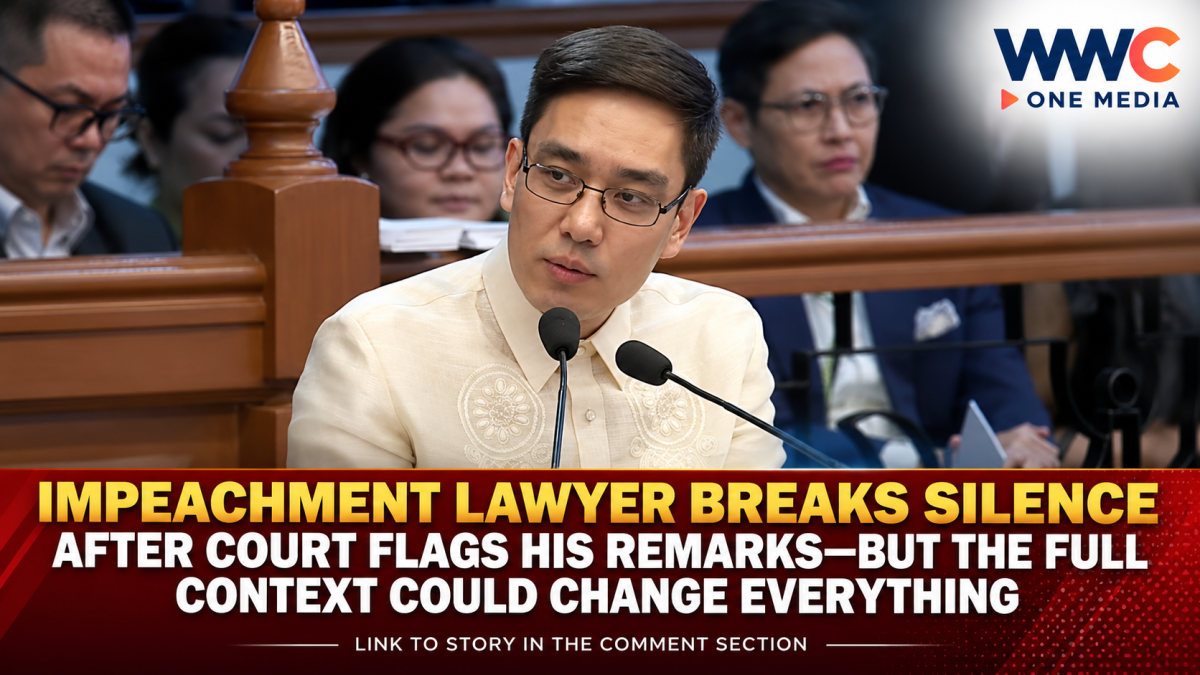
MANILA, Philippines — A lawyer representing the House prosecution in Vice President Sara Duterte’s impeachment trial has pushed back against concerns that his public statements were intended to influence the Senate impeachment court, saying his remarks were meant to explain the proceedings and provide context to the public.
Private prosecutor Benjamin “Jay” Tolosa Jr. was among the prosecution figures ordered by the Senate impeachment court to explain statements that were alleged to have breached its sub judice rule, which restricts parties from publicly discussing the merits of an ongoing case.
Tolosa maintained that his comments should be viewed in their entirety and in the context in which they were made. He argued that the statements largely recounted matters already taken up during the proceedings rather than attempting to prejudge the case or pressure senators acting as impeachment judges.
Why Tolosa was ordered to explain his remarks
The controversy followed the Senate impeachment court’s issuance of show-cause orders to Tolosa and Bicol Saro party-list Rep. Terry Ridon over public statements connected with Duterte’s ongoing impeachment trial.
The orders were issued on September 16, 2026, according to Philstar’s reporting. The court asked the two members of the prosecution team to explain why their remarks should not be considered violations of its sub judice restrictions.
The issue is significant because the impeachment court has been tightening its enforcement of rules governing what parties can say outside the courtroom while the trial remains pending.
GMA News reported that Ridon and Tolosa argued that their statements concerned procedure and summaries of proceedings, rather than the substantive merits of the impeachment case.
Tolosa: Context matters
Tolosa has maintained that the statements cited by the court were made in good faith and that the complete context should be considered.
The prosecution lawyer has also argued that public briefings serve to keep Filipinos informed about an impeachment proceeding that is being conducted before the Senate.
The dispute therefore centers not simply on whether the prosecutors spoke publicly, but on what they said, how the statements were framed and whether the remarks crossed the line from reporting on proceedings into publicly arguing the merits of a case still before the court.
The court’s sub judice rule
The Senate impeachment court’s restrictions are designed to prevent parties from using media interviews or other public platforms to litigate the case outside the courtroom.
The Philippine Tribune reported that Rule 18 of the Senate impeachment court bars lawyers from publicly discussing the merits of the case, including through media interviews and social media posts.
The court previously announced a stricter enforcement approach and a “two-strike” framework for violations. According to the Tribune, a first violation could result in a public reprimand and stern admonition, while subsequent violations could carry financial penalties of up to P30,000 for each subsequent incident.
The court had also encouraged both sides to designate spokespersons who were not directly participating in the trial to reduce the possibility of lawyers or litigants commenting on matters still being litigated.
Prosecution asks for the rule to apply to everyone
The controversy has also opened a separate dispute over whether the sub judice rule is being applied consistently to both sides.
After Tolosa and Ridon received the show-cause orders, members of the House prosecution team called on the impeachment court to apply the same standard to Duterte.
Philstar reported that Rep. Zia Alonto Adiong argued that if prosecutors were being required to explain public statements, the respondent should also be subject to the same restrictions. He pointed to Duterte’s public comments questioning the court and suggesting presidential influence over senators, judges and police.
GMA News separately reported that Ridon and Tolosa questioned why Duterte had not been asked to explain those remarks, with Tolosa describing them as an attack on the integrity of the court.
Those comments represent the prosecution’s position; the underlying dispute remains for the impeachment court to resolve.
Tolosa has been a prominent figure in the trial
Tolosa has played a visible role in the proceedings since joining the House prosecution team.
The House of Representatives formally announced him in June as a private prosecutor and legal spokesperson for the impeachment case against Duterte. The House said his role included communicating developments in the proceedings to the public.
He has also taken an active role inside the courtroom.
During the trial’s 21st day in September, Tolosa questioned former Education Undersecretary Michael Wesley Poa regarding the Department of Education’s confidential funds during Duterte’s tenure as education secretary. The Senate impeachment court declared Poa a hostile witness, allowing Tolosa to ask leading questions.
The dispute comes as the trial enters another critical phase
The controversy over public statements comes amid an increasingly contentious phase of Duterte’s impeachment trial.
The prosecution and defense continue to clash over witnesses, evidence and courtroom procedure. The Senate impeachment court has also had to intervene several times to enforce courtroom rules.
The current dispute over the sub judice rule adds another layer: how much can the lawyers and other participants publicly discuss while the Senate is still weighing the evidence?
For now, Tolosa has maintained that his statements should not be interpreted as an attempt to influence the senators’ eventual decision. The impeachment court will determine whether the explanations provided by Tolosa and Ridon sufficiently address the concerns raised by the show-cause orders.
The outcome could help define how strictly the Senate impeachment court will regulate public commentary for the remainder of Duterte’s trial.