MANILA — ASEAN is moving faster to modernise trade across Southeast Asia, allowing member states to begin applying parts of an upgraded regional goods-trade agreement before the pact formally enters into force in 2027.
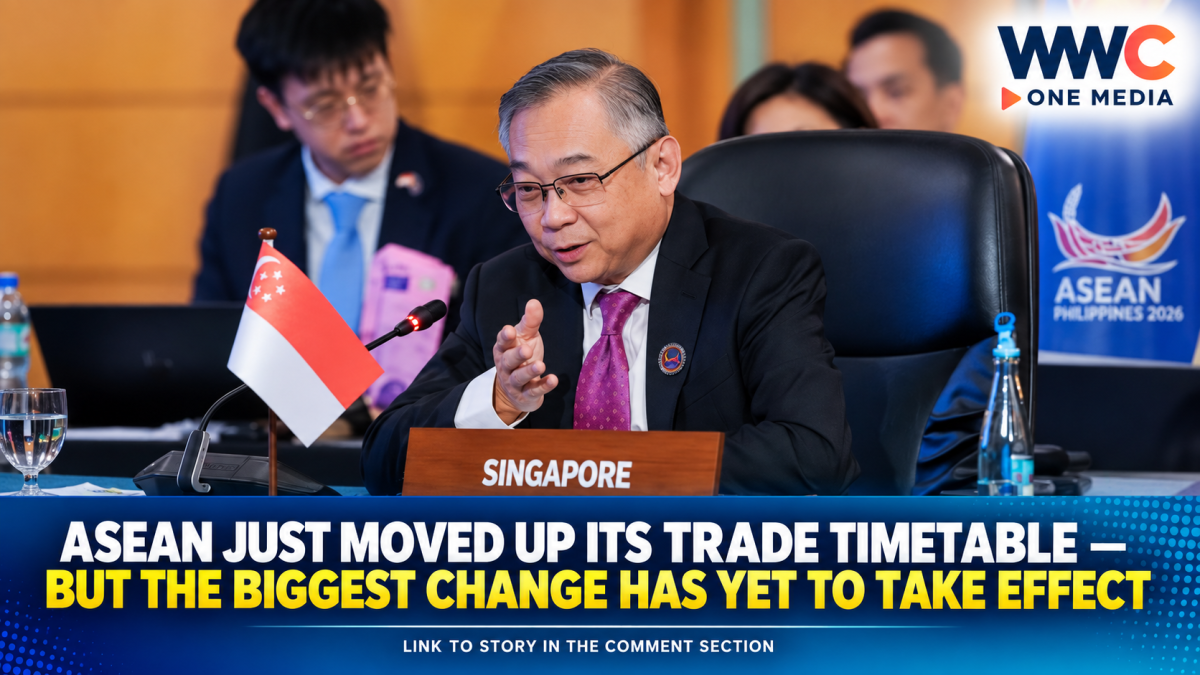
The decision, reached by ASEAN economic ministers in Manila on Sept. 19, could give participating member states an earlier pathway to implement the upgraded ASEAN Trade in Goods Agreement (ATIGA) as the region seeks to make cross-border commerce more efficient and strengthen supply-chain resilience.
Singapore Deputy Prime Minister and Minister for Trade and Industry Gan Kim Yong said the early rollout would help goods move more smoothly across borders and improve businesses’ access to markets throughout Southeast Asia. The development was reported by The Straits Times following the first day of the 58th ASEAN Economic Ministers’ Meeting and related meetings.
The important detail: it is provisional, not yet full entry into force
The latest decision is more nuanced than simply saying ASEAN has brought the upgraded trade pact into force early.
Under a declaration adopted by the 10 ASEAN member states, countries can voluntarily and reciprocally apply the Second Protocol to Amend ATIGA on a provisional basis if they notify the ASEAN Secretary-General of their intention to do so.
The upgraded agreement’s formal entry into force remains scheduled for June 1, 2027.
That means implementation can begin earlier between participating countries, while the full legal entry into force of the amended agreement remains tied to the existing timetable.
The distinction matters for companies because not every provision will necessarily be applied provisionally.
What is changing under the upgraded ATIGA?
ATIGA has been the central legal framework governing trade in goods within ASEAN since it entered into force in 2010.
ASEAN says the agreement is designed to facilitate the free flow of goods and deepen regional economic integration. By 2025, about 98.86 per cent of products had their tariffs fully eliminated within ASEAN under ATIGA.
The latest upgrade goes beyond simply cutting tariffs.
Negotiations began in 2022 and concluded in May 2025. The Second Protocol was subsequently signed in 2025. ASEAN describes the upgrade as a way to make its trade rules more responsive to changes in the regional and global trading environment.
Among the areas covered by the modernised framework are:
- Trade facilitation and customs procedures
- Greater transparency surrounding non-tariff measures
- Digital trade documentation
- Electronic certificates of origin
- Supply-chain connectivity
- Trade and environmental issues
- Remanufactured goods
- Food security
- Trade during humanitarian or other crises
The Philippines News Agency reported that the upgraded framework is also expected to make administrative requirements easier for businesses through self-declaration of origin and digital documentation.
Why ASEAN is accelerating the process
The push comes as Southeast Asia faces a more uncertain global trading environment, including supply-chain disruptions and economic pressures linked to geopolitical developments.
ASEAN economic ministers had already discussed accelerating the upgraded ATIGA’s implementation earlier in 2026.
The Business Times reported in May that ASEAN countries were seeking to bring the agreement into force more quickly amid supply-chain disruptions and rising energy costs associated with the conflict in the Middle East.
The issue was subsequently linked to a decision by ASEAN leaders in May to accelerate work on the agreement.
Indonesia’s Trade Ministry said on Sept. 19 that the provisional-application approach was part of the mandate arising from the ASEAN leaders’ May 2026 discussions on responding to the Middle East situation.
What could this mean for businesses?
For companies operating across Southeast Asia, the significance lies less in another round of tariff cuts and more in reducing the friction involved in moving goods across borders.
ASEAN’s upgraded rules are intended to make trade procedures more predictable, improve transparency and strengthen regional supply chains.
The ASEAN Secretariat said ministers meeting in Manila also discussed preparations for the early entry into force of the upgraded ATIGA, alongside measures including expansion of the ASEAN Authorised Economic Operator Mutual Recognition Arrangement and improvements to the ASEAN Customs Transit System.
For businesses that frequently move components and finished products between ASEAN economies, these mechanisms could matter because delays and administrative requirements can add costs even when tariffs are already low.
The Philippines News Agency also highlighted the potential benefits for certified traders from expedited cargo clearance through mutual recognition arrangements for authorised economic operators.
Not every upgraded provision will apply immediately
There is another important limitation.
The provisional application does not mean every provision of the upgraded ATIGA will immediately operate between participating countries.
Reporting on the adopted declaration indicates that some provisions are excluded from provisional application and will instead apply when the protocol formally enters into force.
These include certain provisions concerning tariff commitments, rules of origin and specified agricultural and remanufactured-goods provisions.
For companies, that means the practical impact will depend on which ASEAN countries participate in provisional application and which specific provisions are applicable between them.
ASEAN’s wider economic integration push
The ATIGA move is part of a broader effort to deepen ASEAN’s economic integration.
The economic ministers are also working on the review of the ASEAN Trade in Services Agreement, while discussions are continuing on implementation of the ASEAN Digital Economy Framework Agreement, which is expected to cover areas including e-commerce, digital payments, cross-border data flows and cybersecurity.
Taken together, the initiatives point toward an ASEAN economic agenda increasingly focused not only on tariffs, but also on digital commerce, supply chains, customs efficiency and regulatory cooperation.
The ASEAN Secretariat says the bloc’s objective is to reinforce ASEAN as a single market and production base while maintaining regional competitiveness and resilience.
What happens next?
ASEAN member states that are ready to move ahead can notify the ASEAN Secretariat and begin provisional application on a voluntary and reciprocal basis.
The upgraded ATIGA is still scheduled for formal entry into force on June 1, 2027, meaning the current development should be understood as an accelerated implementation mechanism rather than a replacement of that date.
For Southeast Asian businesses, the immediate question is therefore not simply whether ASEAN has changed its trade rules.
It is how quickly individual member states will adopt the provisional framework — and how much difference those changes make at the border.