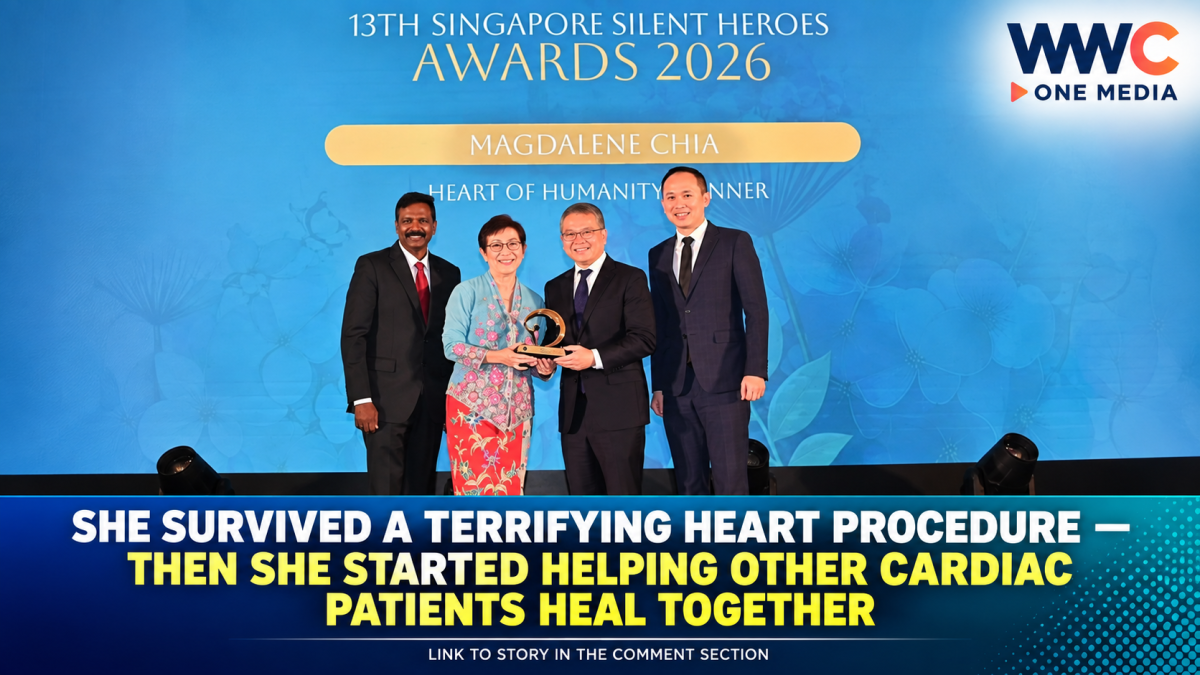
SINGAPORE — A frightening heart procedure in 2017 could have marked the end of one difficult chapter for Magdalene Chia. Instead, it became the beginning of a mission to make sure other cardiac patients in Singapore would not have to face recovery alone.
Chia, 70, is the founder of the Caring Hearts Support Group, a patient-led initiative linked to the National University Heart Centre Singapore (NUHCS). On Sept 19, she was recognised with the Heart of Humanity accolade at the 13th Singapore Silent Heroes Awards.
Her story is one of personal fear transformed into community support — and it highlights a growing recognition that recovering from heart disease involves more than medical treatment alone.
A frightening diagnosis became a turning point
Chia’s own health problems began in her mid-50s, when she experienced symptoms including heart palpitations, breathlessness and mobility difficulties.
In 2017, doctors at the National University Heart Centre discovered a critical arterial blockage. She subsequently underwent an artery stent procedure.
For Chia, the experience was frightening partly because she did not know what to expect.
After completing her treatment, she discovered that an existing patient support group at NUHCS was close to shutting down.
Rather than allowing the support network to disappear, Chia helped establish the Caring Hearts Support Group in 2018.
According to NUHCS, the group is a voluntary initiative created by heart patients for other heart patients, with the aim of helping members remain connected and work towards healthier lives.
From one patient’s experience to a growing community
The group has since expanded considerably.
The latest figures reported by The Straits Times say Caring Hearts now has 150 members and connects about 120 cardiac patients with fellow patients, caregivers and spouses. It also organises roughly 20 to 30 activities each year, including monthly walks and informal gatherings where members can discuss recovery challenges and coping strategies.
NUHCS has described Caring Hearts as a bridge between medical care and the emotional support patients often need while adapting to life after a cardiac event.
The group also conducts educational activities with heart-health professionals, giving members opportunities to learn more about managing their conditions and maintaining healthier lifestyles.
For Chia, that peer connection can be particularly important for patients who may appear physically recovered but are still struggling emotionally.
She has highlighted working-age patients as a group that can be particularly shaken by an unexpected heart attack or cardiac diagnosis, with some becoming anxious about returning to normal activities.
Why peer support matters after a heart attack
Cardiac rehabilitation does not end simply because a patient leaves hospital.
Singapore’s Ministry of Health said in January 2026 that patients with cardiovascular conditions can receive structured follow-up care through specialist outpatient clinics and primary-care settings. Such care can include managing risk factors and lifestyle changes, while suitable patients may be referred to cardiac rehabilitation programmes provided by public healthcare institutions or social service agencies.
NUHCS similarly describes cardiac rehabilitation as involving areas such as lifestyle-modification education, safe and individualised exercise and counselling, followed by community-based support aimed at maintaining healthier habits over the longer term.
That is where patient communities such as Caring Hearts can complement formal medical care.
Instead of hearing only from doctors and healthcare professionals, patients can also speak with people who have experienced a similar diagnosis, treatment and recovery process.
NUHCS says the group’s philosophy is built around patients supporting one another throughout their heart-health journey. Its materials emphasise that members should not have to walk the recovery journey alone.
Singapore already has a wider network of cardiac support
Caring Hearts is part of a broader ecosystem of cardiac rehabilitation and peer-support initiatives in Singapore.
The Singapore Heart Foundation, for example, operates a Heart Wellness Programme for people who have completed hospital-based cardiac rehabilitation as well as individuals at risk of heart disease. Its programme includes prescribed exercise, professional support and peer interaction through its Healthy Heart Support Group.
HealthHub also lists cardiac rehabilitation support groups that organise group exercise, meetings, social activities and CPR training for caregivers in different parts of Singapore.
These programmes reflect an increasingly community-based approach to heart health: treatment may begin in hospital, but maintaining healthier habits and rebuilding confidence can continue in the community.
Seven years on, the mission continues
Caring Hearts has now been operating for more than seven years.
In a 2025 NUHCS feature marking the group’s seventh year, Chia was identified as its Programme Volunteer Lead and described the initiative as a patient-driven effort focused on friendship, support and helping fellow cardiac patients stay heart healthy.
Her work has also extended beyond informal companionship. Chia has participated in patient advocacy and health-related initiatives, and she has undergone health-coaching training to strengthen the support she provides to members.
The result is a model built around a simple idea: recovery is not necessarily a journey that patients need to make by themselves.
More than an award
Chia’s recognition at the 2026 Singapore Silent Heroes Awards places a spotlight on a form of community service that often happens quietly.
The awards, organised by the Civilians Association (Singapore), recognise individuals for contributions to their communities. The 2026 edition includes five categories, including Heart of Humanity and Inspiring Youth.
For Chia, the recognition comes nearly a decade after the cardiac procedure that changed her life.
Her experience also illustrates a wider lesson in cardiac recovery: surviving a major health event may be only the beginning. For many patients, rebuilding confidence, maintaining lifestyle changes and finding people who understand what they have been through can become an equally important part of the journey.
And sometimes, the person who understands that journey best is someone who has walked it themselves.