
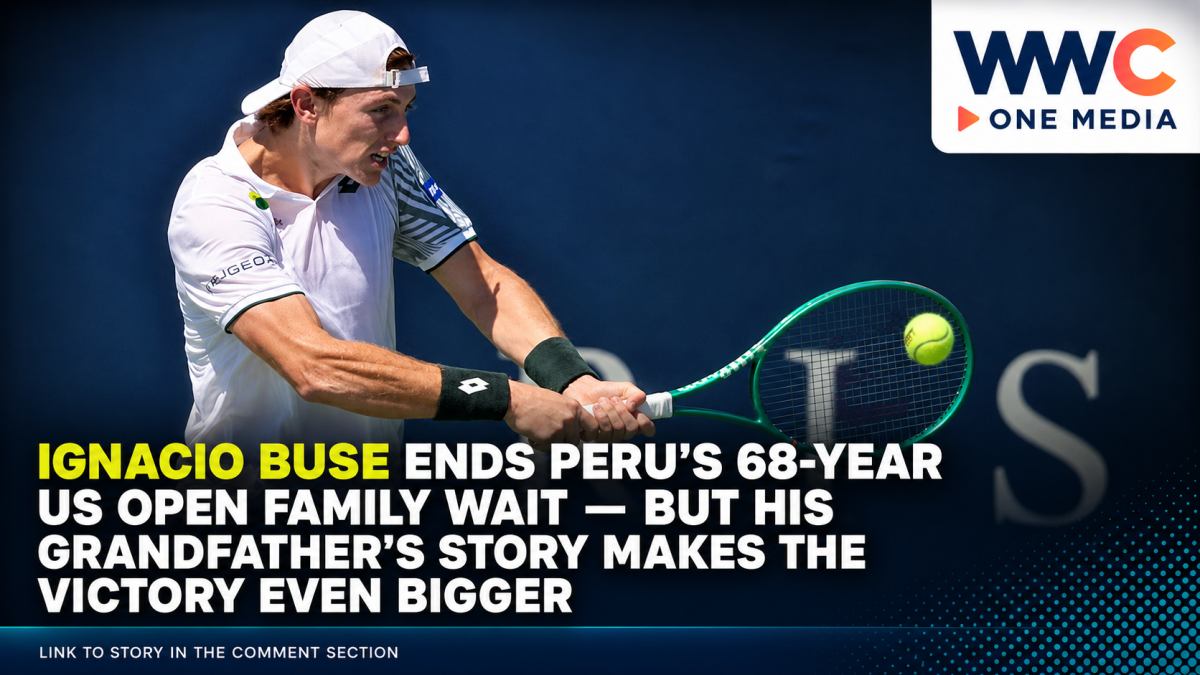
NEW YORK — Ignacio Buse did more than win his first US Open main-draw match. The 22-year-old Peruvian revived a family story at Flushing Meadows that had been waiting nearly seven decades for its next chapter.
Buse survived an exhausting five-set battle against American Marcos Giron on Wednesday, September 2, defeating the home favorite 3-6, 6-3, 6-3, 6-7(6), 6-1 after three hours and 48 minutes on Court 6.
The victory sent the No. 32 seed into the second round of the US Open — and made Buse the latest member of his family to win at the historic Grand Slam, 68 years after his grandfather Eduardo Buse recorded his final victory at the tournament in 1958.
Buse Had to Win the Match Twice
For long stretches, it appeared the young Peruvian had seized control.
After dropping the opening set 6-3, Buse responded by taking the next two by identical 6-3 scores. Giron, however, refused to disappear.
The American forced a fourth-set tiebreak and edged it 8-6, dragging Buse into a deciding fifth set after nearly three hours of physical and emotional tennis.
That was where Buse showed why his rise through the ATP rankings has accelerated so dramatically in 2026.
Rather than allowing the missed opportunity in the fourth set to unravel him, he reset mentally and dominated the decider 6-1.
A backhand volley on match point finally ended the contest, triggering celebrations from Buse’s team and Peruvian supporters in the stands.
“It’s a mental battle out there. I just stayed calm,” Buse told reporters after the victory, describing the occasion as a “very special moment.”
His composure was particularly significant because the match itself had already been disrupted by New York’s weather. Rain affected play on the outside courts, with Buse and Giron’s match among those caught in the delays during a difficult week of scheduling at Flushing Meadows.
A US Open Story That Began With His Grandfather
The significance of Buse’s victory stretches much further back than his own career.
His grandfather, Eduardo Buse, competed at what was then called the U.S. National Championships as early as 1942.
Eduardo and his twin brother Enrique became important figures in Peruvian tennis, and their legacy is still visible in Lima, where the Estadio Hermanos Buse bears their family name.
Ignacio never met his grandfather, but the family’s tennis history has remained part of his identity.
Eduardo’s final US Championships victory came in 1958, when he defeated American Edward Atkinson in five sets in the opening round.
That tournament looked very different from the modern US Open.
Matches were played on grass at the West Side Tennis Club in Forest Hills, New York. The competition would later become the US Open and eventually move to hard courts in 1978.
Nearly seven decades later, another Buse has now won a men’s singles match in New York.
Buse Is No Longer Just a Promising Prospect
The family connection may provide the emotional headline, but Buse’s recent results suggest something much larger is developing in Peruvian tennis.
He arrived at the US Open having climbed to a career-high world No. 30, an extraordinary rise for a player who only broke into the ATP Top 100 in January 2026.
His breakthrough season began producing trophies in May.
Buse came through qualifying at the ATP 500 tournament in Hamburg before stunning American Tommy Paul 7-6(6), 4-6, 6-3 in the championship match.
The victory made Buse the first Peruvian man to win an ATP Tour singles title since Luis Horna in 2007.
Then came another breakthrough just before New York.
On August 29, Buse defeated Britain’s Arthur Fery 6-3, 6-2 to capture the Winston-Salem Open, his second ATP title of the season.
At 22 years and five months, he became the youngest champion in Winston-Salem tournament history, surpassing the previous age mark set by Hubert Hurkacz.
The victory also made Buse the first Peruvian to capture an ATP Tour hard-court title since 1993, according to the ATP.
Those results have transformed him from an emerging South American prospect into a seeded player at a Grand Slam.
Peru Suddenly Has a New Tennis Standard-Bearer
Buse’s progress is particularly significant for a country that has produced relatively few men’s ATP singles champions.
His Hamburg title placed him alongside Pablo Arraya, Jaime Yzaga and Luis Horna among Peruvian men to capture tour-level singles trophies.
With his second title at Winston-Salem, Buse moved level with Horna on two career ATP crowns. Only Yzaga, an eight-time ATP champion, has won more among Peruvian men.
And Buse has reached that territory at just 22.
His rise has been rapid.
The ATP says he entered the Top 200 in May 2025, cracked the Top 100 in January 2026 and reached the Top 50 by May before climbing to No. 30 following his Winston-Salem triumph.
That trajectory gives his US Open victory a different meaning.
This is no longer simply the story of a young player producing an emotional win because his grandfather once competed on the same stage.
Buse is beginning to build a résumé of his own.
Benjamin Bonzi Is the Next Test
There will not be much time for Buse to celebrate.
His reward for surviving Giron is a second-round meeting with France’s Benjamin Bonzi, giving the Peruvian another opportunity to extend what has already become the most significant season of his young career.
The expectations surrounding him are considerably different now than they were at the start of 2026.
He is a two-time ATP champion.
He is a Top-30 player.
He is seeded at the US Open.
And he has now put the Buse family name back into the winners’ column at America’s Grand Slam for the first time since 1958.
For nearly 70 years, Eduardo Buse’s US Open victory stood as part of Peru’s tennis past.
After one bruising five-set battle in New York, his grandson may be turning it into the beginning of something much bigger.
WWC ONE MEDIA MJE




Leave a Reply