
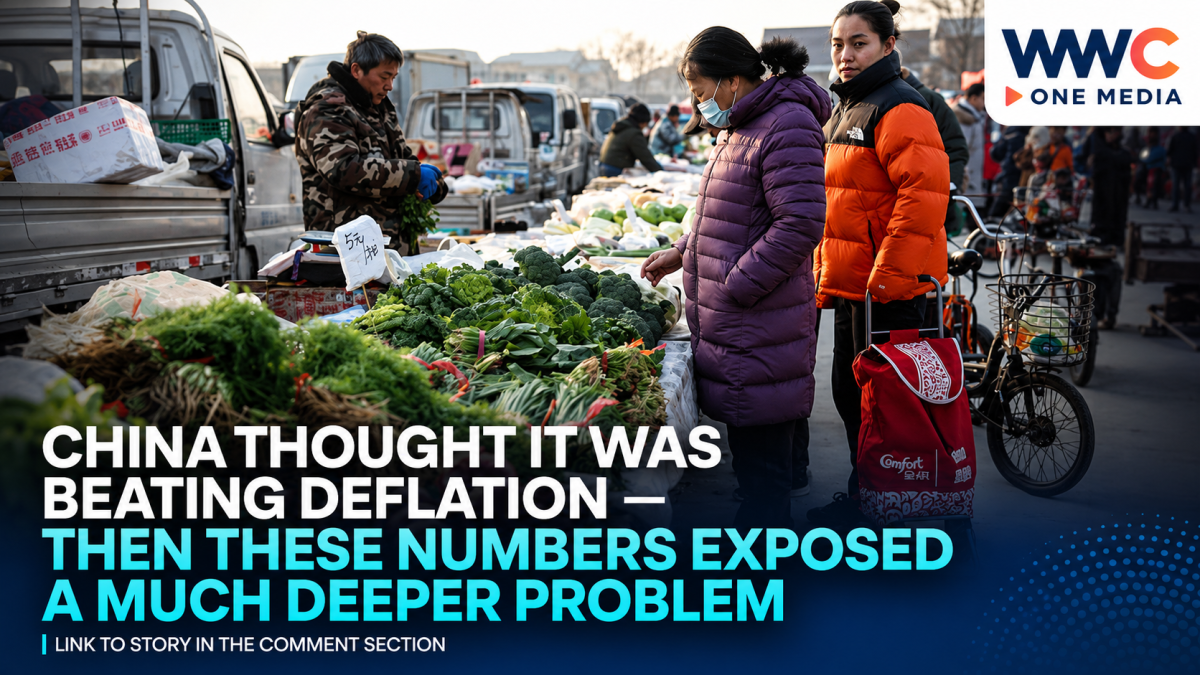
BEIJING — China appeared to be finally putting years of deflationary pressure behind it.
Then the latest numbers arrived.
Consumer prices rose just 0.5% year on year in July 2026, slowing sharply from the previous month, while prices actually slipped 0.1% from June. Food prices were 1.5% lower than a year earlier, and prices of consumer goods increased only 0.2%, according to China’s National Bureau of Statistics.
The figures reinforce a troubling reality for Beijing: China may have succeeded in pushing some headline price indicators back above zero, but it has not yet fixed the underlying economic forces that created the deflation problem in the first place.
That distinction matters.
Asia Times argued in August that hopes China had decisively defeated deflation were being challenged by the rapid slowdown in consumer-price growth. The subsequent economic data have strengthened the case that Beijing’s battle is far from over.
Factory Prices Are Rising — But Not Necessarily for the Right Reason
At first glance, China’s producer-price numbers appear considerably stronger.
The Producer Price Index, which measures factory-gate prices, increased 3.5% year on year in July. But that was down from 4.1% in June and below the 3.8% increase economists surveyed by Reuters had expected.
More importantly, producer prices fell 0.7% month on month.
The composition of the increase also tells a complicated story.
Mining prices jumped 16.4% from a year earlier and raw-material prices rose 6.1%, while prices for consumer goods produced by factories fell 0.8%. Food-related producer prices dropped 2.1%, clothing prices fell 1.1%, and daily-use goods declined 1.0%.
In other words, some of the inflation China is experiencing has come from higher upstream costs rather than a powerful revival in consumer demand.
Reuters has previously described this risk as a form of “bad inflation”: businesses pay more for energy and raw materials while struggling to pass those costs on to customers because consumers remain cautious. That can squeeze corporate margins instead of producing the healthy demand-driven inflation policymakers would prefer.
Beijing’s Bigger Enemy Is the Price War
China’s problem is also deeply connected to what officials increasingly call “involution-style” competition — an environment in which companies repeatedly slash prices, expand production and chase market share even when doing so destroys profitability.
The phenomenon has spread across industries including electric vehicles, solar panels, lithium batteries, cement and food delivery.
Beijing has been trying to stop it.
Regulators have pushed companies to avoid irrational price competition, while authorities have targeted excessive industrial capacity and encouraged consolidation in sectors where companies have been selling products at increasingly unsustainable prices.
Yet the results have been limited.
Reuters reported in July that Chinese regulators were again preparing to confront the solar industry over excessive competition after previous attempts failed to eliminate the overcapacity pushing prices down. Some major solar manufacturers were still expecting billions of yuan in first-half losses.
The reason is structural: companies have enormous factories, workers to employ, debts to service and local governments that often depend on industrial activity.
Closing capacity may improve prices, but it can also mean shutting factories and eliminating jobs.
That makes Beijing’s cure politically and economically painful.
China Can Produce. The Harder Problem Is Getting Consumers to Spend.
Behind the price wars sits an even larger imbalance.
China remains extraordinarily good at producing goods. But its domestic economy is struggling to absorb everything its factories can make.
July provided a striking example.
Chinese exports surged 23.9% year on year, supported in part by booming global demand for semiconductors and other technology products. Yet domestic indicators were considerably weaker.
Industrial output grew 4.5%, slowing from 5.3% in June.
Retail sales — one of the most closely watched measures of consumer activity — increased only 0.6%, below expectations. Fixed-asset investment contracted 6.7% over the first seven months of the year compared with the same period in 2025.
This creates a feedback loop.
Weak consumption leaves factories with too many products.
Too many products encourage companies to cut prices.
Lower prices squeeze profits.
Weak profits can restrain wages, hiring and investment.
And nervous households become even more reluctant to spend.
The Property Crisis Is Still at the Center of the Problem
China’s long-running housing downturn makes that cycle much harder to break.
New-home prices fell 3.2% year on year in July and declined 0.1% from the previous month, according to Reuters calculations based on official data.
Only 17 of the 70 cities monitored recorded monthly increases in new-home prices.
The implications extend well beyond real estate.
For years, property represented one of the most important stores of wealth for Chinese households. Falling home values can therefore make families feel poorer even when their salaries have not fallen.
That discourages consumption and encourages precautionary saving — exactly the opposite of what Beijing needs if it wants domestic demand to absorb more of the country’s enormous industrial output.
A Reuters Breakingviews analysis argued that this property-driven loss of household wealth is one reason China’s anti-“involution” campaign has struggled to gain traction: factories cannot easily stop competing for shrinking domestic demand simply because policymakers tell them to.
And the property outlook remains difficult. Economists surveyed by Reuters in late August expected Chinese home prices to decline 3.4% in 2026 and property investment to plunge about 20%.
There Are Signs of Improvement — Just Not Enough to Declare Victory
The picture is not uniformly negative.
China’s official manufacturing PMI improved to 49.8 in August from 49.2 in July, while the new-orders index jumped to 50.6 and the production index reached 50.4.
Those numbers suggest conditions inside manufacturing improved toward the end of the summer.
But the headline PMI remained below 50 — the threshold separating expansion from contraction — and employment indicators stayed weak. The broader composite PMI output index was also below 50 at 49.5.
So Beijing has evidence that its economy can stabilize.
What it still lacks is convincing evidence of a self-sustaining domestic-demand recovery.
Why the World Should Care
China’s deflation problem does not stay inside China.
When Chinese companies cannot sell enough goods domestically, they have a powerful incentive to look overseas.
That has helped drive enormous export volumes and intensified trade disputes with the United States and Europe, particularly in electric vehicles, solar equipment and other manufactured products.
China recorded a record trade surplus of roughly $1.2 trillion in 2025, and international pressure has grown for Beijing to reduce its dependence on exports by stimulating domestic consumption.
Yet that requires much more than ordering companies to stop cutting prices.
It requires restoring household confidence, stabilizing property values, improving job security and shifting more economic resources toward consumers.
Those reforms are far more difficult than regulating a price war.
The Bottom Line
China has not fallen back into simple, economy-wide deflation. Consumer and producer prices were both higher than a year earlier in July.
But that does not mean Beijing has won.
The deeper deflationary machinery — weak household demand, falling property wealth, industrial overcapacity, intense corporate competition and cautious consumers — remains largely intact.
Even China’s bond market is flashing the same warning. As government bond yields have risen across many major economies, China’s benchmark 10-year yield recently fell below 1.7%, with Reuters attributing part of that divergence to the country’s continuing struggle with weak inflation and the lingering property crisis.
Beijing can pressure factories to stop cutting prices.
It can encourage mergers.
It can accelerate infrastructure spending.
And it can attempt to shut excess capacity.
But unless Chinese households regain enough confidence to spend substantially more of their income, companies will continue fighting over limited domestic demand.
That may be the central contradiction facing the world’s second-largest economy:
China has spent decades becoming exceptionally good at making things. Its next economic battle may depend on convincing its own people to buy more of them.
WWC ONE MEDIA MJE




Leave a Reply